
Yes and no. According to DataForSEO, the share of Google queries with five or more words has grown, but mostly because short queries are disappearing, not because people type more. In the 83 sites we measure in Search Console, only queries of 15 words or more grow, mainly on desktop, and they bring almost no clicks. Queries of five words or more do not grow.
What the DataForSEO study says and what it actually measures
The figure going around comes from "Search Insider: 2026 Edition", the report DataForSEO published in October 2026. One of the posts that spread it was Jimmy Park's on LinkedIn. According to the report, the share of US English queries with five or more words rose on desktop from 29.3% to 34.8% between September 2025 and August 2026, and on mobile from 29.6% to 31.9%.
What it measures is the share of distinct queries: how many of all the different queries in a month have a given length. It does not measure search volume, impressions or clicks. It compares two single months, not the same season in two years. And the data, from more than 2,000 websites, is filtered using "a minimum of 1,000 impressions per month". The report does not say whether that minimum applies per query or per website.
Table A1 in the appendix gives the absolute numbers, and they change the reading:
| Desktop | Sep 2025 | Aug 2026 | Change |
|---|---|---|---|
| Distinct queries, total | 1,973,761 | 1,317,423 | −33% |
| 3 words | 552,649 | 327,052 | −41% |
| 10 to 14 words | 24,926 | 27,878 | +12% |
| 15 words or more | 7,308 | 10,791 | +48% |
Source: DataForSEO, Search Insider 2026, table A1 (US, English). On mobile the total falls from 1,227,623 to 1,002,411 queries (−18%).
On desktop a third of all distinct queries disappears, and three- and four-word queries lose about 41%. In absolute numbers only the 10-to-14-word and the 15-plus groups grow. The share of long queries rises mainly because the total shrinks.
Why September 2025 is a poor starting point
In mid-September 2025 Google stopped supporting the num=100 parameter, which rank tracking tools used to load a hundred results on one page. Search Engine Roundtable reported on September 22, 2025 that many sites saw desktop impressions and their number of queries fall. According to Tyler Gargula's analysis, which it cites, short and mid-length queries lost the most impressions.
If the starting month still contains impressions from tools and the end month does not, the length mix changes without any change in people. That is why our own measurement also compares October with October, two months in which num=100 no longer worked.
What we see in 83 sites
We measured 83 Search Console properties that we manage: 28 in Spain, 35 in the German-speaking market and 17 in English, without client names. Search type web, September and October 2025 against September and October 2026, final data up to November 22, 2026. We counted distinct queries, like DataForSEO, plus impressions and clicks.
| Group | 5+ words, all devices | 15+ words, desktop | Clicks from 15+ words |
|---|---|---|---|
| Spain (28) | 23.31% → 22.34% | 0.06% → 0.42% | 0.00% |
| German (35) | 11.86% → 11.15% | 0.07% → 0.68% | 0.00% |
| English (17) | 19.59% → 15.98% | 0.09% → 0.65% | 0.00% |
| All 83 | 18.77% → 17.05% | 0.07% → 0.56% | 0.00% |
Source: Search Console data from 83 properties managed by ZDS, Sep–Oct 2025 vs Sep–Oct 2026, retrieved November 22, 2026. Share of distinct queries; clicks as a share of all clicks.
Queries of five words or more do not gain ground in any group. Per site the picture is mixed: the share rose in 41 of the 83. Queries of 15 words or more on desktop do grow, and almost everywhere: in 64 of the 83 sites. October against October shows the same, from 0.07% to 0.58%. On mobile they barely move (0.02% to 0.03%).
The three largest sites account for 49% of impressions, so we also looked at the median per site. For 15-plus queries on desktop it goes from 0.022% to 0.194%. In every comparison, their share of clicks stays at 0.00%.
When the increase arrived
To see whether the change came overnight or gradually, we counted queries of 15 words or more day by day, from August 1, 2025 to November 20, 2026, in the same 83 sites.
There is no jump on a single day. On desktop, until January 2026, there were between 80 and 120 distinct queries of 15 words or more per day. The increase starts at the end of January and speeds up in March and April: 438 a day in the week of April 6, 774 in the week of April 20. Since September, the weekly average has been between 958 and 1,424 a day. On mobile it rises too, from about 20 to 25 a day in autumn 2025 to between 85 and 88 in early November 2026, but far below desktop: its weight in impressions goes from 0.01 to 0.02 per thousand to about 0.05 per thousand.
The increase does not hinge on a few sites, although it is concentrated: 60 of the 83 had more of these queries per day in September and October 2026 than in January, and the three with the most account for 76%. Without those three, the monthly count still rises from 2,302 (September 2025) to 8,107 (October 2026). On desktop their weight in impressions stays small, 2.7 per thousand in November 2026, and clicks stay between 0 and 16 a week, with no trend.
Where these queries come from: what we know and what we don't
Google wrote on May 19, 2026 that in the US "the average AI Mode search is triple the length of a traditional Search query". It gives no method and no word count. The Search Console help adds that a follow-up question within AI Mode counts as a new query, with its own impressions and clicks. So AI Mode can put long query texts into the Performance report. What we don't know is whether the 15-plus queries in our sites come from there: the generative AI report Google launched on June 3, 2026 shows impressions only, without queries.
The dates don't settle it either. According to Google's blog, AI Mode reached the US on May 20, 2025, the UK on July 28, 2025, and Spain and Germany on October 8, 2025, months before the increase. Moving from an AI Overview into an AI Mode conversation arrived on January 27, 2026, but only on mobile. Our mobile numbers also rise over 2026, but far less than on desktop, so that date does not explain the desktop increase. On desktop it came on May 19, 2026. We found no Google announcement from March or April 2026 that fits the desktop increase.
One of our own sites offers a clue: runtruffle.com, which is not a client site. Between August 25 and November 20, 2026 it had 158 distinct queries of 15 words or more, with 610 impressions and no clicks. The median length is 21 words, 83% are questions, and 27% open with a professional role, such as "as the COO of…". They read like prompts from tools that measure visibility in AI answers, not like searches by people. Andy Headington of the agency Adido described the same thing on April 2, 2026 across 25 travel sites: very detailed prompts that start by describing a person ("i am a 55-64…"). These are observations on one site and in one sector, not proof for the 83.
What remains open: the increase could come from AI Mode searches, from tools or agents sending prompts to Google, from scrapers, or from a change in how Google records queries. That it coincides in time with the spread of AI search does not prove the cause.
What other studies say
The numbers don't line up because each source measures something different.
| Source and date | What it measures | Finding | Limit |
|---|---|---|---|
| DataForSEO, October 2026 | share of distinct queries, 2,000+ sites, US | 5+ words on desktop: 29.3% → 34.8% | two single months, total down 33% |
| Google, May 19, 2026 | average length of AI Mode searches, US | three times a traditional search | no method, no word count |
| Adido, April 2, 2026 | impressions and clicks by length, 25 travel sites | half of impressions reached at 9.8 words (before 8.64); for clicks it falls from 3.75 to 3.0 | one sector, period not stated |
| ZDS, November 22, 2026 | distinct queries, impressions and clicks, 83 sites | mainly 15+ on desktop grows, almost without clicks | sites we manage, not a market sample |
Source: as given in each row, accessed November 24, 2026.
Two mix-ups show up in AI assistants' answers to this question. The first is citing Google's line that 15% of searches every day are new as evidence. Google has repeated it since at least April 25, 2017, and it refers to queries Google has never seen before, not to long queries. The second is mixing up share and volume: a share can rise without a single additional long query.
What Search Console doesn't show you
The interface shows 1,000 rows. The API returns more, but not always the same ones. In one of our properties, a request with the query dimension alone returned 51,758 rows, and the same request with query and device returned 466,350. Impressions covered went from 31% to 55%. With query and date, the API returns exactly 5,000 rows per day.
Search Console also hides the text of some queries for privacy reasons. Across the 83 sites, that hidden part was 47.2% of impressions in 2025 and 49.6% in 2026, and 30.5% and 36.8% of clicks. We don't know how long those queries are. If they are mostly rare, and therefore long, the visible share of long queries would be a lower bound. That is an inference, not a measurement.
How to measure it in your own Search Console
- In the Performance report, filter queries with a regular expression on the word count:
^\S+(\s+\S+){14,}$for 15 words or more,^\S+(\s+\S+){4,}$for five or more. - Split desktop and mobile. In our sites, the change is much larger on desktop.
- Compare October with October, not September 2025, to keep the
num=100effect out. - Look at clicks next to impressions. A long query without clicks tells you something different from one with clicks.
- If you use the API, request the
queryanddevicedimensions together, notqueryalone.
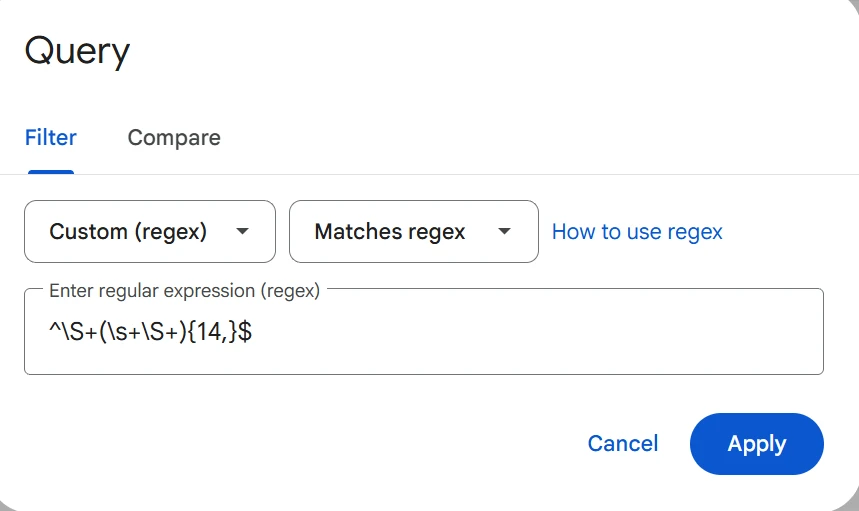
^\S+(\s+\S+){14,}$, in a property of our own.What changes for your strategy
Very long queries can be measured, but in our sites they bring almost no visits. They don't justify rewriting content for 20-word phrases. Long-tail queries are still what the long tail keyword entry describes, and search intent matters more than the number of words.
If the goal is to appear in AI Mode answers, that is where you have to measure. AI Mode splits a question into sub-queries (query fan-out), and those internal searches don't show up as text in Search Console. What happens to traffic when the answer is already on the results page is covered in AI Overviews and traffic.
On November 24, 2026, Google preannounced the December 2026 core update. According to its status dashboard, it improves how its systems understand and rank relevant content, including for longer and more complex questions. It is scheduled for December 2026, so its effect on these queries can only be measured afterwards.
Frequently asked questions
Are Google searches getting longer?
According to DataForSEO, the share of distinct US queries with five or more words is growing, mostly because short ones are disappearing. In 83 sites we measure, mainly queries of 15 words or more on desktop grow, and they bring almost no clicks.
Do AI Mode searches count in Search Console?
Yes. According to Google, AI Mode impressions and clicks are included in the Performance report under the web search type. A follow-up question within AI Mode counts as a new query.
How can I see long queries in Search Console?
In the Performance report, with a query filter using a regular expression. For 15 words or more, use ^\S+(\s+\S+){14,}$. Split desktop and mobile, and compare the same month in two years.
Do longer searches bring more clicks?
In our 83 sites, queries of 15 words or more bring hardly any clicks: their share of all clicks stays at 0.00%. Adido found in 25 travel sites that half of all clicks now come from shorter queries than a year earlier.
What does it mean that 15% of searches are new?
Google has said since at least 2017 that 15% of searches every day are queries it has never seen before. The statement is about new queries, not longer ones.
Sources
- DataForSEO: Search Insider 2026 Edition, October 2026, section "Research Scope and Methodology" and appendix A, table A1
- Google: How AI Mode is changing and expanding the way people search, May 19, 2026
- Search Console Help: impressions, position and clicks, AI Mode section
- Google Search Central: Search Generative AI performance reports, June 3, 2026
- Google blog on the AI Mode launches: US, May 20, 2025; UK, July 28, 2025; Spain, October 8, 2025 (in Spanish); Germany, Austria and Switzerland, October 8, 2025 (in German)
- Google on AI Overviews and AI Mode: January 27, 2026 and May 19, 2026
- Search Engine Roundtable: impact of the num=100 block on Search Console data, September 22, 2025
- Adido: Are Search Queries Getting Longer, Andy Headington, April 2, 2026
- Google: Our latest quality improvements for Search, April 25, 2017
- Google Search Status Dashboard: December 2026 core update, November 24, 2026
How this article was made
The Search Console data comes from 83 properties we manage, downloaded from the API in November 2026 and aggregated without client names or query texts. Sources were accessed on November 24, 2026. The text was written with AI assistance based on that data and those sources, and reviewed before publication.