
Skip to content

SEO Tools SEO Tools

SEO Tools: Whose Authority Score Is It, Really?

Definition

Domain Authority, Domain Rating, Authority Score, and the Sistrix Visibility Index get quoted in the SEO industry as if Google published them. Google doesn't. They're proprietary models built by Moz, Ahrefs, Semrush, Sistrix, Majestic, and SimilarWeb, each with its own index, its own number range, and its own blind spots. This section walks through each tool: whose number it is, how it's calculated, and what it doesn't tell you.

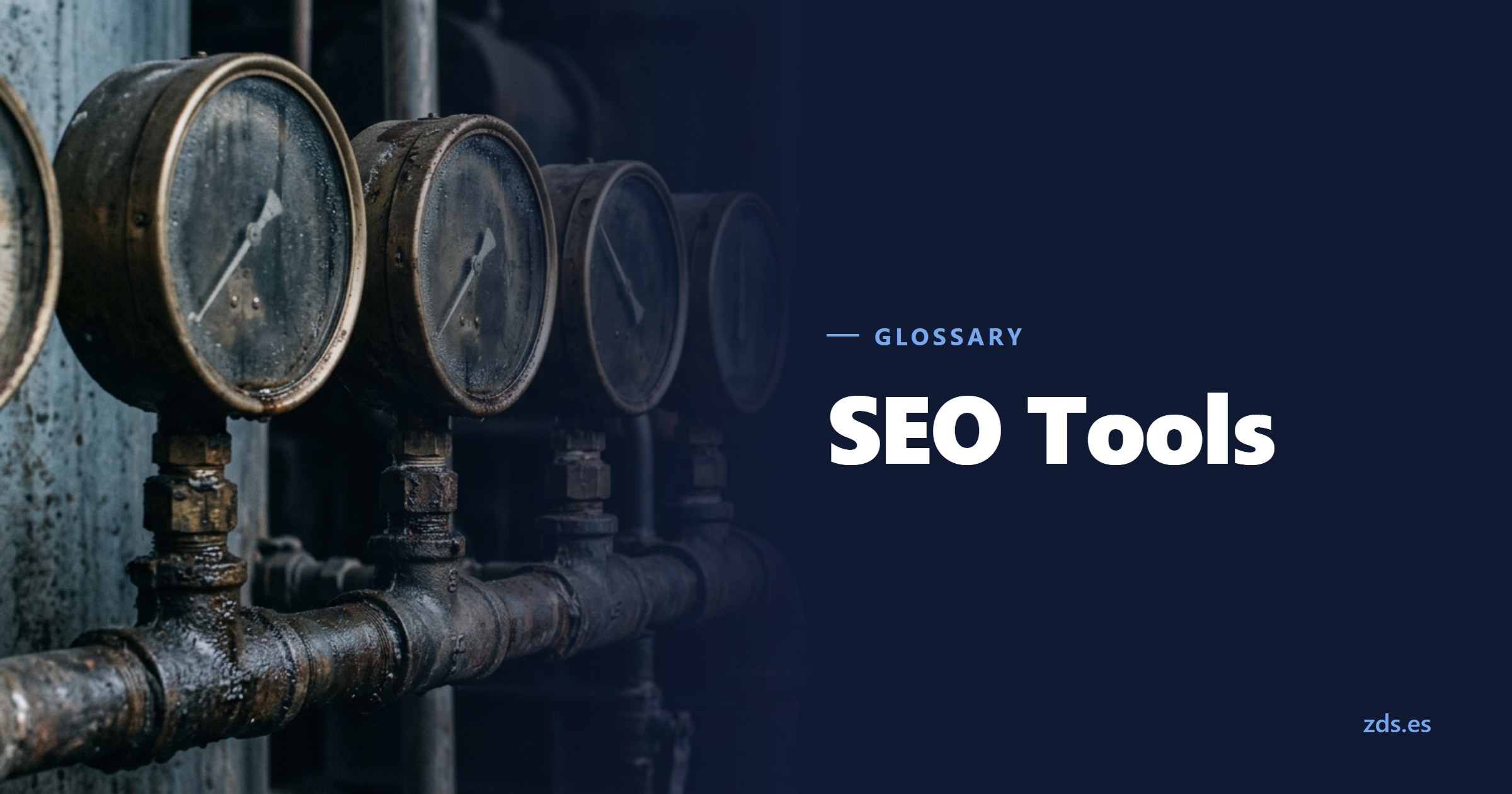
A row of brass pressure gauges on one pipe, their needles at differing positions — beside the title SEO Tools
Each gauge reads differently on the very same pipe
On this page 3
  1. Why these numbers aren't Google facts
  2. Six tools, six different authority metrics
  3. Why this matters if you read SEO reports or buy them
In brief

Six tools, six different ways of answering the same question. Each page in this section takes apart one authority or traffic metric: who calculates it, and where it stops being useful, so an SEO report stops reading like a black box.

A row of brass pressure gauges on one pipe, their needles at differing positions — beside the title SEO Tools
Each gauge reads differently on the very same pipe

Why these numbers aren't Google facts

When a report says a domain "has authority 45" or that its visibility "went up", it sounds like a measurement, something close to what Google Search Console shows for clicks and impressions. It isn't. Domain Authority, Domain Rating, Authority Score, the Sistrix Visibility Index, Trust Flow, and SimilarWeb's traffic estimates are products built by private companies, using data each company collects on its own.

Google doesn't publish a domain authority score. It has said so directly: in March 2018, a Google spokesperson answered a question in a public forum by saying the company has "nothing like a website authority score". We couldn't verify that quote against the original thread, so it's confirmed only through two matching secondary sources, not the primary one. Nothing has changed since. No official Google Search Central guide mentions Domain Authority, Domain Rating, or any comparable metric as part of the ranking algorithm.

What Google actually runs on is hundreds of internal signals, calculated against its own index, none of them published as a retrievable number anywhere. The six tools covered in this section don't touch that index. Each built its own, crawling the web with its own bot, such as the Ahrefs Bot, Majestic's crawler, or Sistrix's crawler, or, in SimilarWeb's case, by pulling from user panels and internet service provider data instead of links. The result is six different snapshots of the same website, taken with six different cameras, at six different times.

None of these tools is lying when it calls its number "authority". The problem starts when that number gets presented as a Google fact instead of what it actually is: one vendor's estimate, useful inside its own frame of reference, but not directly comparable to another vendor's number or to how the real search algorithm actually works.

Six tools, six different authority metrics

The six tools in this section don't measure the same thing. Each built its own index, for links, for traffic, or for both, and gave the result its own name. Knowing that name, and where it comes from, makes any SEO report easier to read.

  • Moz: Domain Authority (DA), scored 0 to 100, calculated from Moz's own link index (Link Explorer). Good for comparing domains against each other, not for predicting an exact ranking position.
  • Ahrefs: Domain Rating (DR), also 0 to 100, built on the link index the Ahrefs Bot crawls. Measures the strength of a whole domain's inbound link profile, not a single page.
  • Semrush: Authority Score, a blend of link data from Semrush's own index with traffic and quality signals. The newest of the three 0-to-100 scores, and the one packing the most variables into a single number.
  • Sistrix: the Visibility Index, which doesn't measure links at all. It tracks actual rankings across a fixed set of keywords Sistrix monitors in Google, so it moves with observed rankings, not with a link profile.
  • Majestic: Trust Flow and Citation Flow, two separate numbers instead of one. Citation Flow counts how many links exist; Trust Flow weighs what kind of domains those links come from.
  • SimilarWeb: no authority score at all, just an estimate of monthly traffic per domain, built from user panels, internet service provider data, and statistical models, not from links.

Why this matters if you read SEO reports or buy them

This stops being a technicality the moment someone acts on the number: hiring an agency, approving a link-building budget, comparing your site against a competitor's. A report that says "authority dropped" without naming which tool measured it isn't saying anything you can check.

The most common mistake is seeing two tools show different scores for the same domain and assuming one of them got it wrong. It didn't. A Domain Authority of 45 and an Authority Score of 38 on the same domain aren't a contradiction, because each number comes from a different index built on a different formula. Comparing one tool's number directly against another's is like comparing Celsius to Fahrenheit without converting: both describe something real, just not on the same scale.

They don't even answer the same question. The Sistrix index says something about actual Google rankings for a set of keywords. Domain Authority and Domain Rating say something about a link profile. SimilarWeb says something about estimated traffic. None of them replaces the others, and none of them replaces Google Search Console, the only source with real data straight from Google about a given site.

None of this makes these tools useless. It makes them readable. Someone who knows where a number comes from can ask an agency which tool it used, compare domains on the same terms, and get skeptical the moment a third-party score gets sold as a Google fact. The six pages that follow this one go into each tool in detail: what it measures, how it calculates it, and what question it can't answer.

Manuel Riveiro Rodriguez CEO & Digital Strategist

A technical audit covers this and everything else in one pass.

Request an audit

Frequently asked

Why do two tools show different authority scores for the same website?

Because each tool calculates its number from its own index, with its own formula and its own scale. There's no direct conversion between them: putting Moz's Domain Authority next to Semrush's Authority Score doesn't show which tool is right, it shows they're measuring different things.

Does Google use any of these metrics for ranking?

No. Google doesn't publish a domain authority score and has said so directly. All six tools covered in this section are products built by private companies, independent of the actual search algorithm.

Which of the six tools is "the right one"?

None of them is universally better; each answers a different question. Domain Authority and Domain Rating talk about links, the Sistrix index talks about actual Google rankings, SimilarWeb talks about estimated traffic. The right tool depends on the question being asked.

If they're not Google data, are they even useful?

Yes, as a relative reference: comparing your own domain against a competitor's using the same tool on the same date, or spotting a sudden drop worth investigating. They stop being useful the moment the number gets treated as absolute truth or passed off as something Google published.

Entries

The six tools, one by one

What each figure measures, who calculates it, and what it is good for — and what not.

Domain Authority (DA)

Moz

The metric that popularised the idea of domain authority. A Moz estimate, not a Google figure.

Read the entry
Domain Rating (DR) · URL Rating (UR)

Ahrefs

Scores the link-profile strength of a domain and of a single page.

Read the entry
Authority Score (AS)

Semrush

Blends links, estimated traffic and spam signals into a single number.

Read the entry
Visibility Index

SISTRIX

Built from a fixed keyword set the tool crawls itself.

Read the entry
Trust Flow · Citation Flow

Majestic

Separates how many links there are from what they are worth.

Read the entry
Estimated traffic

SimilarWeb

An estimate from panel and clickstream data, not a measurement like Analytics.

Read the entry