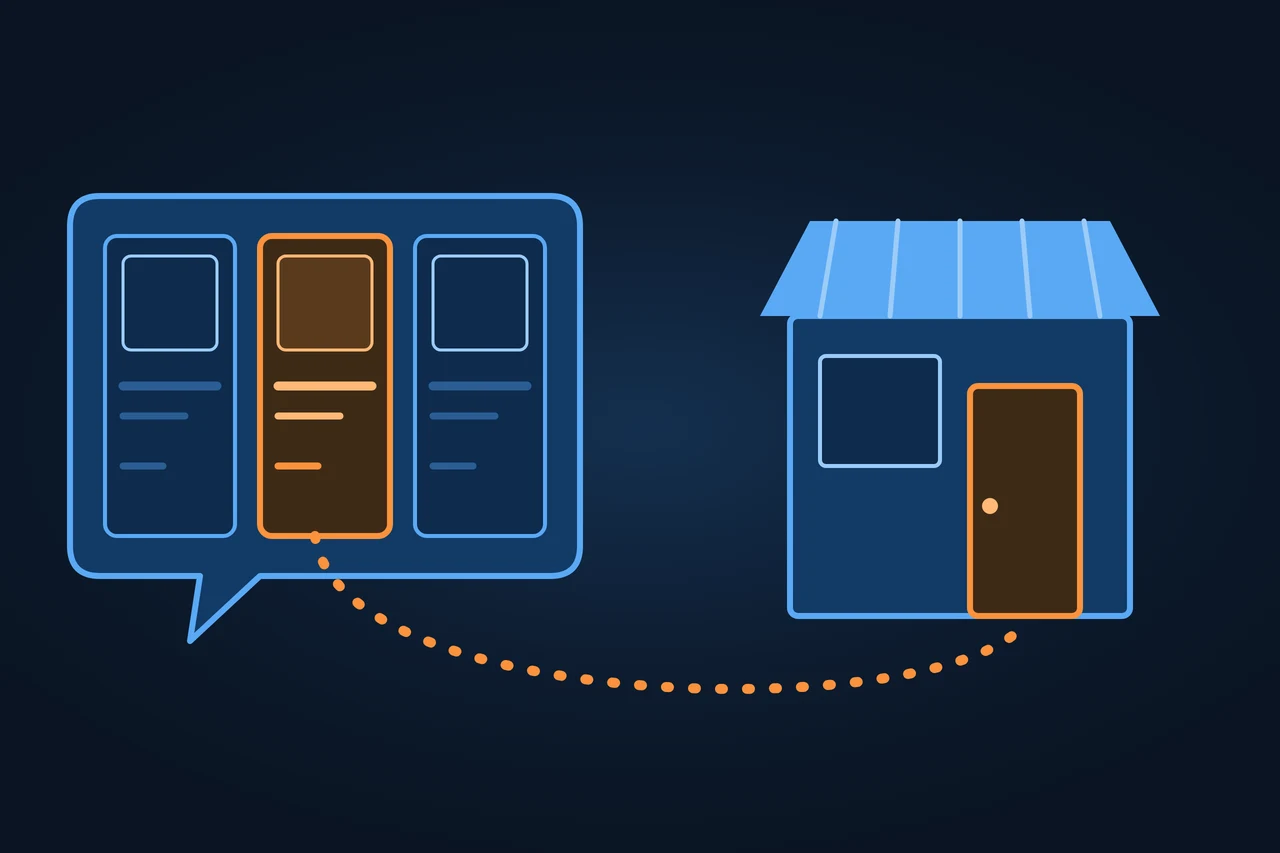
ChatGPT Shopping is the part of ChatGPT that shows products when someone asks with intent to buy: cards with an image, a price and merchants. In November 2025 OpenAI also introduced a buying adviser called shopping research. According to OpenAI's page for merchants, the company is moving away from a standalone Instant Checkout experience, and purchases are completed on merchant-owned websites or apps (as of November 7, 2026). For a store, the useful question is whether its catalog reaches those answers and what it can do today, while the merchant program is open only in the US. What ChatGPT is more broadly, what each plan costs and when it searches the web is summarized in our ChatGPT guide.
What ChatGPT Shopping shows
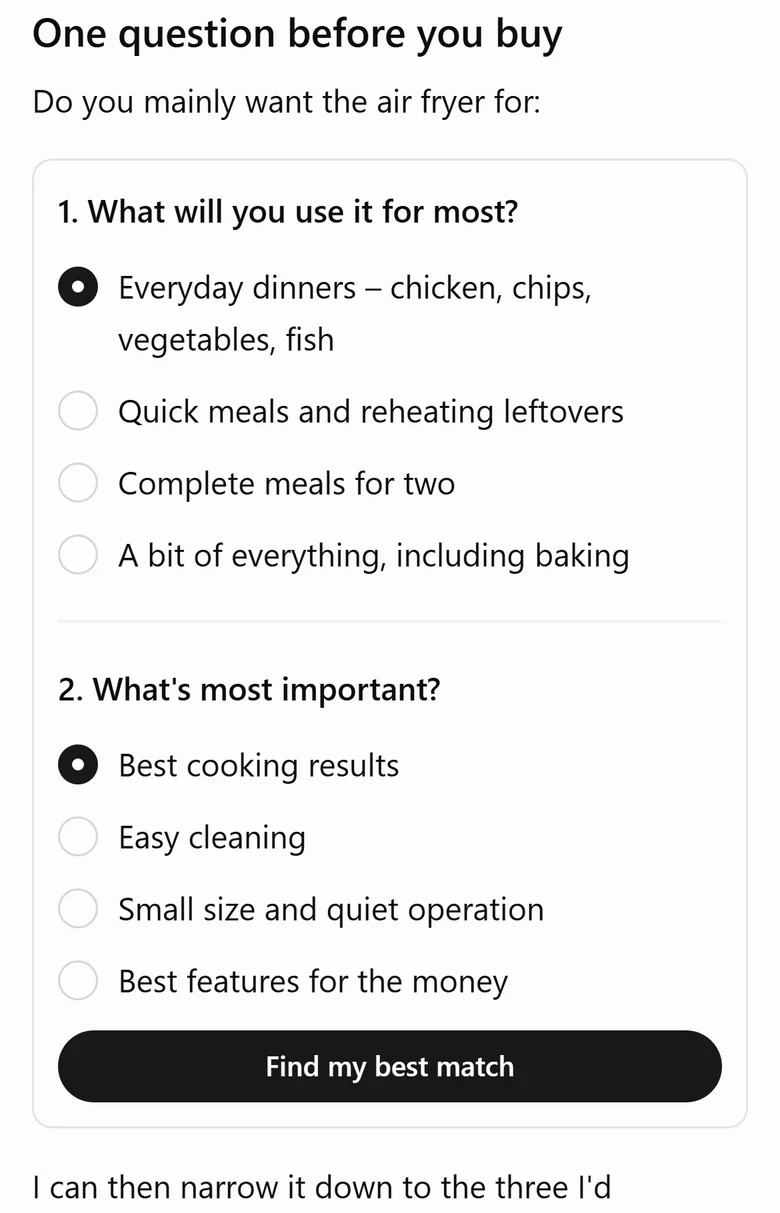
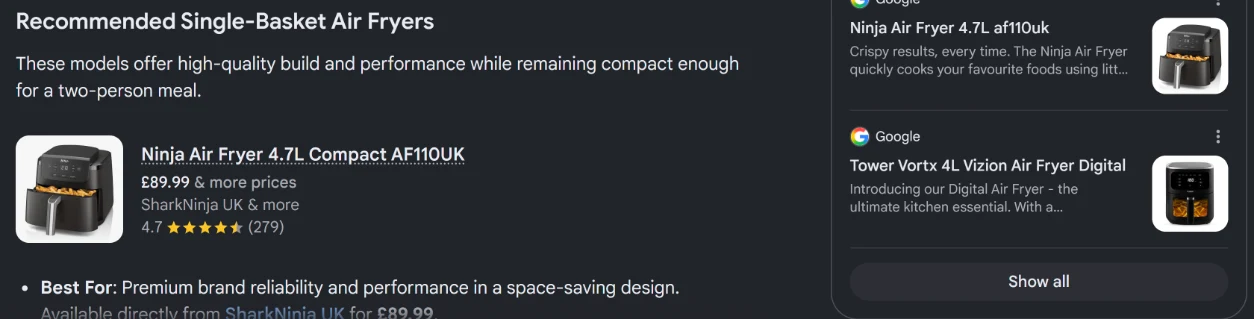
When a question has buying intent ("an air fryer for two people under 100 dollars"), ChatGPT can answer with product options, each with an image, details and links to merchants. According to OpenAI's help page, it draws on structured metadata from first-party and third-party providers, such as price or description, and on other third-party content (as of October 30, 2026).
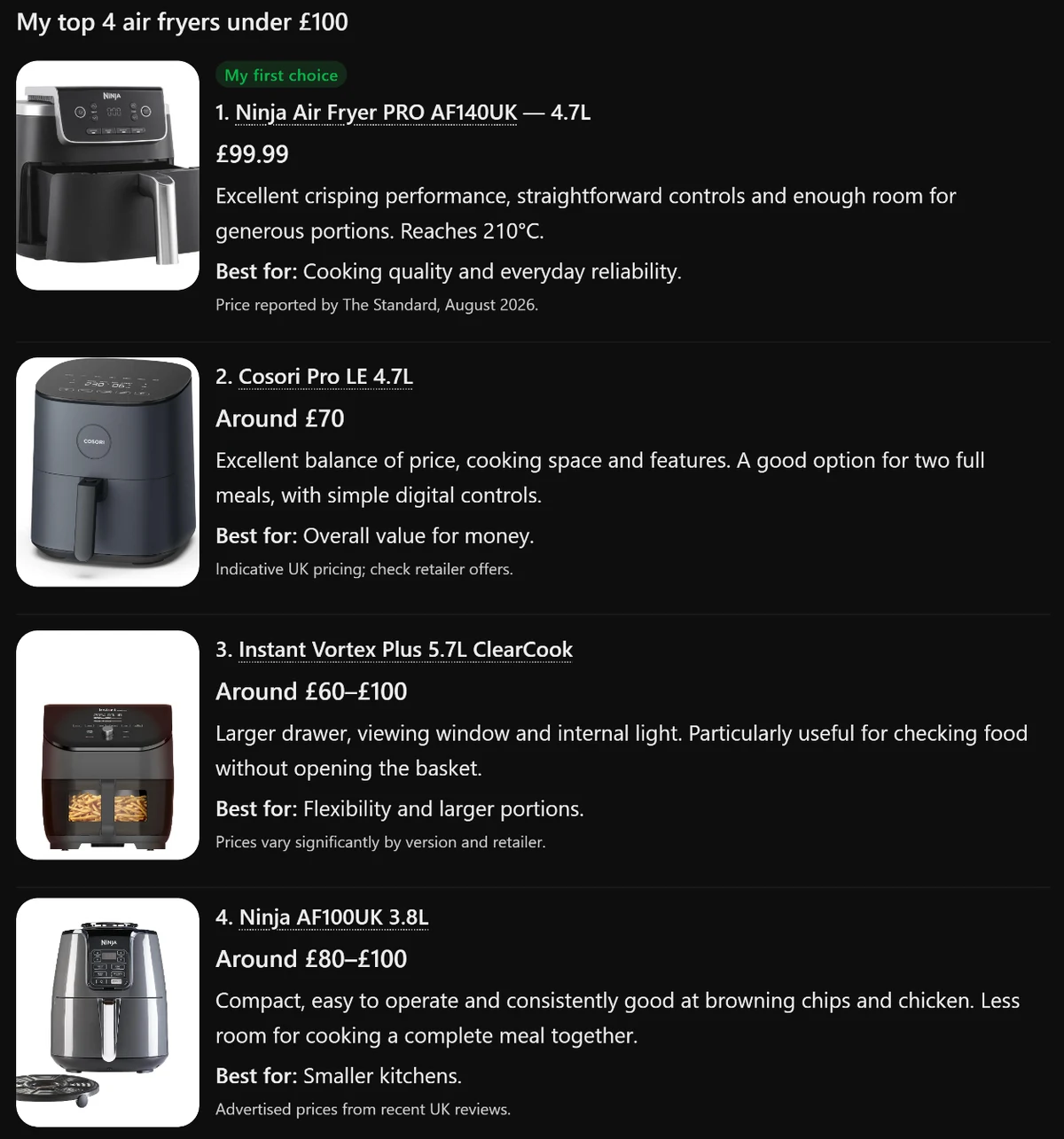
Two details on that page matter to any store. The price in the first answer, OpenAI says, typically reflects the first merchant listed, which may not be the lowest; when several merchants sell the item, a "Best price" label appears. And merchants are ranked on factors such as availability, price, quality and whether they are the maker or primary seller of the item. OpenAI states that product results are not ads and are not influenced by partnerships.
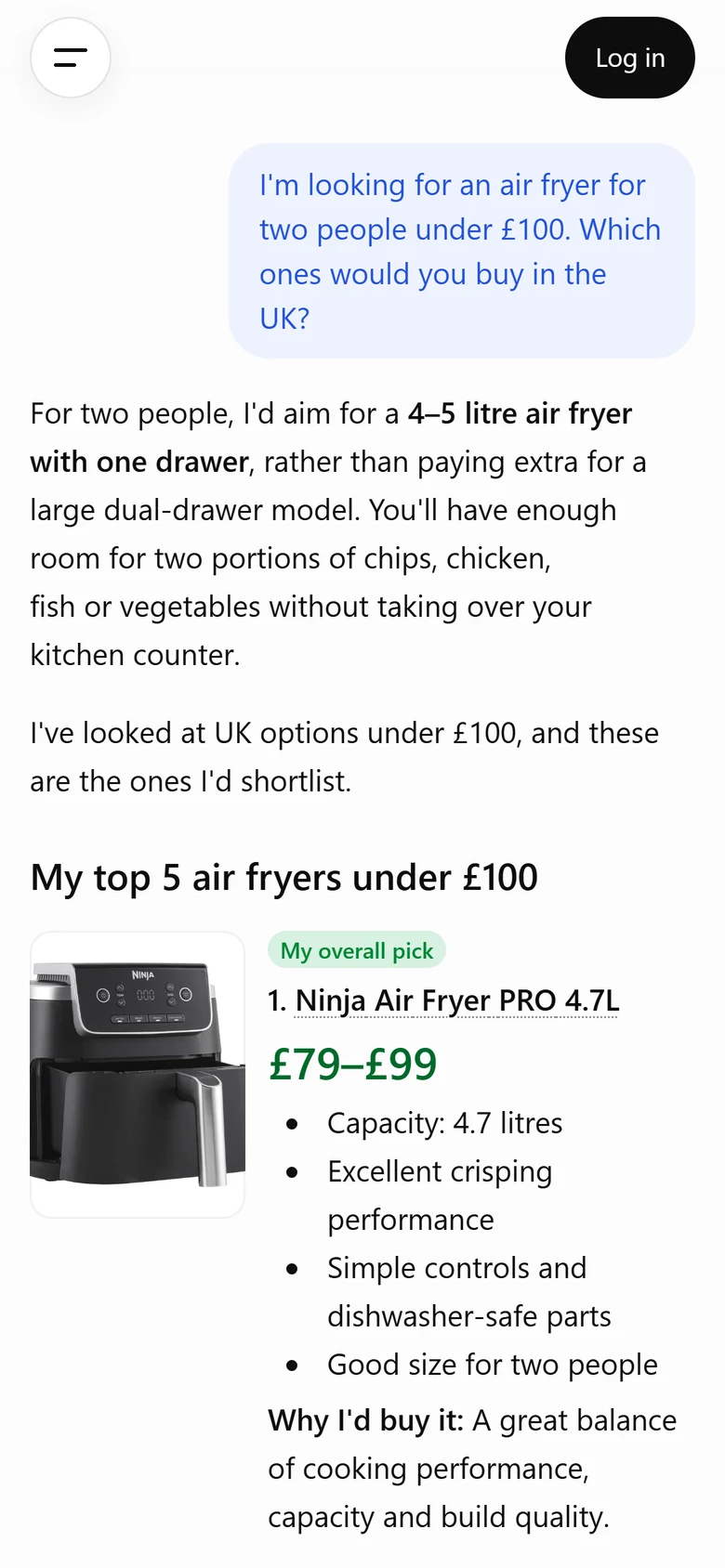
Shopping research is something else: an adviser that asks about budget and preferences, searches for a few minutes and returns a buyer's guide. OpenAI launched it on November 24, 2025, powered by a version of GPT-5 mini trained for shopping tasks, and warned that it can get prices and availability wrong. Its own help page now redirects to the general shopping page, which no longer mentions the feature (as of October 30, 2026). Whether it is still available, and in what form, OpenAI does not say on the pages we read.
From Instant Checkout to today
Instant Checkout lasted a few months. These dates can be checked against OpenAI sources:
- September 16, 2025. The ChatGPT release notes say search now detects shopping intent better.
- September 29, 2025. OpenAI launches Instant Checkout and the Agentic Commerce Protocol, built with Stripe. US users can buy from US Etsy sellers in the chat, and merchants pay a small fee on completed purchases.
- November 20, 2025. Instant Checkout rolls out to Shopify merchants in the US, starting with Spanx, Skims and Glossier.
- November 24, 2025. Shopping research launches. The announcement says that in the future users will be able to buy directly in ChatGPT from Instant Checkout merchants.
- March 4, 2026. The merchant page is still titled "Instant Checkout for merchants in ChatGPT" (Internet Archive capture).
- March 24, 2026. The release notes announce richer product results and side-by-side comparison. They do not mention checkout.
- April 5, 2026. The same page is titled "Power product discovery in ChatGPT" and says OpenAI is moving away from a standalone Instant Checkout and prioritizing product discovery and merchant-owned checkout (Internet Archive capture). Later captures through September repeat the sentence.
OpenAI gives no date for the change on any page we read. The archive captures place it between March 4 and April 5, 2026. The German blog wernerstrauch gives March 24, citing CNBC, and plentyone and Darkroom write "March 2026"; those are the outlets' own statements. The developer documentation still describes checkout inside ChatGPT, with three flows a merchant would have to implement. The newer merchant page says the opposite. For the current state the merchant page carries more weight, but the contradiction is real.
How products get into ChatGPT
There are three routes, and they are not exclusive.
Crawling. OAI-SearchBot is the crawler OpenAI uses to read the web for ChatGPT search. According to OpenAI's documentation, sites that block it in robots.txt are not shown in search answers, though they can still appear as navigational links, and a robots.txt change takes about 24 hours to apply. GPTBot is a different crawler, used for model training; blocking it does not remove a site from search. ChatGPT-User fetches pages when a user asks it to and, according to OpenAI, robots.txt rules may not apply to it.
The feed. OpenAI accepts product catalogs via SFTP, APIs or commerce platforms but does not require them: the merchant page says a feed is not needed if ChatGPT already crawls the site, although a feed gives more control. The developer specification lists nine required fields: item_id, title, description, url, brand, seller_name, image_url, availability and price. The GTIN is optional, and OpenAI recommends uploading a full snapshot at least once a day. On access, the page says that anyone who has applied is on the waitlist and that a self-serve portal is coming "later this year", with no year given (as of November 7, 2026). The logic is the same as a product feed for Google Shopping.
Platforms. Merchants on Shopify or Etsy already have their catalogs integrated, with no application or extra setup, according to OpenAI. On product markup, the OpenAI pages we read do not mention schema.org; they speak of structured metadata from first-party and third-party providers. Product schema markup helps with Google and does no harm here, but there is no documentation that ChatGPT reads it.
Nobody pays to appear: the merchant page says there are no fees on purchases that start in ChatGPT. The protocol OpenAI proposes for sharing product data is covered in the entry on agentic commerce.
What is available in the US, the UK, Germany and Spain
| Feature | US | UK | Germany and Spain |
|---|---|---|---|
| Merchant program (feed) | Waitlist | No | No |
| Merchant offers in product cards | Yes | Not documented | Not documented |
| Instant Checkout | Discontinued | No | No |
| Self-serve ads for advertisers | Yes | Yes | Yes |
Source: OpenAI merchant page ("Shopping is currently live in the U.S."), as of November 7, 2026; Ads Manager availability, as of October 27, 2026. The help page names no countries for product cards. In a test by our AI visibility team with a Business account, product cards appeared without merchant offers, which is why the table says "not documented" rather than "no": the merchant program and merchant offers are documented only for the US.
ChatGPT compared with Google AI Mode and Perplexity
| Assistant | Where the products come from | Buying in the assistant | Access for merchants |
|---|---|---|---|
| ChatGPT | Crawling, merchant feeds, Shopify and Etsy | Instant Checkout discontinued in 2026 | Application with a waitlist, US only |
| Google AI Mode | Shopping Graph, over 50 billion product listings according to Google | Agentic checkout since November 13, 2025 at eligible US merchants | Merchant Center |
| Perplexity | Its own product cards | "Buy with Pro" for US Pro users, announced November 18, 2024 | Free merchant program, announced in 2024 |
Source: each company's pages on the dates given. We could not verify the current state of Perplexity's checkout and merchant program.
Our measurement: who lets ChatGPT's crawler in
To see whether the stores that win on Google today are open to ChatGPT, we read their robots.txt files. We took 25 typical shopping queries per market in Spain and Germany ("running shoes", "mattress", "air fryer" and so on, in each language) and every store in Google's top 10 for them according to Sistrix on November 7, 2026, excluding media, review sites and price comparison sites. We requested /robots.txt exactly once per domain and read it under RFC 9309: if a bot has its own group, that group applies; otherwise the one for *. We did not measure the US or the UK.
| Result | Spain | Germany |
|---|---|---|
| Stores in the sample | 135 | 123 |
| robots.txt readable | 132 | 117 |
| Name OAI-SearchBot | 12 | 15 |
| Block OAI-SearchBot entirely | 1 (amazon.es) | 1 (amazon.de) |
| Block it partly | 0 | 1 |
| Block ChatGPT-User | 1 | 1 |
| Block GPTBot (training) | 7 | 6 |
| Block Googlebot (control) | 0 | 0 |
Source: our own measurement, November 7, 2026, around 08:00 UTC.
Almost every store that shows up on Google for shopping queries lets ChatGPT's search crawler in. The exception is the biggest one: Amazon's robots.txt in Spain and Germany blocks OAI-SearchBot and ChatGPT-User with Disallow: /. More stores block the training crawler, GPTBot, than the search crawler, and for appearing in answers it is the search crawler that counts.
The measurement has limits. It does not show whether a store's firewall rejects OAI-SearchBot even though robots.txt allows it: 30 stores rejected our own request made without a browser fingerprint, and we do not imitate OpenAI's crawler because that would mean faking its identity. It does not show whether a store is in the merchant program either. The sample covers the stores Google showed for those 50 queries on that day; it is not a ranking of the largest stores. Amazon's block on ChatGPT-User shows intent, because according to OpenAI that agent may not follow robots.txt.
How to measure visits from ChatGPT
In Google Analytics 4, visits from ChatGPT are found through the session source: chatgpt.com as the referrer, or a utm parameter on the link. OpenAI does not document which parameter it adds on the pages we read, so it is worth checking your own data before building a filter. If the browser or app sends no referrer, the visit shows up as direct and cannot be attributed. The entry on AI referral traffic explains this kind of visit and why part of it is lost.
Ads in ChatGPT and organic results
OpenAI announced ads on January 16, 2026 and started testing them in the US on February 9, on the Free and Go plans only. Ads appear below the answer and are labeled, and according to OpenAI they do not influence what ChatGPT answers; in the European Economic Area and Switzerland, personalized ads are not offered at first (as of November 3, 2026). For stores there is a clear line: products from a campaign feed are used only in ads and, according to OpenAI, do not appear in organic conversations (as of November 5, 2026). Paying for ads does not put a catalog into the product results.
What a store can do today
- Check robots.txt. If you want to appear, do not block OAI-SearchBot. Blocking GPTBot is a separate decision about training.
- Check the firewall. Look in your server or CDN logs to see whether requests from OAI-SearchBot get a response or an error.
- Prepare a feed with the nine required fields from OpenAI's specification and add the GTIN, which is recommended rather than required. If you sell in the US, apply on the merchant page.
- If you use Shopify or Etsy, your catalog is already integrated; make sure titles, prices, availability and images are complete.
- Keep product pages complete and consistent with the feed: price, availability, brand, description. That is what the crawler reads.
- Measure: set up a GA4 segment for visits from chatgpt.com and review it every month.
- Revisit the merchant page every few months. The program, the countries and the checkout have changed several times within a year.
We measure how a brand appears today in ChatGPT and other assistants in our AI Visibility service. How to get ChatGPT to recommend a brand beyond shopping queries is covered in this article.
Frequently asked questions
How do I get my products listed in ChatGPT Shopping?
Make sure OAI-SearchBot can crawl your product pages, and keep price, availability and descriptions complete. In the US you can also apply on OpenAI's merchant page to submit a feed; Shopify and Etsy catalogs are integrated already. Outside the US the merchant program is not open (as of November 7, 2026).
Can you buy directly in ChatGPT?
Not through Instant Checkout. OpenAI moved away from it as a standalone feature between March and April 2026. ChatGPT shows products and merchants, and the purchase is completed on the merchant's website or app.
Does it cost anything to appear in ChatGPT Shopping?
There are no fees on purchases that start in ChatGPT, according to OpenAI's merchant page. Ads are paid separately and, according to OpenAI, do not bring products into the organic results.
Are the products ChatGPT shows ads?
According to OpenAI, no: ChatGPT selects product results on its own, and partnerships play no part. Ads appear separately, below the answer, and are labeled.
What happened to ChatGPT shopping research?
OpenAI launched it on November 24, 2025. Its own help page now redirects to the general page on shopping with ChatGPT, which does not mention shopping research (as of October 30, 2026). OpenAI has not said on the pages we read whether the feature was retired or folded into regular search.
Sources
- OpenAI: ChatGPT for merchants, FAQ, accessed November 7, 2026
- OpenAI: Shopping with ChatGPT Search, updated October 30, 2026
- OpenAI: Shopping research, November 24, 2025
- OpenAI: Buy it in ChatGPT, Instant Checkout and the Agentic Commerce Protocol, September 29, 2025
- OpenAI: ChatGPT release notes, entries of September 16 and 29, November 20 and 24, 2025 and March 24, 2026
- Internet Archive: merchant page on March 4, 2026 and on April 5, 2026
- OpenAI developers: product feed specification, getting started and checkout key concepts, accessed November 7, 2026
- OpenAI: overview of OpenAI crawlers, accessed November 7, 2026
- OpenAI: our approach to advertising, January 16, 2026
- OpenAI: Ads in ChatGPT, updated November 3, 2026, and campaigns from product feeds, updated November 5, 2026
- Google: agentic checkout and AI shopping, November 13, 2025
- Perplexity: Shop like a Pro, November 18, 2024
- wernerstrauch: ChatGPT Shopping, October 14, 2026 (in German); plentyone, updated August 31, 2026 (in German); Darkroom, July 20, 2026
- RFC 9309: Robots Exclusion Protocol
How this article was made
This article was written in November 2026 with AI assistance. It started from an analysis of the top ten search results in Spain, the US and Germany, most of which still describe buying inside the chat. The dates come from OpenAI's own pages and their Internet Archive captures. The robots.txt measurement is our own, from November 7, 2026, with a single request per store. It contains no client data.
