ChatGPT is OpenAI's conversational assistant. It answers questions in plain language, writes, summarizes, translates and works with files, and when it needs current information it searches the web and links its sources. OpenAI launched it on November 30, 2022. According to OpenAI, more than a billion people were using it every week as of August 2026.
This guide reflects the state of things on November 7, 2026: which models it runs, what each plan costs, where its answers come from and when it cites sources. The second half covers what only one of the 25 guides we analyzed even mentions: which OpenAI crawlers visit your website, what your robots.txt changes, and what our own tracker shows when we compare ChatGPT's answers with Perplexity's.
What is ChatGPT, and what does GPT stand for?
ChatGPT is a product of OpenAI. Since October 2025, OpenAI has had two parts: a nonprofit, the OpenAI Foundation, controls the for-profit company, OpenAI Group PBC. OpenAI set this out on October 28, 2025.
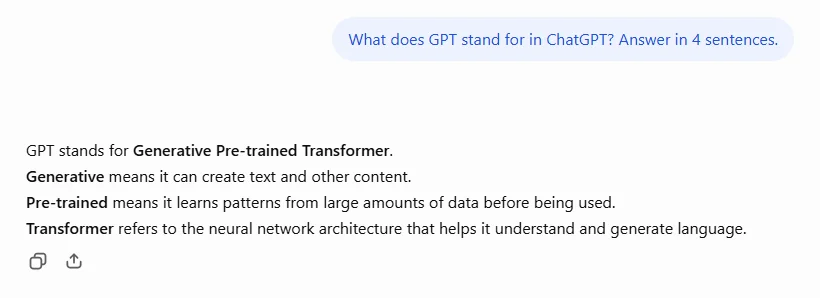
GPT stands for generative pre-trained transformer. OpenAI uses the term in its documentation for its text models. Each word names part of the method:
- Generative: the model produces new text rather than picking from stored answers.
- Pre-trained: it first learns from a very large amount of text and is then tuned for particular tasks, such as conversation.
- Transformer: the neural network architecture that Google researchers published in June 2017 in the paper "Attention Is All You Need".
OpenAI's first GPT dates from June 2018. ChatGPT arrived four and a half years later as a conversational interface on top of those models.
| Fact | As of November 7, 2026 |
|---|---|
| Company | OpenAI (OpenAI Group PBC, controlled by the OpenAI Foundation) |
| Launch | November 30, 2022 |
| Users | More than 1 billion weekly, according to OpenAI (August 31, 2026) |
| Models in Chat | GPT-6 Sol on Plus, Pro, Business and Enterprise; GPT-6 Luna on Free and Go (since October 7, 2026) |
| Where it runs | chatgpt.com, iOS and Android apps, desktop app for macOS and Windows |
Source: OpenAI, "Built to Benefit Everyone: OpenAI’s Updated Structure" (October 28, 2025), post on ChatGPT ads (August 31, 2026), ChatGPT release notes (October 7, 2026) and download help page, accessed November 7, 2026.
Model names change every few months. GPT-5.5, for example, was retired from ChatGPT on October 14, 2026. If a page tells you ChatGPT runs on GPT-4o, it is describing 2024.
How does ChatGPT work? Language model, training and search
ChatGPT runs on a large language model. The model has learned, from a very large amount of text, which word is likely to follow another. It does not keep copies of what it read. In OpenAI's description, the model adjusts a large set of numbers, its parameters, so that they capture patterns, and uses them to generate new text for every answer.
Training happens in two stages. In the first, the model learns from three kinds of sources that OpenAI lists in its help center:
- information that is publicly available on the internet,
- information OpenAI accesses through partnerships with third parties,
- information that users, human trainers and researchers provide or generate.
In the second, people rate answers and the model learns to prefer the ones they rate higher. OpenAI used this method, reinforcement learning from human feedback (RLHF), for the very first version in 2022.
For you as a user, a different distinction matters more: ChatGPT can answer in two ways.
- From the model. The answer comes from what the model learned in training. There is no web lookup and no list of sources. That works for drafting, explaining or rephrasing, but it can be behind on recent facts.
- With search. ChatGPT queries the web, reads the results and writes the answer with links. When it uses outside search providers, it rewrites your question into one or more search queries and sends them there. This feature has existed since October 31, 2024.
According to OpenAI's help center, ChatGPT searches on its own when your question would benefit from current information. You can also trigger a search yourself: type "/" in the message box, or open the tools list and choose Search. OpenAI does not say on the pages we read which search engine it uses. It refers to "search providers" and links, among others, to Microsoft's privacy statement. The claim that ChatGPT "searches Bing", which Gemini made in 12 of its 24 answers about ChatGPT and Perplexity in our November 7, 2026 test, is not something OpenAI states in those words.
Whether a search answer helps you depends on which pages ChatGPT reads. That is where a website can make a difference, as the sections below explain.
Where does ChatGPT get its information, and when does it cite sources?
In a search answer, ChatGPT puts links in the text and a Sources button underneath. Clicking it opens a sidebar with the pages it used. Besides search results, OpenAI says it uses content provided directly by its partners, which include news publishers.
An answer without search has no sources. If you ask for references, ChatGPT can make them up: OpenAI's help center lists "fabricated quotes, studies, citations or references to non-existent sources" as a typical error. The same page warns that search results and citations can also be incomplete, outdated or incorrect.
Can you trust ChatGPT? You can work with it under a few rules:
- If a fact is recent or matters, ask it to search and open at least one source.
- If there is no Sources button, the answer came from the model. Treat it as a draft.
- Check that the source says what ChatGPT attributes to it. An AI citation does not guarantee the sentence is on the page.
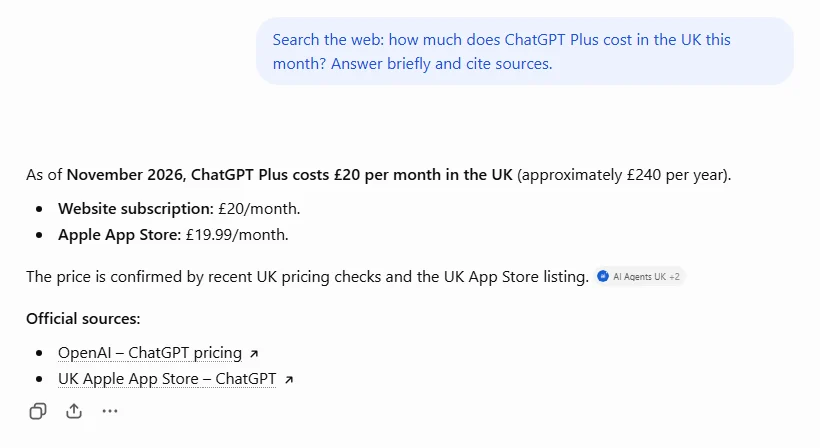
OpenAI does not explain in detail how ChatGPT chooses among the results it finds. It does state one condition: its search crawler has to be allowed to read the page.
OpenAI's crawlers and what your robots.txt does
OpenAI visits websites with three separate agents. Each has its own purpose, and each is controlled separately in robots.txt.
| Agent | What it is for | What blocking it does |
|---|---|---|
| OAI-SearchBot | Finding pages for ChatGPT's search answers | Your site is not shown in search answers, except as a navigational link |
| GPTBot | Crawling content that may be used to train the models | You signal that your content should not be used for training |
| ChatGPT-User | Opening a page when a user asks ChatGPT or a GPT to | OpenAI says robots.txt rules may not apply, because a person starts the action |
Source: OpenAI, "Overview of OpenAI Crawlers", developers.openai.com, accessed November 7, 2026.
The first two settings are independent. You can allow OAI-SearchBot to appear in answers and block GPTBot to keep your content out of training. After a robots.txt change, OpenAI says it takes about 24 hours for its search systems to adjust. More on these agents in our entry on AI crawlers.
How many sites block OpenAI? We measured it on November 7, 2026, on the stores Google shows at the top for shopping queries: 135 stores in Spain and 123 in Germany, with a single fetch of each robots.txt. We have not measured the US or the UK.
| Market | Readable | Block OAI-SearchBot fully | Block GPTBot |
|---|---|---|---|
| Spain | 132 of 135 | 1 (Amazon) | 7 |
| Germany | 117 of 123 | 1 (Amazon), one more partly | 6 |
Source: ZDS measurement, November 7, 2026, one fetch per store.
Almost every store lets ChatGPT's search crawler in. More stores block training than search, and even they are a minority. The measurement does not show whether ChatGPT displays these stores, only whether it could read them. The full method is in our article on ChatGPT Shopping.
ChatGPT Free, Go, Plus and Pro: what each plan includes and what it costs
ChatGPT has a free plan and four paid plans for individuals and teams. In the US, according to OpenAI's announcements and help center, the plans cost:
| Plan | US price | Ads | What it adds, according to OpenAI |
|---|---|---|---|
| Free | $0 | Yes | Unlimited text chats with GPT-6, subject to abuse guardrails; limited files, images, voice and deep research |
| Go | $8 a month | Yes | More messages with tools, more uploads, images, voice chats and memory |
| Plus | $20 a month | No | Reasoning models with GPT-6, deep research, projects and custom GPTs, more Codex |
| Pro | $100, $200 or $500 a month (Pro 100, 200, 500) | No | Pro reasoning with GPT-6 Astra, unlimited use subject to abuse guardrails, API credits |
| Business | $25 per user a month, $20 billed annually | No | Team workspace, no training on its data by default |
Source: OpenAI, "Introducing ChatGPT Go, now available worldwide" (January 16, 2026), help articles on Plus and Pro, openai.com/business/pricing, accessed November 7, 2026. Enterprise and Edu: contact sales.
Three things the table does not show:
- We fetched chatgpt.com/pricing from Spain, so it showed euro prices: €8 for Go, €23 for Plus and from €103 for Pro. OpenAI notes that local prices may differ from a conversion of the US price, and the exact amount appears at checkout. In the UK, check the page from a UK connection.
- Go has been available in every country where ChatGPT is offered since January 16, 2026.
- Ads began testing in the US on February 9, 2026, on the Free and Go plans only, and on August 18, 2026, OpenAI announced their expansion to 31 European markets. OpenAI says ads are always labeled, kept separate from the answer and do not influence what ChatGPT says. Plus and above are ad-free.
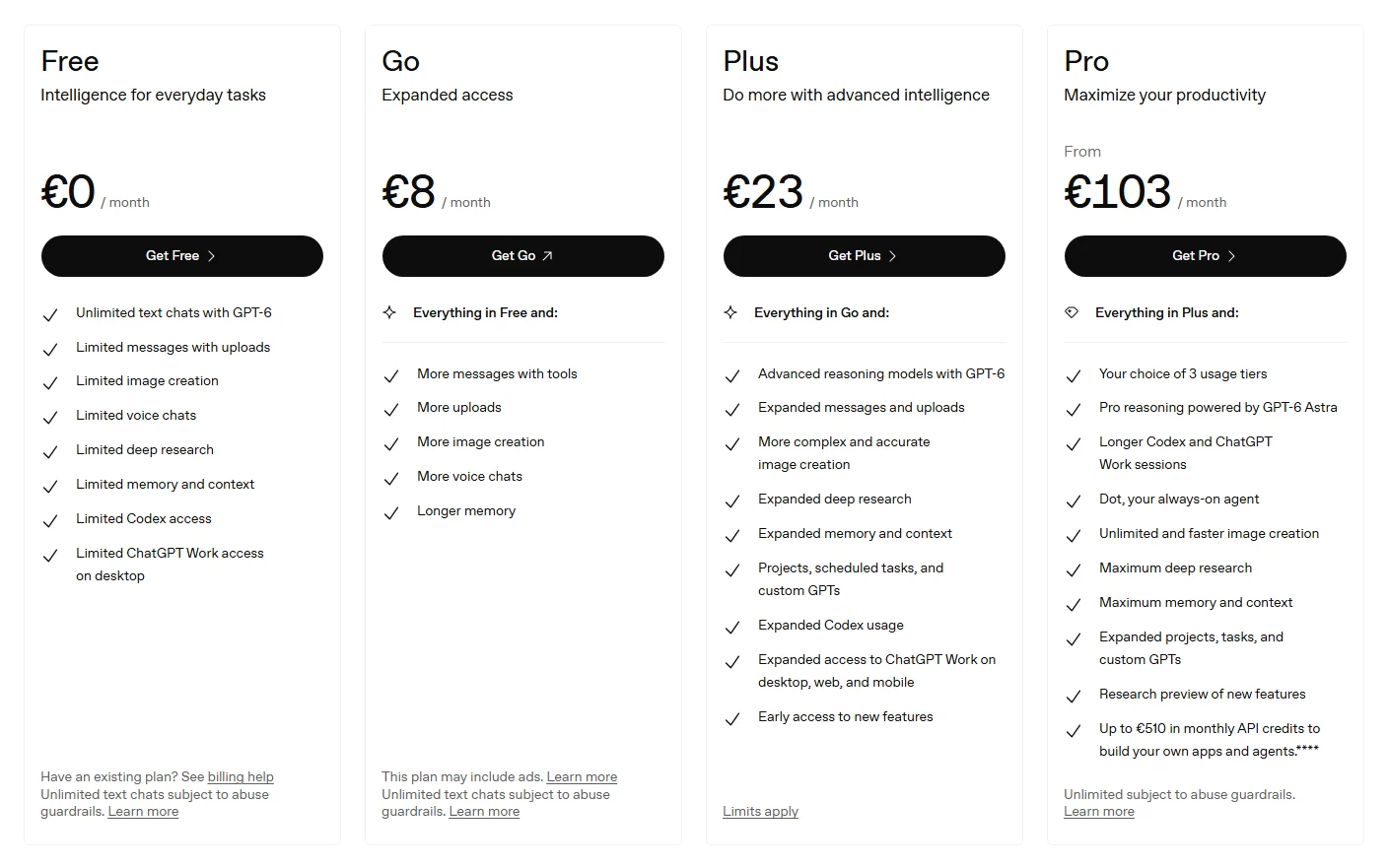
Which plan do you need? For occasional questions and short texts, Free is enough. Plus makes sense if you work with files, deep research or Codex every day. Pro is meant for very heavy use, and it costs at least five times as much as Plus.
What ChatGPT is used for
In September 2025, OpenAI published the largest study so far of consumer ChatGPT use, together with Harvard economist David Deming. It analyzed 1.5 million conversations with automated tools, without anyone reading the messages. Three quarters of conversations were about practical guidance, seeking information or writing. Coding was a niche use. About 30% of use was work-related and 70% personal.
In practice, these are the clearest uses:
- Writing and editing: emails, website copy, summaries of long documents. Writing is the most common work task in OpenAI's study.
- Asking and learning: explaining a concept, preparing for an exam, comparing options before a decision. Students should ask for a search and open the sources.
- Working with files: upload a spreadsheet and ask for an analysis or an Excel formula, or a PDF and ask for the key points.
- At work: the Business and Enterprise plans add shared workspaces, and according to OpenAI their content is not used for training by default.
- Shopping: for a buying question, ChatGPT can show product cards with prices. How that works and how products get in is covered in ChatGPT Shopping.
A specific prompt gets better results than a vague one. Say who the text is for, how long it should be and which facts it must use.
ChatGPT vs Gemini, Claude, Perplexity and Copilot
All five assistants have a free plan and paid plans. They differ in who runs them, how they use search and what the first paid tier costs. The table only reflects what the vendors say on their own pages, without ratings.
| Assistant | Company | Search and sources, according to the vendor | Cheapest paid plan (US) |
|---|---|---|---|
| ChatGPT | OpenAI | Searches when the question needs it or when you ask; shows sources | Go, $8 a month |
| Gemini | Not described on the plan pages we read | Google AI Plus, $4.99 a month | |
| Claude | Anthropic | Searches the web, including on the free plan | Pro, $20 a month or $17 billed annually, before tax |
| Perplexity | Perplexity AI | Every answer includes inline citations | Pro, $17 a month billed annually |
| Microsoft Copilot | Microsoft | Searches the web and gives grounded answers | No plan of its own; included in Microsoft 365 Personal, $9.99 a month |
Source: pricing and product pages of OpenAI, Google, Anthropic, Perplexity and Microsoft, accessed November 7, 2026.
For a website, search is the difference that matters most. ChatGPT decides whether to search. Perplexity is built around search and cites sources in every answer. We compare the two in detail in what is Perplexity AI.
Two assistants that both search do not necessarily find the same pages. In our tracker, ChatGPT and Perplexity shared no domain in four out of ten pairs of answers to the same question. The figures are further down, in the section on your website and brand.
Limits: errors, privacy and detecting AI text
Errors. OpenAI's help center says ChatGPT can produce incorrect or misleading answers and can sound confident even when it is wrong. Among the errors it lists are invented quotes and sources. This is known as an AI hallucination.
Privacy. On personal Free, Plus and Pro accounts, using your conversations to improve the models is switched on by default. You can turn it off under Settings, Data controls, "Improve the model for everyone", and keep your chat history. Three details are worth knowing:
- If you rate an answer with a thumbs up or down, the whole conversation may be used for training, even with the setting off.
- Temporary chats are not used for training, but OpenAI may keep a copy for up to 30 days for safety purposes.
- On Business, Enterprise and Edu, OpenAI does not train on the content by default. Enterprise and Edu customers can also keep their data in Europe (EEA and Switzerland), among other regions.
What not to put into ChatGPT follows from this: anything you would not want stored on OpenAI's servers, such as passwords, health data or customers' personal data, unless you are on a business plan whose terms you have checked.
Detecting AI text. In January 2023, OpenAI released a classifier meant to identify AI-written text. It withdrew it on July 20, 2023, because of its low accuracy: in OpenAI's tests it identified 26% of AI-written text and labeled 9% of human-written text as AI. Asked today whether AI detectors work, OpenAI's help center answers: "In short, not in our experience." Asking ChatGPT whether it wrote a text does not help either. It does not know, and it may make up an answer.
What ChatGPT means for your website and your brand
For a website, ChatGPT is two things: a source of visits, and a place where your brand is discussed without you in the room.
Visits arrive when someone clicks a link in an answer. In Google Analytics 4 they show up with chatgpt.com as the referrer or with a utm parameter on the link. OpenAI does not document, on the pages we read, which parameter it adds, so check your own data before you build a filter. When the app sends no referrer, the visit counts as direct. Why some of it is lost is explained in our entry on AI referral traffic.
Mentions are harder to see. Nobody tells you when ChatGPT recommends a competitor. That is why we measure. Our tracker puts the same questions every day to ChatGPT and Perplexity, among other models. From August 9 to November 6, 2026, that came to about 52,700 answers per model, across all languages, mostly German, English and Spanish. We compared the two answers to the same question in the same run, across 39,241 pairs in which both models named at least one domain:
| Market | Pairs with at least one domain in common |
|---|---|
| Spain | 61.0% |
| Germany | 59.4% |
| English | 63.3% |
| Total, all languages | 60.7% |
Source: ZDS tracker, August 9 to November 6, 2026, about 52,700 answers per model.
In four pairs out of ten, ChatGPT and Perplexity share no domain at all. The median across all pairs is a single shared domain. Being named by ChatGPT does not mean Perplexity names you, and the reverse holds too. Each assistant has to be measured on its own.
Limits of this measurement:
- The questions come from our clients' projects, many in hospitality and travel. They are not a sample of the market.
- Our tracker asks the models for a list with links. That is why ChatGPT puts links in almost every answer. It says nothing about how it links in an ordinary conversation. What can be compared is one model against the other under the same instruction.
- We ask through OpenAI's API, not in the ChatGPT app with search. What a user sees in their own chat may differ.
- We do not publish which domains appear, because client domains are among them.
- The English market is our English-language projects, not a US sample.
What can you do to show up? First, let OAI-SearchBot read your site. Then make sure the facts about your brand, products and prices are stated clearly on your own site, and that other trusted sites write about you, because ChatGPT writes with what it finds. Finally, measure regularly, because answers change with every model. The concrete steps are in our guide on how to make ChatGPT recommend your brand. The wider practice is called GEO, and the measurement AI visibility.
Frequently asked questions
Is ChatGPT free?
Yes. The free plan runs GPT-6 Luna and allows unlimited text chats, subject to abuse guardrails. Files, images, voice and deep research are limited. Since 2026 it can show ads, as can Go. Plus, Pro and the business plans are ad-free.
What does GPT stand for?
Generative pre-trained transformer: a model that generates text, has learned beforehand from a large amount of data and uses the transformer architecture from 2017.
Who owns ChatGPT?
OpenAI. Since October 2025, the for-profit OpenAI Group PBC has been controlled by the nonprofit OpenAI Foundation.
Does ChatGPT search the internet?
Yes, when it decides the question needs it or when you choose Search. It then shows links and a Sources button. Without search it answers from what it learned in training.
Can I stop ChatGPT from using my website?
Yes, with robots.txt. Blocking GPTBot keeps your content out of training. Blocking OAI-SearchBot removes you from search answers. They are separate decisions.
How do I know if ChatGPT cites me?
Your analytics shows visits from chatgpt.com. If ChatGPT names you without a link, the only way to know is to ask systematically, which is what an AI visibility tracker does.
Can you detect whether ChatGPT wrote a text?
Not reliably. OpenAI withdrew its own detector in 2023 because of low accuracy and now says that, in its experience, detectors do not work.
Sources
- OpenAI, "Introducing ChatGPT", November 30, 2022
- OpenAI, "Built to Benefit Everyone: OpenAI’s Updated Structure", October 28, 2025
- OpenAI, "A milestone in expanding access to AI", August 31, 2026
- OpenAI, "ChatGPT release notes", accessed November 7, 2026
- OpenAI, "Model Release Notes", accessed November 7, 2026
- OpenAI, API documentation, "Key concepts", accessed November 7, 2026
- OpenAI, "Improving language understanding with unsupervised learning", June 11, 2018
- Vaswani et al., "Attention Is All You Need", arXiv, June 12, 2017
- OpenAI, "How ChatGPT and our foundation models are developed", accessed November 7, 2026
- OpenAI, "Introducing ChatGPT search", October 31, 2024
- OpenAI, "Searching the web with ChatGPT" help article, accessed November 7, 2026
- OpenAI, "Does ChatGPT tell the truth?", accessed November 7, 2026
- OpenAI, "Overview of OpenAI Crawlers", accessed November 7, 2026
- OpenAI, "How people are using ChatGPT", September 15, 2025
- OpenAI, "Data controls in ChatGPT", accessed November 7, 2026
- OpenAI, "Temporary chat in ChatGPT", accessed November 7, 2026
- OpenAI, "Enterprise privacy at OpenAI", updated January 8, 2026
- OpenAI, "Data residency and inference residency for ChatGPT", accessed November 7, 2026
- OpenAI, "New AI classifier for indicating AI-written text", January 31, 2023, note of July 20, 2023
- OpenAI, "How can educators respond to students presenting AI-generated content as their own?", accessed November 7, 2026
- OpenAI, "Ads in ChatGPT", accessed November 7, 2026
- OpenAI, "ChatGPT Pricing", accessed November 7, 2026
- OpenAI, "Business Pricing", accessed November 7, 2026
- OpenAI, "Introducing ChatGPT Go, now available worldwide", January 16, 2026
- OpenAI, "What is ChatGPT Plus?", accessed November 7, 2026
- OpenAI, "About ChatGPT Pro tiers", accessed November 7, 2026
- OpenAI, "Multi-currency billing", accessed November 7, 2026
- OpenAI, "ChatGPT Ads expands across Europe", August 18, 2026
- Google, "Google AI plans with Cloud Storage", accessed November 7, 2026
- Anthropic, "Plans & pricing", accessed November 7, 2026
- Perplexity, "Perplexity Pro", accessed November 7, 2026
- Microsoft, "Microsoft Copilot Plans for Individuals", accessed November 7, 2026
- Microsoft, copilot.com, accessed November 7, 2026
How this article was made
This article was written in November 2026 with AI assistance. It started from an analysis of the top ten search results in Spain, Germany and the US and of the answers ChatGPT, Gemini, Claude and Perplexity give today to the same questions. Gemini, for example, described the state of 2024 in 11 of its 24 answers. The facts about ChatGPT come from OpenAI's own pages, accessed on November 7, 2026. The robots.txt measurement and the comparison of ChatGPT with Perplexity are ours. We do not publish client data.
