Perplexity is an AI search engine. You ask a question, it searches the web at that moment and gives you a written answer with numbered citations that link to the original pages. It is built by Perplexity AI, a San Francisco company founded in August 2022, which launched the product in December that year.
This guide reflects the state of things on November 7, 2026. The difference from ChatGPT is search: ChatGPT decides whether to search, Perplexity always does. Both searching does not mean both cite the same sources. In our tracker, ChatGPT and Perplexity share no domain in four out of ten pairs of answers to the same question.
What is Perplexity, and who owns it?
Perplexity AI was founded in August 2022. Aravind Srinivas, a co-founder and its CEO, wrote that the company was incorporated on August 3, 2022. The first version of the search engine, then called Ask, came out in December 2022. The company is based in San Francisco.
Perplexity's help center describes it as an AI-powered search engine that searches the web to deliver conversational answers backed by verifiable sources. It works as a search layer: it finds pages, then writes the answer with models from several companies.
| Fact | As of November 7, 2026 |
|---|---|
| Company | Perplexity AI, Inc., San Francisco |
| Founded | August 2022; first product in December 2022 |
| CEO | Aravind Srinivas, co-founder |
| Usage | 1.5 billion questions a month, according to Perplexity (undated page, accessed November 7, 2026) |
| Products | Perplexity search, Comet browser, Perplexity Computer |
Source: Perplexity blog (March 28, 2023 and January 4, 2024), terms of service, "Getting started" page and Aravind Srinivas's LinkedIn post (August 2023).
Perplexity publishes its usage figures without a breakdown. The last dated one is from January 2024: 10 million monthly active users and more than half a billion queries over 2023. In March 2023 it had 2 million users.
Where does the name come from? In everyday English, perplexity means confusion. In AI it is also a metric for how well a language model predicts text, a point we return to in the FAQ.
How does Perplexity work? Live search, models and citations
Every question goes through the same steps. Perplexity searches the web in real time, picks a set of pages, reads them and writes an answer. Each statement carries a number that links to the original source. In the words of its help center, content is sourced from the web in real time as you ask your questions.
To write, Perplexity uses models from several companies. On the free plan it picks the model automatically ("Best"). On Pro and Max you can choose. This is the list Perplexity published as of October 27, 2026:
| Plan | Models you can choose (selection) |
|---|---|
| Free | Automatic choice ("Best"), no manual model choice |
| Pro and Max | GPT-6.1 Sol (OpenAI), Gemini 3.8 Flash (Google), Claude Sonnet 5.5 (Anthropic), Grok 4.7, Kimi K3, GLM 5.3 |
| Max only | GPT-6 Astra, Gemini 4 Argon, Claude Opus 5.5, Claude Fable 5.1 |
Source: Perplexity, "What advanced AI models are included in my subscription?", table as of October 27, 2026.
Sonar, Perplexity's own model, is no longer in that table. It still appears in the API documentation. If a page says Perplexity Pro runs on "Sonar Large, based on Llama 3" or on Claude 3.5 Sonnet, it is describing 2024. That is what Gemini told us when we asked on November 7, 2026.
Can you use Perplexity without an account? Yes. According to its help center, you can use some but not all features without signing in. You need an account for Pro Search, to upload more than three files a day and to save your sessions. Logged-out sessions stay visible for 14 days and then disappear.
What sources does Perplexity cite, and how does it choose them?
Perplexity does not publish the rules it uses to choose sources. What you can see is what it cites. We checked on November 7, 2026, with 24 questions about ChatGPT and Perplexity in Spain, Germany and the US, sent to Perplexity's API with live search:
- For questions about a product, such as what it is, what it costs or what sources it uses, 51% to 100% of the citations came from the vendor itself, such as openai.com or perplexity.ai.
- For the questions about how a brand gets cited, only 0% to 25% came from the vendor. The rest were small agency blogs: 19 to 25 domains per answer, almost each cited only once.
- The median was 7 domains per answer.
When a topic has no reference page, Perplexity spreads its citations across many small sources. For a brand, that gap is an opening: a clear, current page on its topic can become the source that is missing.
How reliable is Perplexity? The numbered citations let you check each statement, and you should. A number after a sentence does not guarantee the source says exactly that. How citations in AI answers work is explained in our entry on AI citation.
PerplexityBot, Perplexity-User and your robots.txt
Perplexity visits websites with two agents. One crawls; the other opens pages when a user asks a question.
| Agent | What it is for, according to Perplexity | robots.txt |
|---|---|---|
| PerplexityBot | Surfacing and linking websites in Perplexity's search results; not used to crawl content for AI foundation models | Managed through robots.txt; changes can take up to 24 hours |
| Perplexity-User | Visiting a page when a user asks a question, to answer and link to it; not used for crawling or collecting training data | Because a user requested the fetch, it "generally ignores robots.txt rules" |
Source: Perplexity, "Perplexity Crawlers", docs.perplexity.ai, accessed November 7, 2026.
If you block PerplexityBot, your site stops appearing in Perplexity's results. Blocking Perplexity-User in robots.txt achieves little, since Perplexity says that agent generally does not follow it. To stop it you have to block the IP addresses Perplexity publishes. More on these agents in our entries on AI crawlers and robots.txt.
How many stores block Perplexity? We measured it on November 7, 2026, on the same stores we used for ChatGPT's crawler: those Google shows at the top for shopping queries, with a single fetch of each robots.txt. We have not measured the US or the UK.
| Market | Readable robots.txt | Name PerplexityBot | Block PerplexityBot fully |
|---|---|---|---|
| Spain | 127 of 135 | 10 | 1 (Amazon) |
| Germany | 114 of 123 | 12 | 3 (Amazon and two others) |
Source: ZDS measurement, November 7, 2026, one fetch per store.
In Germany, one of the three stores that block PerplexityBot lets ChatGPT's search crawler in. Each assistant's rules are set separately.
The dispute with Cloudflare
On August 4, 2025, Cloudflare, a security and content delivery company, accused Perplexity of stealth crawling. According to its blog, when its test domains blocked Perplexity's declared crawler, it saw requests from a generic browser posing as Google Chrome on macOS. Perplexity replied on its own blog the same day: its agents act on behalf of users, do not store the information or train on it, and Cloudflare was mistaking them for malicious bots. We have not found an independent check of either position.
Perplexity Free, Pro and Max: what each plan includes and costs
Perplexity has a free plan, two paid plans for individuals and plans for businesses. Prices are in US dollars.
| Plan | Price | What it includes, according to Perplexity |
|---|---|---|
| Free | $0 | Practically unlimited basic searches, a few Pro Searches (3 a day in its table), no model choice |
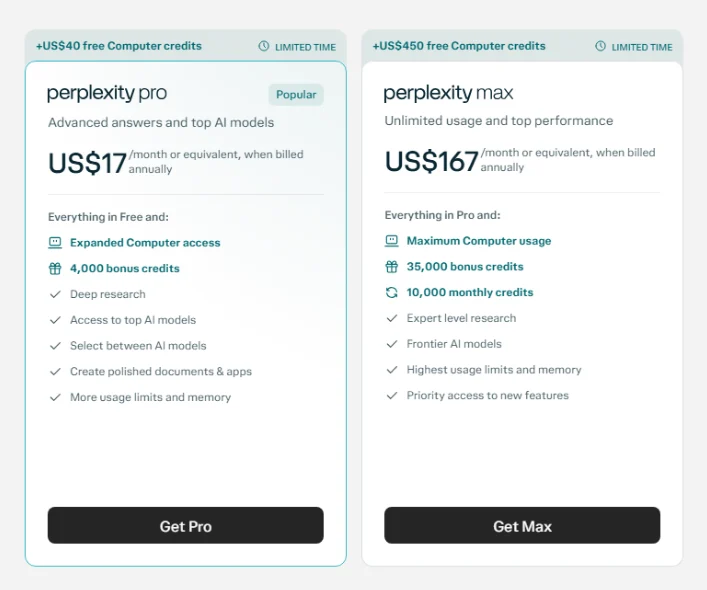
| Pro | $17 a month billed annually | Model choice, deep research, more Computer use, higher limits and more memory |
| Max | $200 a month or $2,000 a year | Maximum Computer use, frontier models, the highest limits, priority access to new features |
| Education Pro | $10 a month | Everything in Pro for verified students and educators |
| Enterprise Pro | $40 per seat a month or $400 a year | Pro plus seat management; data is never used for training |
Source: Perplexity, perplexity.ai/pro, perplexity.ai/max and help articles on plans, Max, Education Pro and Enterprise, accessed November 7, 2026.
The Pro page only shows the annual price. We did not find a month-to-month price on the pages we read. There is also Enterprise Max, at $325 per seat a month.
To cancel Pro on the web: Settings, Subscription, "Manage Subscription", then "Cancel subscription". If you subscribed through the App Store or Google Play, you cancel there. The account goes back to Free at the end of the billing period. Deleting your account does not cancel the subscription.
Perplexity Pro for students
Students and educators can get Education Pro for $10 a month, according to perplexity.ai/students and the help center, as of November 7, 2026. It includes everything in Pro, plus Learn Mode and education-specific tips. Verification runs through SheerID:
- You can sign up with any email address, personal or academic.
- With an existing account, click Upgrade, switch to the Education plan and choose "Verify as student".
- If your school is not on the list, you can ask SheerID to add it.
- The discount does not transfer to another email address. Moving it means verifying again.
Perplexity's own pages contradict each other on one point. The Education Pro article promises "unlimited Pro Searches", while the comparison table in the plans article lists weekly limits for it. We have not been able to resolve this.
Earlier free-Pro deals tied to telecom and payment partners were time-limited and country-specific. Perplexity's help center says every promotion needs a valid credit or debit card and renews at the standard price unless you cancel before the free period ends. It also says Perplexity does not offer special discounts based on location, currency or demographic status.
Perplexity vs ChatGPT, Google and Claude
All four answer questions with written text. They differ in how they use the web. The table reflects only what the vendors say, without ratings.
| Assistant | Web search, according to the vendor | Sources in the answer | Cheapest paid plan (US) |
|---|---|---|---|
| Perplexity | Always, in real time | Numbered citations in every answer | Pro, $17 a month billed annually |
| ChatGPT | When the question needs it or when you ask | Links and a Sources button in search answers | Go, $8 a month |
| Google AI Mode | Part of Google Search, built on its index | Links to the web | Not needed for basic use; Google AI Pro extends use of the strongest model |
| Claude | Searches the web, including on the free plan | Not described on its pricing page | Pro, $20 a month or $17 billed annually, before tax |
Source: help and pricing pages of Perplexity, OpenAI, Google and Anthropic, accessed November 7, 2026.
What can Perplexity do that ChatGPT can't? It searches on every question without being asked and numbers every source. With one Pro subscription you can also choose models from OpenAI, Google, Anthropic and xAI. ChatGPT, by contrast, can answer without searching, which helps with drafting but gives you no sources.
Is Perplexity better than Google? It depends on the question. Google also answers with AI in AI Mode, which is available in the US and the UK and links to the web. See what is AI Mode.
For a brand, a different comparison matters: if you appear in one, do you appear in the other? In our tracker, ChatGPT and Perplexity share at least one domain in 60.7% of pairs of answers to the same question. The median is a single shared domain. Details follow below.
Comet, Computer and Perplexity's other tools
Perplexity is no longer only a search engine. These are its other tools, with the dates the company gives:
- Comet is a web browser with Perplexity's assistant built in. It launched on July 9, 2025, at first only for Max subscribers. Since October 2, 2025 it has been free for everyone.
- Perplexity Computer launched on February 25, 2026. Perplexity describes it as a general-purpose digital worker that operates the same interfaces you do. The paid plans include credits for it.
- Personal Computer, introduced on March 11, 2026, runs on a dedicated Mac mini that can stay on around the clock, connected to your local apps.
- Computer for Professional Finance, from May 5, 2026, is a version of Computer for finance teams.
Comet is at the center of one of the lawsuits against Perplexity, Amazon's, covered in the next section.
Limits: errors, privacy and lawsuits
Errors. Like any assistant that writes with a language model, Perplexity can be wrong or attribute to a source something it does not say. This is known as an AI hallucination. The numbered citations make checking easier; they do not replace it.
Privacy. On Free, Pro and Max, the "AI data retention" setting is on by default, according to Perplexity's help center. With it on, some data may be used to train AI models and improve search quality. You turn it off in account settings under Preferences. Two limits apply:
- Opting out only covers data collected after the opt-out. Training data already collected cannot be deleted.
- Perplexity Enterprise data is never used for training.
If you delete your account, Perplexity removes your personal information within 30 days.
Lawsuits. Publishers and companies have sued Perplexity in the US. The table lists five cases. We have not read the court filings. The details below come from the media outlets cited:
| Plaintiff | Date | Claim, according to the media |
|---|---|---|
| Dow Jones and New York Post | Oct 21, 2024 | "Massive amount of illegal copying" of copyrighted work (Reuters) |
| Encyclopaedia Britannica and Merriam-Webster | Sep 10, 2025 | Crawling and copying articles; robots.txt ignored or evaded; invented text attributed to them (Courthouse News) |
| Oct 22, 2025 | Scraping comments on an "industrial scale", alongside three other companies (AP) | |
| Amazon | Nov 4, 2025 | Covert access by Comet's shopping agents to its store (Retail Dive) |
| The New York Times | Dec 5, 2025 | Large-scale unlawful copying and distribution of its content (MLex) |
Source: the outlets linked in the sources. Case status only where an outlet reports it.
Two cases have moved forward. In Reddit's case, the court on July 31, 2026 denied the motions to dismiss the anti-circumvention claims except on one point, according to the law firm Loeb & Loeb. In Amazon's case, a California court issued a preliminary injunction against Comet in March 2026, according to eWeek, and the Ninth Circuit lifted it, according to MediaPost on August 4, 2026. None of the cases has a ruling on the merits yet. Perplexity publicly rejected the Reddit and Amazon suits, according to AP and Retail Dive.
What Perplexity means for your website and your brand
For a website, Perplexity brings visits and talks about your brand. Visits arrive when someone clicks a citation. In your analytics, look for the referrer perplexity.ai. When the app sends no referrer, the visit counts as direct. Why some of it is lost is explained in our entry on AI referral traffic.
To see whether Perplexity cites you, you have to ask systematically. That is what our tracker does every day. From August 9 to November 6, 2026, it collected about 52,700 answers from Perplexity, and as many from ChatGPT, to the same questions, across all languages, mostly German, English and Spanish:
| Market | Perplexity answers | With links in the text | Median domains in links |
|---|---|---|---|
| Spain | 10,611 | 79.5% | 7 |
| Germany | 19,911 | 69.8% | 7 |
| English | 16,128 | 79.3% | 7 |
| Other languages or none set | 6,091 | not broken down | not broken down |
| Total | 52,741 | 74.5% | 7 |
Source: ZDS tracker, August 9 to November 6, 2026.
| Market | With source markers [n] | Median markers [n] |
|---|---|---|
| Spain | 82.3% | 10 |
| Germany | 82.7% | 10 |
| English | 78.2% | 9 |
| Total, all languages | 82.2% | 10 |
Source: ZDS tracker, August 9 to November 6, 2026.
Perplexity adds source markers to eight answers out of ten, with a median of ten sources per answer. In the links it writes into the text, the median is seven domains. Compared with ChatGPT, the same question in the same run shares at least one domain in 60.7% of the 39,241 pairs. In four out of ten, none. Showing up in ChatGPT does not get you into Perplexity.
Limits of this measurement:
- The questions come from our clients' projects, many in hospitality and travel. They are not a sample of the market.
- Our tracker asks the models for a list with links. What can be compared is one model against another under the same instruction, not behavior in an ordinary conversation.
- We ask through Perplexity's API. What a user sees in the app may differ.
- The tracker records whether source markers are present but not which domains they point to. So the median number of domains in the first table comes from the links Perplexity writes into the text, not from the markers.
- We do not publish which domains appear, because client domains are among them.
- The English market is our English-language projects, not a US sample.
What can you do? Let PerplexityBot read your site. Put the facts about your brand, products and prices on your own site, clearly and with dates, because for product questions Perplexity mostly cites the vendor. And make sure other sites write about you, because for open questions Perplexity spreads its citations widely. The wider practice is called GEO, and the measurement AI visibility. How we measure it for clients is on our AI visibility service page.
Frequently asked questions
Is Perplexity AI completely free?
There is a free plan with practically unlimited basic searches and a few Pro Searches a day. Pro costs $17 a month billed annually, Max $200 a month, and students can get Education Pro for $10 a month.
Can you use Perplexity without an account?
Yes, with limited features. You need an account for Pro Search, for more than three file uploads a day and to save sessions.
Who owns Perplexity AI?
Perplexity AI, Inc., based in San Francisco. Its CEO is Aravind Srinivas, one of the co-founders.
What does "perplexity" mean in AI?
Besides being the search engine's name, it is a metric for language models. Hugging Face defines it as the exponentiated average negative log-likelihood of a sequence. The lower it is, the better the model predicts the text.
Can I block Perplexity from my website?
Blocking PerplexityBot in robots.txt removes you from its results. Perplexity-User, the agent that opens pages on a user's request, generally does not follow robots.txt, according to Perplexity. Only blocking its published IP addresses stops it.
How do I know if Perplexity cites me?
Your analytics shows visits with the referrer perplexity.ai. If it cites you and nobody clicks, the only way to know is to ask systematically, which is what an AI visibility tracker does.
Is Perplexity better than ChatGPT?
For questions about current facts, Perplexity always searches and cites. ChatGPT searches only when it judges it necessary or when you ask, and without search it writes from the model. For a brand it is not a choice: the two cite different sources, and each has to be measured.
Sources
- Perplexity, "Perplexity raises Series A funding round", March 28, 2023
- Perplexity, "Perplexity raises Series B funding round", January 4, 2024
- Perplexity, "Getting started with Perplexity: Research, browse, and build", accessed November 7, 2026
- Perplexity, terms of service, accessed November 7, 2026
- Perplexity, "What is Perplexity?", accessed November 7, 2026
- Perplexity, "How does Perplexity work?", accessed November 7, 2026
- Perplexity, "What advanced AI models are included in my subscription?", October 28, 2026
- Perplexity, "Account Management and Security", August 29, 2026
- Perplexity, "Perplexity Crawlers", accessed November 7, 2026
- Cloudflare, "Perplexity is using stealth, undeclared crawlers to evade website no-crawl directives", August 4, 2025
- Perplexity, "Agents or Bots? Making Sense of AI on the Open Web", August 4, 2025
- Perplexity, perplexity.ai/pro, accessed November 7, 2026
- Perplexity, perplexity.ai/max, accessed November 7, 2026
- Perplexity, "Perplexity Max", September 14, 2026
- Perplexity, "Which Perplexity Subscription Plan is right for you?", November 6, 2026
- Perplexity, "What is Education Pro?", September 28, 2026
- Perplexity, perplexity.ai/students, accessed November 7, 2026
- Perplexity, "How to verify your student status", August 5, 2026
- Perplexity, "Enterprise pricing and billing: Frequently asked questions", November 6, 2026
- Perplexity, "What is Enterprise Max?", October 21, 2026
- Perplexity, "Canceling a Subscription", September 25, 2026
- Perplexity, "Partner Promotions and Referral Programs", September 8, 2026
- Perplexity, "Introducing Comet", July 9, 2025
- Perplexity, "The Internet is Better on Comet", October 2, 2025
- Perplexity, "Introducing Perplexity Computer", February 25, 2026
- Perplexity, "Everything is Computer", March 11, 2026
- Perplexity, "Computer for Professional Finance", May 5, 2026
- Perplexity, "Data Collection at Perplexity", August 31, 2026
- Perplexity, "How long Perplexity retains your search and personal data", August 25, 2026
- Google, "Get AI-powered responses with AI Mode in Google Search", help center, accessed November 7, 2026
- OpenAI, "Searching the web with ChatGPT", help article, accessed November 7, 2026
- Anthropic, "Plans & pricing", accessed November 7, 2026
- Reuters via Insurance Journal, Dow Jones and New York Post lawsuit, October 21, 2024
- Courthouse News, Britannica and Merriam-Webster lawsuit, September 11, 2025
- AP via ClickOnDetroit, Reddit lawsuit, October 22, 2025
- Retail Dive, Amazon lawsuit, November 6, 2025
- MLex, New York Times lawsuit, December 5, 2025
- Loeb & Loeb, "Reddit v. SerpApi LLC", August 2026
- eWeek, preliminary injunction against Comet, March 10, 2026
- MediaPost, appeals court lifts the injunction, August 4, 2026
- Hugging Face, "Perplexity of fixed-length models", accessed November 7, 2026
How this article was made
This article was written in November 2026 with AI assistance. It started from an analysis of the top ten search results in Spain, Germany and the US and of the answers ChatGPT, Gemini, Claude and Perplexity give today to the same questions. Gemini, for example, described Perplexity's models as they were in 2024. The facts about Perplexity come from its own pages, accessed on November 7, 2026. For the lawsuits we cite media reports, not the court filings. The robots.txt measurement and the tracker data are ours. We do not publish client data.
