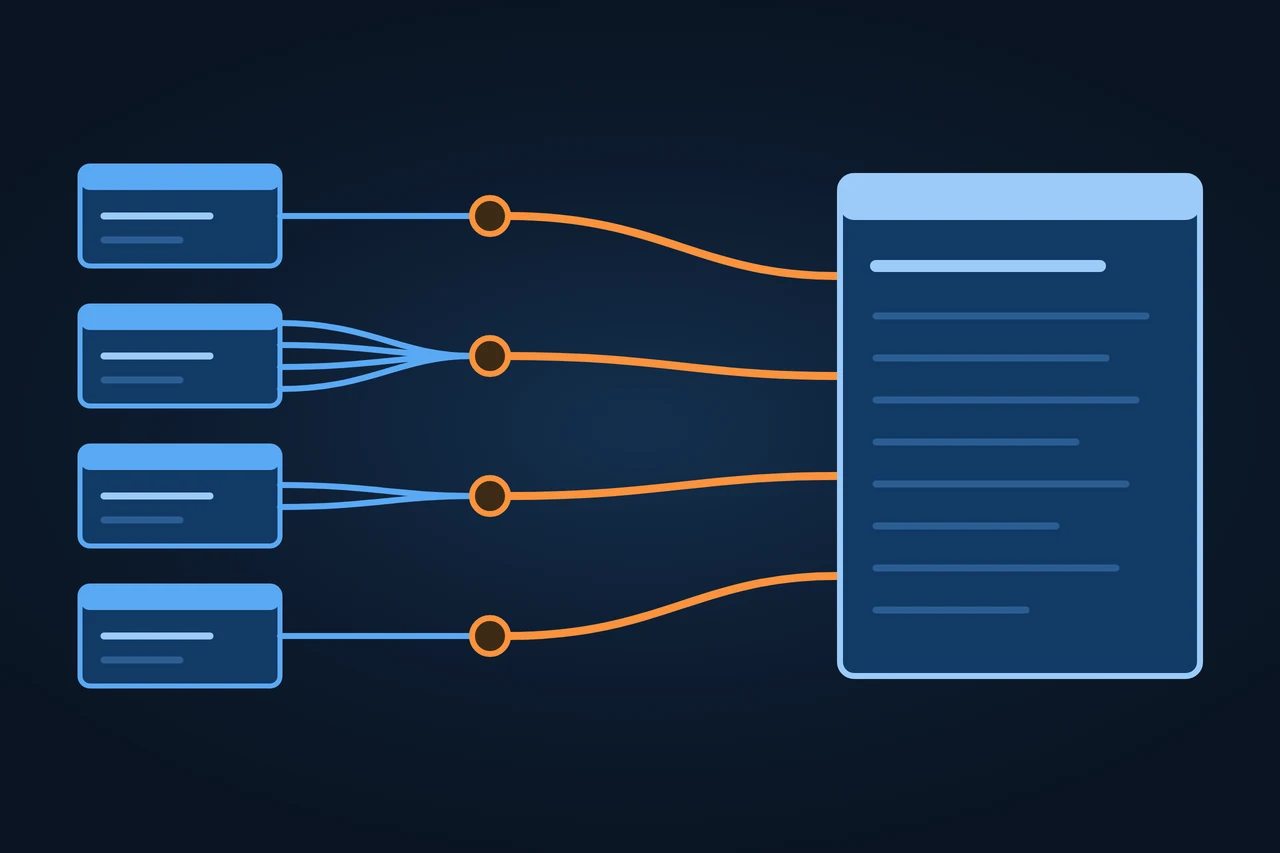
Referring domains are the websites from which at least one link points to a site or page. Each website counts once, however many links it sends: ten links from one domain make ten backlinks but one referring domain. Moz calls the same metric linking domains, Majestic also says ref domains, and Spanish and German tools translate it as dominios de referencia and verweisende Domains.
Referring domains are the websites that link to a site, each counted once. How Ahrefs, Majestic, Moz, Semrush and Search Console count them.
Origin of the term
The word sits close to the HTTP header "Referer", which tells a server the page a visitor came from. RFC 1945, the HTTP/1.0 specification of May 1996, already named one use of that header: a server can build "lists of back-links" from it. RFC 9110 of June 2022 notes that "the field name is misspelled". None of the tool documentation says the SEO metric was named after the header, so the link between the two is a family resemblance of words, not a documented origin.
In web analytics the same words mean something else. In Adobe Analytics, "Referring domain" is a dimension that reports which domains visitors click through to reach your site. A link on the other site only shows up there once someone clicks it.
How it works
A link tool crawls the web, stores every link it finds to your site and then removes duplicates at the level of the linking website. What counts as one website differs slightly from tool to tool, and that is where the totals start to drift apart.
Where two tools can count differently
1crawls the web
2stores every link it finds to your site
Which links count at all?nofollow links
3removes duplicates at the level of the linking website
What counts as one website?subdomains such as www. or m.
4shows the total: referring domains
Timelost links are kept for a different period
Why can two tools report two different totals for one site?
Ahrefs gives its own example: two links from the New York Times still make one referring domain. Subdomains are folded into the main domain. In Ahrefs' help, three subdomains of the same domain, hosted on three different servers, produce one referring domain and three referring IPs. Google Search Console groups its links report the same way: protocol, subdomains such as www. or m., and subdirectories are stripped, and everything lands under the root domain.
The second question is which links count at all. Ahrefs, Moz and Semrush include nofollow links in the referring domains list and let you filter them out. Ahrefs makes one exception: its Domain Rating only counts referring domains with at least one followed link. Semrush calls a domain "follow" if it sends at least one follow link, and "nofollow" if it sends none.
The third question is time. A link that was live last year may be gone today, and each tool keeps lost links for a different period or in a separate index. That is why the same site shows different totals in different tools on the same day. Ahrefs says so itself: "we all crawl the web differently."
Types and variants
Metric
What is counted
Where you see it
Backlinks
every single link to the site, including several from the same page or website
all tools, Search Console
Referring domains
each linking website once
Ahrefs, Majestic, Semrush, SE Ranking
Linking domains
the same idea under Moz's name; the API used to call it linking root domains
Moz
Referring IPs
the IP addresses that host linking websites; one IP can host many domains
Ahrefs, Majestic, Semrush
Referring subnets
C-class subnets; several sites in one subnet may belong to one owner
Majestic, SE Ranking API
Source: help pages and glossaries of Ahrefs, Majestic, Moz, Semrush and SE Ranking (accessed 10.11.2026).
Examples
Take a page that receives links from three websites. Site A links five times from three of its pages. Site B links once. Site C links once from blog.c.com and once from www.c.com.
That makes 8 backlinks. Tools that fold subdomains into the root domain, as Ahrefs, Majestic and Search Console document, report 3 referring domains. A tool that treated blog.c.com as its own website would report 4. Site A's five links carry no more weight in this count than site B's single link.
The same links, counted twice
Site A
3 pages · 5 links
Site B
1 link
Site C
blog.c.com · 1 link www.c.com · 1 link
Backlinksevery link on its own
8
Referring domainssubdomains folded into the root domain
3
Referring domainsblog.c.com as its own website
4
More links from the same site only raise the top row.
How to measure it
No two tools report the same figure, so the useful question is what each one counts:
Tool
Linking subdomains
nofollow links
Data and time window
Ahrefs
folded into the root domain
included, filter "Dofollow"; Domain Rating counts followed links only
own crawler; the API returns live links, links since a date or all time
Google Search Console
grouped under the root domain
the report does not say whether a link is nofollow
Google's own data, a sample; removed links can stay in
Majestic
counted by root domain
marked with the source flag "NoFollow"
Fresh Index updated through the day, Historic Index back to 2006
Moz
not documented
filter for follow or nofollow
new linking domains reach the index in about 3 days; "lost" does not mean removed
SE Ranking
not documented
separate count of referring domains with at least one dofollow link
analysis with or without the target's subdomains; trends from 7 days to 12 months
Semrush
shows the root domain of each referring domain
filter Follow or Nofollow
new means the last 30 days, lost means the last 6 months
Source: Ahrefs Help Center and Academy, Google Search Console Help, Majestic Glossary, Moz Help Hub, SE Ranking Knowledge Base and API documentation, Semrush Knowledge Base (accessed 10.11.2026).
Search Console is the only source in this table that shows what Google itself has recorded. It is also the least complete: Google calls the report a sample, not a full list.
Advantages and disadvantages
The metric shows how many separate websites link to you, which a backlink total cannot. A thousand links from one partner site and a thousand links from a thousand sites look the same as backlinks and very different as referring domains.
It has three blind spots. It counts spam domains the same way as a trade association or a newspaper. It says nothing about whether the linking site is on your topic. And it only covers what the tool's crawler has found.
Ahrefs published one data point on the relationship with traffic in December 2023. Of the roughly 20 million pages in its index with no referring domains, 2,997 received more than 1,000 search visits a month. Ahrefs adds that its sample leans towards the "quality side of the web" and that correlation does not imply causation.
Google does not publish a metric called referring domains. What Google says about links is more general. Its documentation on crawlable links states that "Google uses links as a signal when determining the relevancy of pages and to find new pages" (last updated 10.12.2025). Its guide to ranking systems lists PageRank as part of the core systems.
Semrush's knowledge base goes further and says Google weighs a high number of referring domains "as a ranking signal". Google's documentation contains no such statement, so that sentence is Semrush's claim.
Google's spam policies, last updated on 28.08.2026, define link spam as links created "primarily for the purpose of manipulating search rankings", for example bought links or excessive link exchanges. Those domains count as referring domains in every tool. According to the Search Console help, Google typically ignores links from known spam sites.
How to apply it, step by step
Open Google Search Console, go to Links and look at Top linking sites. That list is free and comes from Google's own data.
Choose one tool for your regular checks and set the scope: root domain, subdomain or a single page.
Write down the date of every export, because lost links drop out on each tool's own schedule.
Look at new and lost referring domains once a month, not just the total.
Check unknown sites. If one looks like spam, ask for removal first. The Search Console help names disavow as the step for when everything else has failed.
Best practices
Compare figures only within the same tool and with the same scope.
Read the followed and nofollow shares separately. A total that grows only through nofollow links is not the same as one that grows through followed links.
Set new referring domains against lost ones, so a single month with a gain is not mistaken for a trend.
Check where new domains come from. Ten domains from one network can be a problem, and Majestic's subnet count helps to spot that.
Common mistakes
Putting the Ahrefs figure next to the Semrush figure and treating the gap as a change.
Reporting backlinks when the report says referring domains.
Reading "lost" as "removed". Moz says it only means its crawler failed to fetch the link again.
Setting a target number of referring domains as if Google published one.
Counting new domains from a link network or an expired domain as a win.
How this entry was made
This entry was written in November 2026 with AI assistance. The counting rules come from the help pages of Ahrefs, Majestic, Moz, Semrush, SE Ranking and Google Search Console, read on 10.11.2026, and Google's statements from its own documentation. It was reviewed before publication and contains no client data.
Manuel Riveiro RodriguezCEO & Digital Strategist
A technical audit covers this and everything else in one pass.
A website that links to your site at least once. However many links it sends, it counts as one referring domain.
What is the difference between referring domains and backlinks?
Backlinks count every link, referring domains count the websites the links come from. Ten links from one site make ten backlinks and one referring domain.
How many referring domains do I need?
There is no published figure. Google does not name a number, and the totals differ between tools. Compare yourself with the pages that rank for your topic, in the same tool.
Do nofollow links count as referring domains?
In Ahrefs, Moz and Semrush, yes: a website with only nofollow links still appears, and you can filter it out. Ahrefs' Domain Rating only counts domains with at least one followed link.
Is "referring domains" in Adobe Analytics the same thing?
No. In Adobe Analytics it is a traffic dimension: the domains from which visitors actually clicked through to your site. A link nobody clicks does not appear there.