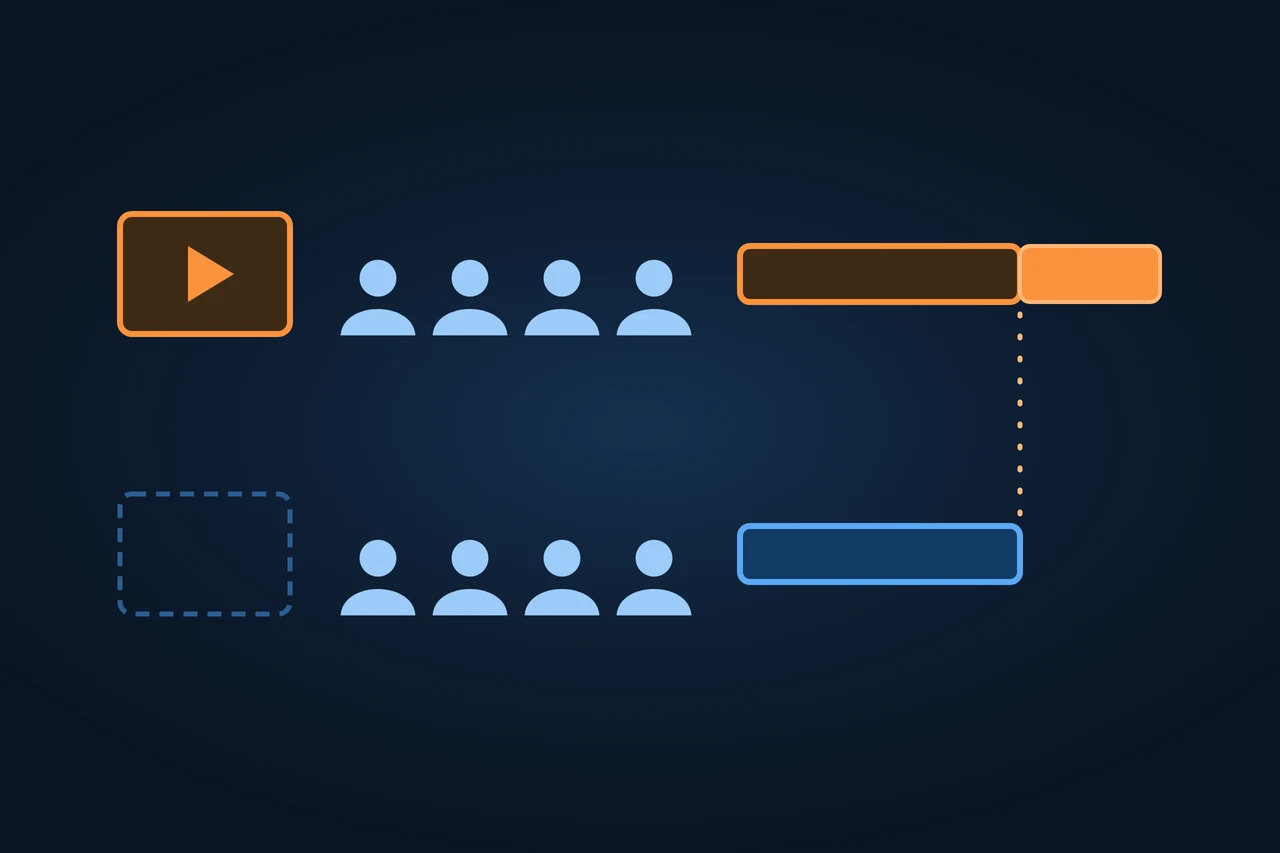
Brand lift measures how much advertising changes how people see a brand: whether they remember the ad, know the brand, would consider it or plan to buy it. It is calculated by comparing two groups from the same audience, one that saw the ad and one that did not. The difference between the two groups' answers is the lift. A brand lift study is the test that makes this measurement, using a short survey inside the ad platform itself.
Brand lift measures how much a campaign changes ad recall, awareness or consideration of a brand by comparing people who saw the ad with people who did not. How it works on Google and Meta, how it is calculated and what budget it takes.
How it works
A brand lift study splits the campaign audience into two groups before it starts:
the exposed group, which sees the ads;
the control group (baseline or holdout), which could have seen them but does not.
The platform then asks people in both groups a short question about the brand. On YouTube it appears before a video. Google measures ad recall, association, awareness, consideration, favorability and purchase intent. Meta asks about ad recall, brand awareness and message association, and uses "causal inference techniques" to calculate the effect.
Because both groups come from the same audience and are split at random, the difference in answers is attributed to the ads. Ruling out chance takes a lot of answers, and Google publishes the numbers: detecting an absolute lift of 2% requires between 4,100 and 11,000 responses; detecting 1% requires between 20,000 and 45,000. The smaller the effect, the more surveys it takes.
Google also caps how often one person is asked: at most one survey a day and three a week.
Two groups from the same audience, the same question
Same audience
Split at random before it starts
Exposed group
Sees the ads
Control group
Could have seen them, but does not
Both get the same short question about the brand
The difference in answers is attributed to the ads
The smaller the effect, the more answers
Absolute lift of 2%
4,100 to 11,000 responses
Absolute lift of 1%
20,000 to 45,000 responses
Responses required according to Google Ads Help
How many answers can your campaign collect?
Types and variants
Brand lift on Google and Meta, according to each platform's help pages:
Platform
What it measures
Requirement and minimum budget
As of
Google (YouTube)
ad recall, association, awareness, consideration, favorability, purchase intent
Only with a Google account representative. Video and Demand Gen campaigns on YouTube. Minimum budget over 10 days by country and number of questions: Spain, US and UK $10,000 to $60,000; Germany $15,000 to $60,000
accessed 27.11.2026
Meta (Facebook, Instagram)
ad recall, brand awareness, message association
With a Meta account representative, or as a brand survey in the Experiments tool. Minimum per test: US $175,000, UK $64,000, Germany $110,000, Spain $39,000, Mexico $44,000
Meta minimums as of 15.09.2026
Source: Google Ads Help ("Set up Brand Lift", "About Brand Lift") and Meta Business Help Center ("Brand Lift minimum requirements", "About Brand Lift tests"), accessed 27.11.2026.
Both platforms say the study itself is not charged: Google calls it "a free tool" and Meta says the test is "free to create". What costs money is the campaign, which has to reach the minimum. When a campaign targets several countries, Meta applies the minimum of the most expensive one.
Google offers two levels. Standard Lift completes within 3 to 14 days, depending on how fast responses come in. Enhanced Lift takes 9 to 14 days, needs three times the minimum budget and collects three times the surveys, which helps detect smaller effects.
Examples
A worked example with round numbers. In the control group, 20% of respondents remember seeing an ad for the brand. In the exposed group, 26% do.
Absolute lift: 26% − 20% = 6 percentage points.
Relative lift: 6 ÷ 20 = 30%.
Headroom lift: 6 ÷ (100 − 20) = 7.5%.
All three figures describe the same result. A report claiming "30% brand lift" and another claiming "6 points" can be talking about the same campaign. Before comparing, check which of the three is used.
How to measure it
Google defines the metrics like this:
Absolute lift = positive response rate in the exposed group − rate in the control group.
Relative lift = absolute lift ÷ control group rate.
Headroom lift = absolute lift ÷ (1 − control group rate). It shows how much of the remaining room was gained.
Lifted users: an estimate of how many people across the campaign's reach changed their view of the brand because of the ads.
Cost per lifted user = total campaign cost ÷ lifted users.
Google recommends cost per lifted user as the primary metric because it accounts for both reach and cost. A high absolute lift on a small campaign can mean fewer people persuaded than a lower lift on a large one.
Each result comes with a confidence interval, which Google says is usually 90%, and a "certainty of lift", calculated as 1 minus the p-value.
Advantages and disadvantages
The advantage of brand lift is that it measures the effect of ads that are not meant to be clicked. In a video campaign built to make a brand known, clicks and views say little. Comparing against a control group isolates what the ads added.
The disadvantages are the entry price and what the answer covers. The minimum budget shuts out low spenders, and the survey records what people say, not what they do.
How it differs from related concepts
Concept
What it measures
How
Brand lift
recall, awareness, consideration, intent
survey of an exposed group and a control group
Search lift
whether people search more for the brand or product
searches by the exposed group against the control group
Conversion lift
visits, purchases, downloads
conversions, split by users or by region
Source: Google Ads Help, "Comparing lift types", accessed 27.11.2026.
All three are forms of incrementality testing: they measure what advertising adds compared with not running it. Brand awareness is one of the things brand lift measures, not a measurement method. Marketing mix modeling estimates each channel's effect from historical data, without a control group.
Criticism and limits
Brand lift measures stated intent. Someone saying they remember an ad or plan to buy is not a purchase. Sales need a conversion lift study or a separate analysis.
The minimum budgets shut out low spenders. In the US, Meta's minimum as of 15.09.2026 is $175,000 per test.
Meta advises against brand lift when other campaigns for the same brand are running on its platforms: the control group could see those ads and the result is contaminated. Meta also asks advertisers to keep creative and budget the same throughout, and to place each ad set entirely inside or entirely outside the test dates. Google asks advertisers not to cut budgets before the minimum is reached.
The result holds for that campaign, that audience and those dates. It does not say how a different creative would perform.
How to apply it, step by step
Without access to a platform study, you can still track a change in how people see the brand. This is not brand lift as Google or Meta define it, because there is no randomized control group:
Pick one metric and write the question before you start.
Measure the starting point: branded searches in Search Console or Google Trends and, if you can, your own survey.
If the campaign is regional, keep a comparable area without ads and use it as the control.
Repeat the same measurement at the end, with the same question.
Note what else changed in that time: prices, press coverage, other campaigns, season.
Read the result as an indication and do not compare it with lift figures published by Google or Meta.
Best practices
Decide before launch which metric matters and what change you would count as success.
Keep creative and budget fixed during the study.
Do not run other campaigns for the same brand on the same platform at the same time.
Always say whether a lift is absolute, relative or headroom.
Compare campaigns by cost per lifted user, not only by percentage.
Common mistakes
Comparing a relative lift with an absolute one.
Reading purchase intent as sales.
Starting a study on a tight budget and cutting it before the minimum is reached.
Creating ad sets that start or end in the middle of the test (Meta).
Calling a before-and-after survey without a control group brand lift.
How this entry was made
This entry was written in November 2026 with the help of AI. The method, metrics, budgets and durations come from the Google Ads and Meta help pages, accessed on 27.11.2026. The round-number example is ours. The entry was reviewed before publication and contains no client data.
Manuel Riveiro RodriguezCEO & Digital Strategist
A technical audit covers this and everything else in one pass.
A test that compares people who saw an ad with people from the same audience who did not. Both groups get the same question about the brand, and the difference between their answers is the lift.
How much does a brand lift study cost?
Google and Meta do not charge for the study, but the campaign has to reach a minimum budget. In the US, Google asks for at least $10,000 over 10 days with one question, and Meta $175,000 per test according to its minimums as of 15.09.2026.
What is the difference between brand lift and conversion lift?
Brand lift uses a survey to measure what people remember or think about the brand. Conversion lift measures actions: visits, purchases or downloads. Both compare an exposed group with a control group.
What metrics does brand lift measure?
On Google: ad recall, association, awareness, consideration, favorability and purchase intent. On Meta: ad recall, brand awareness and message association.
How long does a brand lift study take?
On Google, Standard Lift completes within 3 to 14 days and Enhanced Lift within 9 to 14 days. The minimum budget has to be reached in the first 10 days.