
Skip to content

Glossary Product-led growth (PLG)

What is product-led growth (PLG)? Definition and metrics

  • Content Marketing
Definition

Product-led growth (PLG) is a go-to-market strategy in which the product itself is the main way a company acquires customers, turns them into paying customers and expands what they buy. Users sign up, try the product and see its value before they talk to a salesperson or pay. Harvard Business School Online describes it as letting users experience that value "freely and easily". The opposite is sales-led growth, where the sales team drives each purchase.

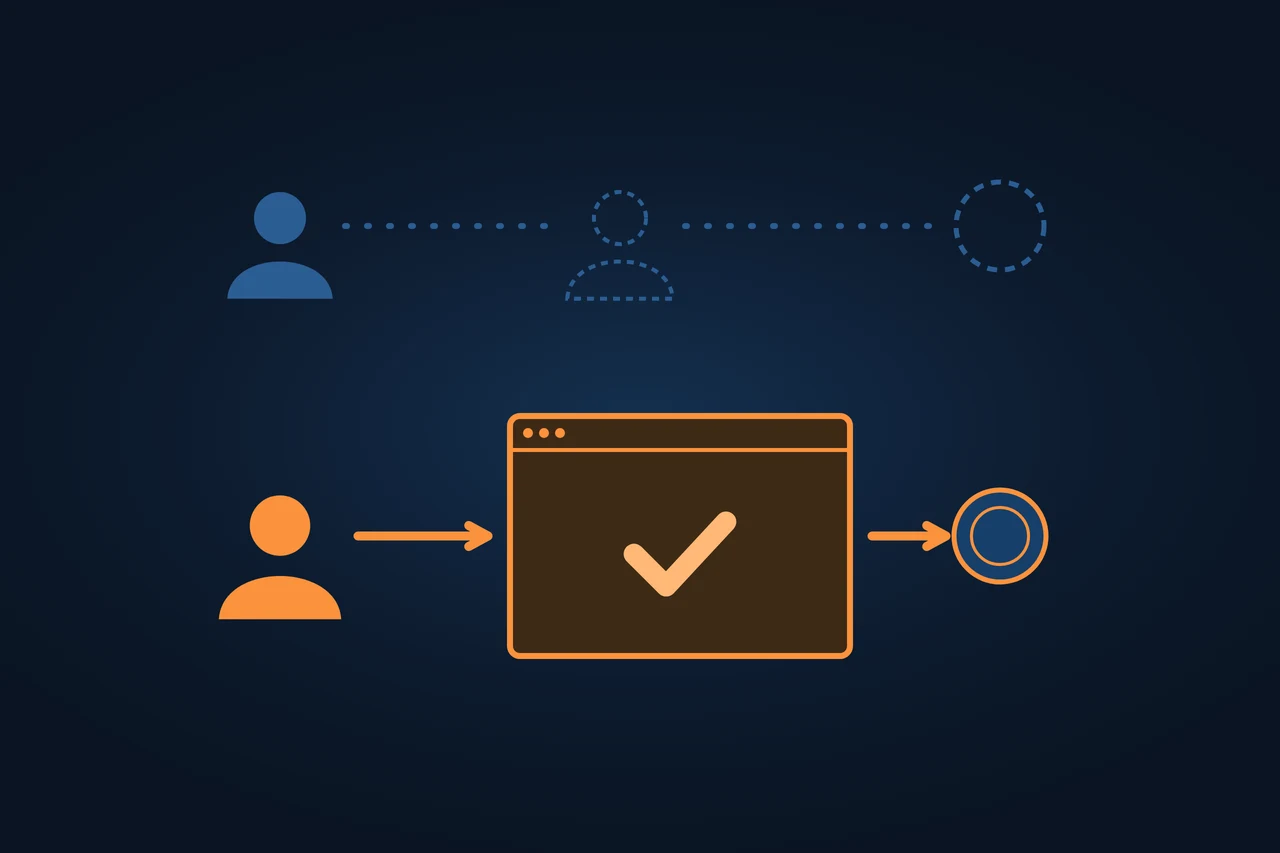
Two paths from a person to a coin: at the top, pale and dotted, it passes the dashed outline of another person and ends at a dashed coin; at the bottom, in orange, a person follows an arrow into a large browser window with a check mark and continues with another arrow to an orange coin, on a dark blue ground.
On this page 12
  1. Origin of the term
  2. How it works
  3. Types and variants
  4. Examples
  5. How to measure it
  6. Advantages and disadvantages
  7. How it differs from related concepts
  8. Criticism and limits
  9. How to apply it, step by step
  10. Best practices
  11. Common mistakes
  12. How this entry was made
In brief

Product-led growth is a model in which the product itself acquires, converts and expands customers. How it works, what to measure and when it fails.

Two paths from a person to a coin: at the top, pale and dotted, it passes the dashed outline of another person and ends at a dashed coin; at the bottom, in orange, a person follows an arrow into a large browser window with a check mark and continues with another arrow to an orange coin, on a dark blue ground.

Origin of the term

The term dates from 2016 and comes from the venture capital firm OpenView, which credits its partner Blake Bartlett with it. An OpenView article from 2 May 2022 says Bartlett collected more than 100 candidate names, among them "user-focused GTM", before settling on "product-led growth". According to the same article, he first tried the phrase on 6 May 2016, with Clearbit founder Alex MacCaw. In an interview with Sacra published on 27 June 2023, Bartlett said "we coined the term at OpenView in 2016".

The earliest OpenView text with the term and a definition is dated 17 August 2016. Its author is Natalie Diggins, then OpenView's entrepreneur in residence, who wrote that no one had yet articulated a common language for this strategy. Before that, according to OpenView, people called such companies "freemium" or "bottom up", labels that in Bartlett's view did not capture what they were doing.

How it works

In a sales-led model the order is acquire, monetize, engage, expand. Marketing brings leads, sales closes the contract and the customer discovers the product's value after signing. In product-led growth, as ProductLed puts it, engagement comes before monetization: acquire, engage, monetize, expand. The customer pays once the product has already solved something for them.

The step that decides the outcome is activation, the moment a new user first gets real value from the product. PLG teams therefore spend most of their effort on self-service sign-up, in-product onboarding and the time it takes a user to reach that moment.

A worked example with round numbers: a product gets 10,000 sign-ups a month. Of these, 2,000 reach activation (20%) and 200 become paying customers (10% of activated users, 2% of sign-ups). If better onboarding lifts activation to 2,500 users and the payment rate stays the same, the company gains 250 paying customers without a single extra sales call.

What moves is the point at which the customer pays

Types and variants

Product-led growth does not require a free plan. The way into the product can take several forms, and sales joins at different points.

VariantHow users get inWhen sales gets involved
Freemiuma free plan with no end date, but with limitswhen the account outgrows the free plan or needs enterprise features
Free trialfull access for a limited timeat the end of the trial, if the account warrants it
Product-led sales (hybrid)self-service sign-up, as abovewhen usage flags the account as a PQL

Source: ProductLed, OpenView (Diggins, 17.08.2016) and this glossary's freemium entry, accessed 24.11.2026.

A product-qualified lead (PQL), in ProductLed's definition, is a lead who has already experienced meaningful value in a free trial or free plan. A marketing-qualified lead is scored on how it interacts with marketing; a PQL is scored on what it does inside the product. Diggins already described PLG in 2016 as a tool to qualify prospects for the sales team.

Examples

Slack was the company most of the executives Diggins spoke to in 2016 named as the model for PLG. According to her article, it began as an internal tool at what was then a gaming company and became a product when employees said they did not want to work anywhere without it. In 2019 Bartlett quoted Slack's S-1 filing: "Many organizations adopt Slack initially as part of our self-service go-to-market approach."

Expensify, the expense report app, shows what a PQL signal looks like in practice. Jason Mills, its director of sales and success, told Diggins that the main indicator is a user who receives a lot of expense reports: if about three or more people in the same company submit reports to that user, sales sees an opportunity and reaches out.

The role of sales varies. According to OpenView's 2022 article, some companies in 2016 said "we do not do sales", with Atlassian named as one, while at Datadog sellers worked with customers to expand large accounts.

How to measure it

PLG metrics follow the user's path through the product. Neither ProductLed nor Atlassian publishes dated benchmark values with a method, so each company tracks its own trend.

MetricWhat it measuresWhy it matters in PLG
Activation rateshare of sign-ups who reach the value momentthe step with the most leverage
Time to valuehow long a new user takes to activatethe shorter, the more users stay
Free-to-paid conversionshare of users who move to a paid accountlinks usage to revenue
PQLaccounts that meet the usage threshold for a sales conversationdecides where sales spends its time
Net revenue retentionrevenue kept and expanded within existing customersmeasures expansion inside accounts
CACsales and marketing cost per new customershould fall when the product converts on its own

Source: ProductLed and Atlassian, accessed 24.11.2026.

Net revenue retention and its formula are covered in the churn rate entry. How much cash the company uses up while the product grows is what burn rate measures.

Advantages and disadvantages

According to ProductLed, the funnel opens earlier, because anyone can try the product without asking for a demo, and sales can focus on accounts that already use it. A customer who upgrades without talking to a salesperson costs less to acquire, and a product that spreads from user to user, as Slack does inside a company, relies less on paid advertising.

On the other side, free users consume infrastructure and support even if they never pay, and the product needs analytics from day one. ProductLed describes the shift as organization-wide, with marketing, sales, customer success and product working from the same metrics. The role of sales does not settle itself either: OpenView still called it an open question in 2022.

How it differs from related concepts

Product-led growth is a company-wide strategy. The concepts around it are a pricing model, a way of working or a state of the product.

ConceptWhat it isRelation to PLG
Freemiumpricing model with a permanent free planone possible way in; Diggins: PLG is "more than just free trials"
Sales-led growthstrategy in which sales drives each purchaseProductLed: if the only way to sell is that someone talks to you, it is sales-led
Growth hackingan experiment-driven way of working focused on growthcan be used inside PLG but does not set the commercial strategy
Product-market fitfit between a product and a market that wants ita precondition; per OpenView, Bartlett wrote in 2014 that fit alone is not enough

Source: OpenView (Diggins, 17.08.2016; Poyar, 02.05.2022), ProductLed, accessed 24.11.2026.

Freemium and PLG sit at different levels: freemium says how a company charges, PLG says what drives its growth. A company can have a free plan and still sell only through account executives. Another can grow through the product with a time-limited trial and no free plan at all. SaaS, in turn, describes how software is delivered, not how it is sold.

Criticism and limits

The model depends on users being able to see the product's value on their own. If the value only appears after installation, integration with other systems or training, self-service sign-up does not lead to activation, and a salesperson or a technical team is needed. The same applies when the buyer is not the user, as in centralized procurement at large companies.

ProductLed criticizes the shallow version: in its words, many SaaS founders choose free trials simply because competitors do, and offer them without building the capabilities behind them.

How to apply it, step by step

  • Define the value moment: the specific action after which a new user has got something useful out of the product.
  • Let people sign up without a sales conversation.
  • Choose the way in: a free plan, a time-limited trial, or both.
  • Track activation and time to value by sign-up cohort.
  • Set the PQL threshold from usage data and agree with sales which accounts they contact.
  • Align paid tiers with usage, so that a user who grows with the product needs to upgrade.

Best practices

  • Pick one definition of activation and do not change it without telling every team.
  • Check the PQL threshold against the accounts that actually ended up paying.
  • Report product-sourced and sales-sourced customers separately.
  • Compare the CAC of both channels before moving budget.
  • Keep sales on large accounts, where the product alone does not close the deal.

Common mistakes

  • Calling a product with a free trial and nothing else product-led.
  • Counting sign-ups instead of activations.
  • Treating PLG and freemium as the same thing.
  • Limiting free access so much that users never reach the value moment.
  • Removing sales entirely from a product sold to large enterprises.

How this entry was made

This entry was written in November 2026 with the help of AI. The origin and the definitions come from OpenView's own texts, read in Internet Archive copies because the OpenView site now redirects to its home page, from Sacra's interview with Bartlett, ProductLed, Harvard Business School Online and Atlassian, all accessed on 24.11.2026. The round-number example is ours. The entry was reviewed before publication and contains no client data.

Manuel Riveiro Rodriguez CEO & Digital Strategist

A technical audit covers this and everything else in one pass.

Request an audit

Frequently asked

What is the meaning of product-led growth?

Product-led growth is a go-to-market strategy in which the product itself acquires, converts and expands customers. Users try the product and see its value before they pay or talk to sales.

What is the difference between product-led and sales-led growth?

In sales-led growth, sales closes the contract and the customer uses the product afterwards. In product-led growth, the customer uses the product first and pays once it has proved useful. Sales can still work on large accounts.

Is product-led growth the same as freemium?

No. Freemium is a pricing model with a permanent free plan. Product-led growth is a commercial strategy that can use freemium, a free trial or neither.

What is a product-qualified lead (PQL)?

A PQL is an account that has already got value from the product in a trial or free plan and meets a usage threshold set by the company. It is the signal for sales to get in touch.

Who coined the term product-led growth?

The term comes from the venture capital firm OpenView in 2016, which credits its partner Blake Bartlett. The first published text with the definition was written by Natalie Diggins of OpenView on 17 August 2016.

Sources

  1. Natalie Diggins, "Product-led Growth: Strategies from Slack & Expensify", OpenView Labs, 17 August 2016, Internet Archive copy.
  2. Kyle Poyar, "How Product-Led Growth Went From Idea to the Biggest Trend In Software", OpenView, 2 May 2022, Internet Archive copy.
  3. OpenView, "Product-Led Growth: What It Is and Why It's Here to Stay", 11 May 2023, Internet Archive copy.
  4. Blake Bartlett, "What is Product Led Growth? How to Build a Software Company in the End User Era", OpenView, 6 August 2019, Internet Archive copy.
  5. Sacra, "Blake Bartlett, partner at OpenView, on the future of product-led growth", 27 June 2023.
  6. ProductLed, "Product-Led Growth (PLG): What it means, examples, and why it's taking off".
  7. Harvard Business School Online, "How to Achieve a Product-Led Growth Strategy", 13 March 2025.
  8. Atlassian, "What Is Product-Led Growth?".