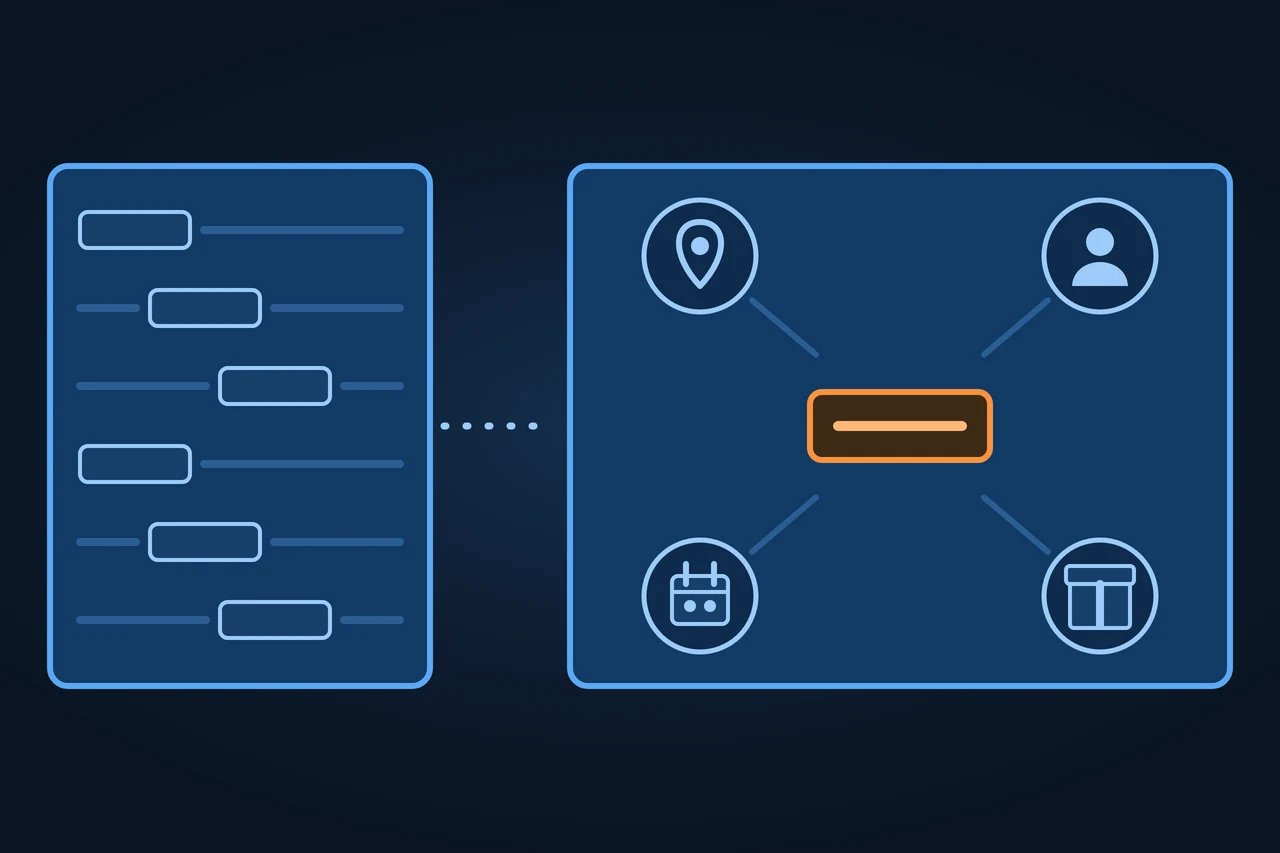
Semantic SEO is a way of planning content around a topic, the entities that make it up and the relationships between them, rather than around a list of separate keywords. The aim is a page that makes clear what it is about and which questions it answers. Merriam-Webster defines "semantic" as "of or relating to meaning in language".
Semantic SEO: planning content around topics, entities and questions. What Google says, semantic search, the LSI keyword myth and how to measure it.
History and development
Google itself has announced, with dates, several changes in how it interprets queries. Each entry below is Google's own description:
16 May 2012: Google launches the Knowledge Graph under the line "things, not strings". The announcement says it then held more than 500 million objects and more than 3.5 billion facts about them and their relationships.
August 2013: Hummingbird. Google's ranking guide lists it among retired systems as "a major improvement to our overall ranking systems".
2015: RankBrain, which Google calls "the first deep learning system deployed in Search", built to understand how words relate to concepts.
2018: neural matching, which Google says matches "fuzzier representations of concepts in queries and pages".
25 October 2019: BERT is applied to ranking and featured snippets. Google expected it to help with one in ten searches in the U.S. in English; by February 2022 it said BERT played "a critical role in almost every English query". The models themselves are covered under natural language processing.
18 May 2021: MUM, trained across 75 languages. Google's current ranking guide says MUM is "not currently used for general ranking in Search".
14 May 2024: AI Overviews begin rolling out to everyone in the U.S.
How it works
Semantic SEO rests on five practices:
Name entities unambiguously. People, places, products and concepts get the name a searcher would use, plus enough context to tell them apart from namesakes. Google's 2012 example was [taj mahal]: the monument, the musician or a casino.
Cover the topic, not one form of the keyword. A page about a subject answers the questions that belong to it. How that coverage builds up across a site is explained under topical authority.
Mark up visible content with structured data. Google states that it "uses structured data that it finds on the web to understand the content of the page".
Link related pages with internal links, so that the relationships between topics are visible in the site itself.
Semantic search is the retrieval side of the same idea. Lexical search matches words: it returns documents that contain the terms in the query. Semantic search matches meaning: it returns documents that say something similar, even in different words. To do that, systems represent meaning as a vector, an embedding, and store those vectors in a vector database. Google's ranking guide names two of its own systems on this side: neural matching, which matches "representations of concepts in queries and pages", and passage ranking, which looks at individual sections of a page to judge how relevant the whole page is.
Google describes its own approach in plainer terms. In "How Search works" it mentions a synonym system: someone searching for "change laptop brightness" can find a manufacturer page that says "adjust laptop brightness". The same page also says that "the most basic signal that information is relevant is when content contains the same keywords as your search query".
One query, two ways to a match
change laptop brightness
Lexical search
matches the words in the query
Page that contains the words
How to change laptop brightness
Semantic search
matches meaning, even in different words
Manufacturer page (Google's example)
Adjust laptop brightness
Example from Google, How Search works. The same page still treats matching keywords as a signal of relevance.
Which words do your readers use for the same thing?
Types and variants
The approaches below appeared roughly in this order, and older ones still show up in SEO tools:
Source: Spärck Jones (1972), Deerwester et al. (1990), Google (2012, 2019, 2025, 2026); see Sources.
Examples
One page about specialty coffee, planned two ways.
Planned from a keyword list:
Specialty coffee
Best specialty coffee
Cheap specialty coffee
Buy specialty coffee
Specialty coffee online
Planned from entities and questions:
What specialty coffee is and who grades it
Origin: country, region and altitude
Variety and processing: washed, natural, honey
Roast level and roast date
Brewing: espresso, filter, French press
Storage and how long beans stay fresh
The first outline repeats one phrase and changes only the modifier. The second names concrete things, each with its own questions, and still leaves room for the main keyword in the title and introduction.
How to measure it
Google publishes no "semantic" score, and no tool can show how Google weighs a page. What you can check is narrower:
Entities in your text. The Google Cloud Natural Language API runs entity analysis on a text and returns each entity with a type, a salience value and, where it finds one, a Wikipedia link. Check whether the entity the page is meant to be about comes back at all, and how it ranks against the others.
Query spread. The performance report in Google Search Console shows which queries lead to a page. Compare that list before and after a rewrite.
Structured data. The Rich Results Test shows whether Google can read the markup on a page.
Google gives no target value for any of these.
Advantages and disadvantages
On the plus side, the method forces a decision before writing: which entities and questions the page covers. That list can be checked against the finished text and against Search Console later.
On the minus side, nobody outside Google knows how much any of this weighs in ranking. The term also attracts claims with no basis in Google's own documentation, LSI keywords being the best-known example.
Semantic HTML, which marks up page structure with elements such as <article> or <nav>, is a different concept despite the shared word.
Tools
Tool
What it is for
Google Cloud Natural Language API
Entity analysis with salience
Google Search Console
Queries per page
InLinks
Entity SEO and internal linking, according to the vendor
Schema Markup Validator
Validating Schema.org markup
WordLift
Knowledge graphs and structured data, according to the vendor
Source: vendor pages, accessed 16.11.2026.
Criticism and limits
One claim that keeps coming up around semantic SEO is "LSI keywords": lists of related terms that some SEO guides tell writers to add. Google's John Mueller replied to that idea on X on 30 July 2019: "There's no such thing as LSI keywords -- anyone who's telling you otherwise is mistaken, sorry." Latent semantic indexing itself is real, a retrieval method described in 1990. Google's documentation does not say it uses it.
Patents are a second weak spot. Google holds US 10,235,423 B2, "Ranking search results based on entity metrics", filed on 12 December 2012 and granted on 19 March 2019. Its abstract describes scoring results with metrics weighted by the type of entity in the search. A patent shows what Google registered. It does not show that Search uses the method.
Third, the "semantic scores" in SEO tools are each vendor's model. A high score in one tool is not a rating from Google, and two tools can score the same text differently. They are useful for comparing drafts of your own page, not as evidence of how Google sees it.
How to apply it, step by step
Define the topic and its main entities before choosing keywords.
Collect the questions people ask: People Also Ask, related searches and the queries in Search Console.
Plan one heading per entity or question, and keep the main keyword in the title.
Name every entity unambiguously in headings and text.
Add structured data only for content that is visible on the page.
Link pages on related topics to each other.
Run the finished text through the Natural Language API and check which entities it finds.
Best practices
Write for the question, not for a variant of the keyword.
Keep the main keyword in the title and the opening paragraph.
Use the names your readers use, and add the formal name once if it differs.
Review every few months which new queries reach the page.
Common mistakes
Padding a text with "LSI keywords".
Treating a tool's semantic score as Google's assessment.
Marking up content that is not visible on the page.
Expecting FAQ rich results: Google stopped showing them on 7 May 2026.
Writing a separate page for every keyword variant of the same topic.
How this entry was made
This entry was written in November 2026 with the help of AI. The dates come from Google's own announcements and Search Central; the LSI quote was checked against the original post on X. It was reviewed before publication and contains no client data.
Manuel Riveiro RodriguezCEO & Digital Strategist
A technical audit covers this and everything else in one pass.
What is the difference between semantic SEO and traditional SEO?
Traditional SEO usually starts from a keyword and where to place it. Semantic SEO starts from the topic, its entities and the questions around it. Keywords still matter: Google calls them the most basic signal of relevance.
What is the difference between semantic and lexical search?
Lexical search finds documents that contain the words in the query. Semantic search finds documents with a similar meaning, even if they use different words.
Do LSI keywords exist?
Not as a Google technique. Google's John Mueller wrote on 30 July 2019 that there is no such thing as LSI keywords. Latent semantic indexing itself is a retrieval method from 1990.
What are semantic keywords?
Terms connected to a topic by meaning, such as entities, synonyms and the questions people ask. It is an industry term for planning content, not a category from Google.
Does semantic SEO help with AI search?
Google says AI Overviews and AI Mode have no additional requirements and need no special optimization. The usual SEO best practices apply, including helpful, reliable, people-first content. Google adds that these features may use a "query fan-out", running several related searches across subtopics to build one answer.