
Skip to content

Glossary Break-even point

What is the break-even point? Formula, example, ROAS

Definition

The break-even point is the sales volume at which revenue equals total costs: the business neither makes nor loses money. Below it there is a loss, above it a profit. For advertising, the same idea gives the break-even ROAS, the minimum return on ad spend at which an order still doesn't lose money. In German it is called Break-even-Point or Gewinnschwelle, in Spanish punto de equilibrio.

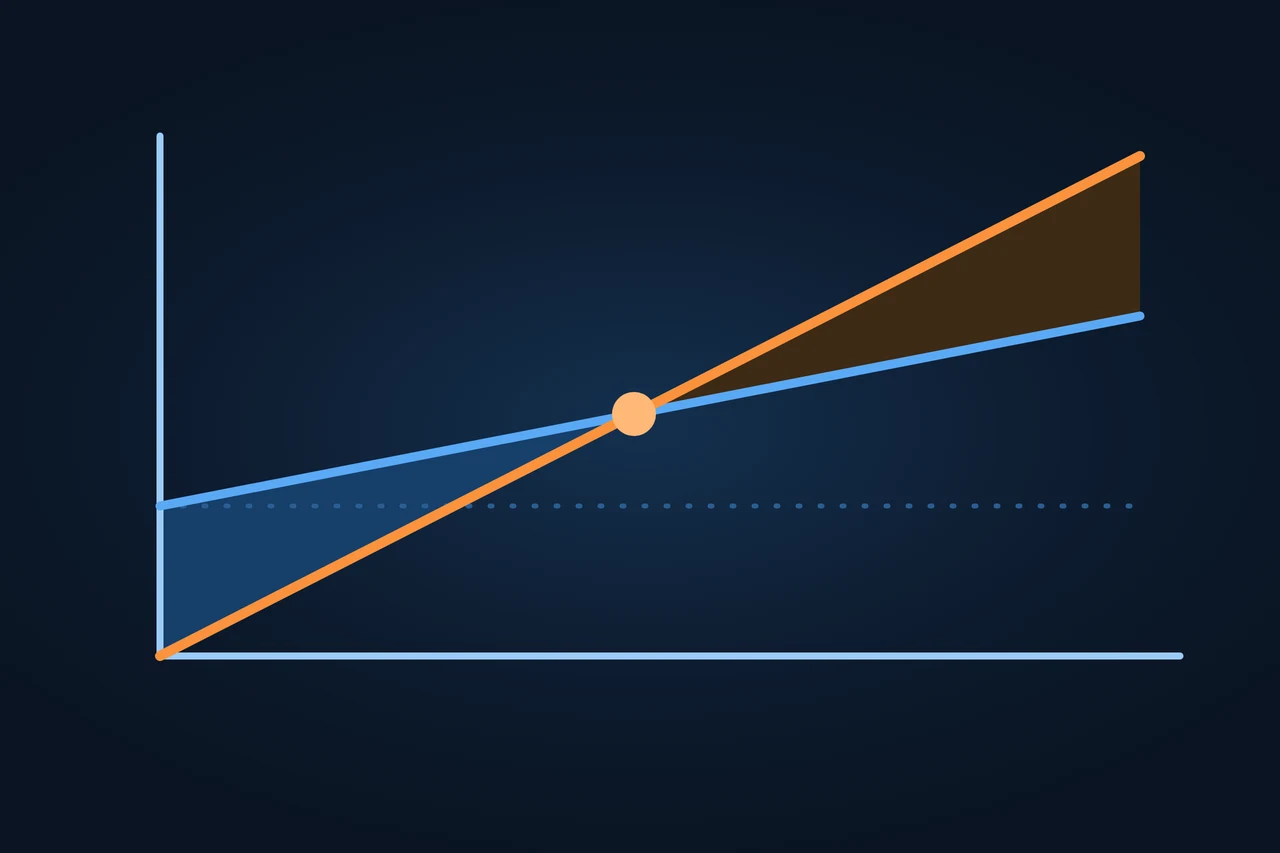
A pair of axes without numbers: a horizontal dotted line, a blue line rising slowly from it and an orange line starting at zero and rising faster; where they cross, a light orange dot, and to the right of the crossing the space between them is filled in dark orange, on a dark blue ground.
On this page 11
  1. How it works
  2. Types and variants
  3. Examples
  4. How to measure it
  5. Advantages and disadvantages
  6. How it differs from related concepts
  7. Criticism and limits
  8. How to apply it, step by step
  9. Best practices
  10. Common mistakes
  11. How this entry was made
In brief

The break-even point is the sales volume at which a business neither makes nor loses money. The formula, a worked example and the break-even ROAS for ads.

A pair of axes without numbers: a horizontal dotted line, a blue line rising slowly from it and an orange line starting at zero and rising faster; where they cross, a light orange dot, and to the right of the crossing the space between them is filled in dark orange, on a dark blue ground.

How it works

According to the Gabler business encyclopedia, at the break-even point the sum of fixed and variable costs equals revenue. Since each unit sold brings in its contribution margin, the break-even point is the number of units whose margins add up exactly to fixed costs:

  • break-even point in units = fixed costs ÷ (price − variable cost per unit);
  • break-even point in sales = fixed costs ÷ contribution margin ratio.

That is how Investopedia and Stripe put it, and in German so does the Gründerplattform run by KfW, Germany's state development bank.

A worked example with round numbers, the same as in the contribution margin entry: an online shop sells orders worth €100 net. Goods, shipping and the payment fee add up to €60, so each order leaves €40 of margin, 40%. Fixed costs are €20,000 a month. The break-even point is 20,000 ÷ 40 = 500 orders a month, or 20,000 ÷ 0.40 = €50,000 in sales.

If the shop also spends €15 on advertising per order, that spend behaves like one more variable cost. The margin drops to €25 and the break-even point rises to 20,000 ÷ 25 = 800 orders, €80,000 in sales.

The same shop, with and without advertising: where profit begins

Types and variants

VariantFormulaWhat it answers
In unitsfixed costs ÷ margin per unithow many units you have to sell
In salesfixed costs ÷ margin ratiohow much revenue you need
With a target profit(fixed costs + target profit) ÷ margin per unithow many units to earn a set amount
Several productsfixed costs ÷ weighted average marginthe same, for a fixed sales mix
Break-even ROAS1 ÷ margin ratio before adshow much each euro of advertising has to sell

Source: Investopedia (11.02.2026), Stripe and Shopify (02.09.2026), accessed 26.11.2026.

For several products, Stripe calculates a weighted average contribution margin based on the sales mix. Gabler warns that in this case many combinations of quantities lead to break-even, so the calculation only holds if the mix stays the same.

Examples

If the shop in the example wants to make €6,000 a month, leaving advertising aside, it needs (20,000 + 6,000) ÷ 40 = 650 orders.

At 650 orders, the shop is 150 above break-even. That cushion is called the margin of safety: (650 − 500) ÷ 650 = 23.1%. Sales could fall by almost a quarter before the shop makes a loss.

How to measure it

For advertising, the threshold is expressed as ROAS, sales divided by ad spend. An order doesn't lose money as long as advertising doesn't exceed its margin before ads. So break-even ROAS is 1 ÷ margin ratio. Shopify puts it the same way, using the margin left after production and fulfillment and before advertising.

Margin ratio before adsBreak-even ROAS
20%5.00
30%3.33
40%2.50
50%2.00
60%1.67

Source: our own calculation with the formula 1 ÷ ratio, as in Shopify (02.09.2026), accessed 26.11.2026.

At the example's 40%, every euro of advertising has to bring in at least €2.50 in sales, which means at most €40 of advertising per €100 order. If the shop wants €10 per order left after ads, the target ROAS is 1 ÷ (0.40 − 0.10) = 3.33: at most €30 of advertising per order.

Three traps change the result:

  • The wrong margin. With gross margin, which only subtracts the goods (55% in the example), you get a ROAS of 1.82. At that level the shop spends €55 on ads per order and loses €15 on each one. Shopify warns about this mistake.
  • VAT. If the sales counted by the ad platform include VAT and the spend doesn't, ROAS looks higher than it is. Keep both sales and spend net.
  • Returns and fees. If they aren't in the margin, the break-even ROAS comes out too low.

Break-even ROAS only covers the order. Fixed costs are covered by the number of orders, which brings you back to the break-even point in units.

Advantages and disadvantages

The calculation is simple and answers concrete questions: from what volume a business is worth it, what happens to break-even when a cost rises or a price falls, and how far spending on a campaign can go. For a business plan, the Gründerplattform recommends stating when break-even will be reached.

Its limits come from its assumptions. Gabler lists them: constant fixed costs, variable costs proportional to sales, and constant prices. In practice fixed costs rise in steps, for example with a second warehouse, and prices change with discounts and seasons.

How it differs from related concepts

ConceptWhat it measuresRelation to the break-even point
Contribution marginwhat each sale leaves after variable coststhe denominator in the formula
ROASsales per euro of advertisingbreak-even ROAS is its minimum
ROIreturn on investmentat the break-even point profit is zero
CAC payback (unit economics)months to recover the cost of winning a customermeasures time, not volume
Burn ratecash the company uses up each monthuntil break-even is reached, there is burn

Source: entries in this glossary, accessed 26.11.2026.

Criticism and limits

The result depends on a split between fixed and variable costs that is only approximate in practice. An error in that split moves the break-even point: if shipping had a fixed component, the margin per order would be higher and so would fixed costs.

Break-even ROAS looks at a single order. If the customer buys again, they are worth more, and a company can accept a lower ROAS on the first purchase; that calculation belongs to customer lifetime value.

How to apply it, step by step

  • Split costs into fixed and variable, and write down what goes on each side.
  • Calculate the contribution margin per unit, net of VAT and including returns and fees.
  • Divide fixed costs by that margin.
  • Calculate break-even ROAS per product or category, not one figure for everything.
  • Recalculate when prices, rates or fixed costs change.
  • Track the margin of safety at your current volume alongside it.

Best practices

  • Calculate with net sales and net costs.
  • Treat advertising as a variable cost of its own.
  • Set the target ROAS above break-even, with the margin you want to earn.
  • Check the product mix if you sell several products.
  • Write the assumptions next to the result.

Common mistakes

  • Using gross margin for the break-even ROAS.
  • Mixing sales including VAT with spend excluding VAT.
  • Treating break-even as a target instead of a floor.
  • Using one target ROAS for products with different margins.
  • Forgetting that fixed costs rise in steps.

How this entry was made

This entry was written in November 2026 with the help of AI. The definitions and formulas come from the Gabler Wirtschaftslexikon, Investopedia, Stripe and the KfW Gründerplattform, the break-even ROAS from Shopify, all accessed on 26.11.2026. The round-number example is ours and is the same as in the contribution margin entry. The entry was reviewed before publication and contains no client data.

Manuel Riveiro Rodriguez CEO & Digital Strategist

A technical audit covers this and everything else in one pass.

Request an audit

Frequently asked

What is the formula for a break-even point?

Fixed costs divided by the contribution margin per unit. With €20,000 of fixed costs a month and €40 of margin per order, that is 500 orders a month.

How do you calculate break-even in units and in sales?

In units, divide fixed costs by the margin per unit. In sales, divide fixed costs by the margin ratio. In the example: 20,000 ÷ 40 = 500 orders, or 20,000 ÷ 0.40 = €50,000.

What is break-even ROAS?

The ROAS at which advertising uses up exactly the margin of an order: 1 divided by the margin ratio before ads. At a 40% margin, it is 2.5.

What is the margin of safety?

How far sales can fall before you make a loss: (current sales − break-even sales) ÷ current sales. At 650 orders with break-even at 500, it is 23.1%.

What is the difference between break-even and ROI?

Break-even is a sales volume; ROI is a percentage return. At the break-even point profit is zero, and above it a return begins.