
Skip to content

Glossary Keyword Research

What Is Keyword Research: Finding and Prioritizing the Right Search Terms

Definition

Keyword research is the process of identifying and analyzing the words and questions a target audience types into search engines, then deciding what content to create and in what order. The output isn't a list of terms; it's that list grouped by the intent behind each search.

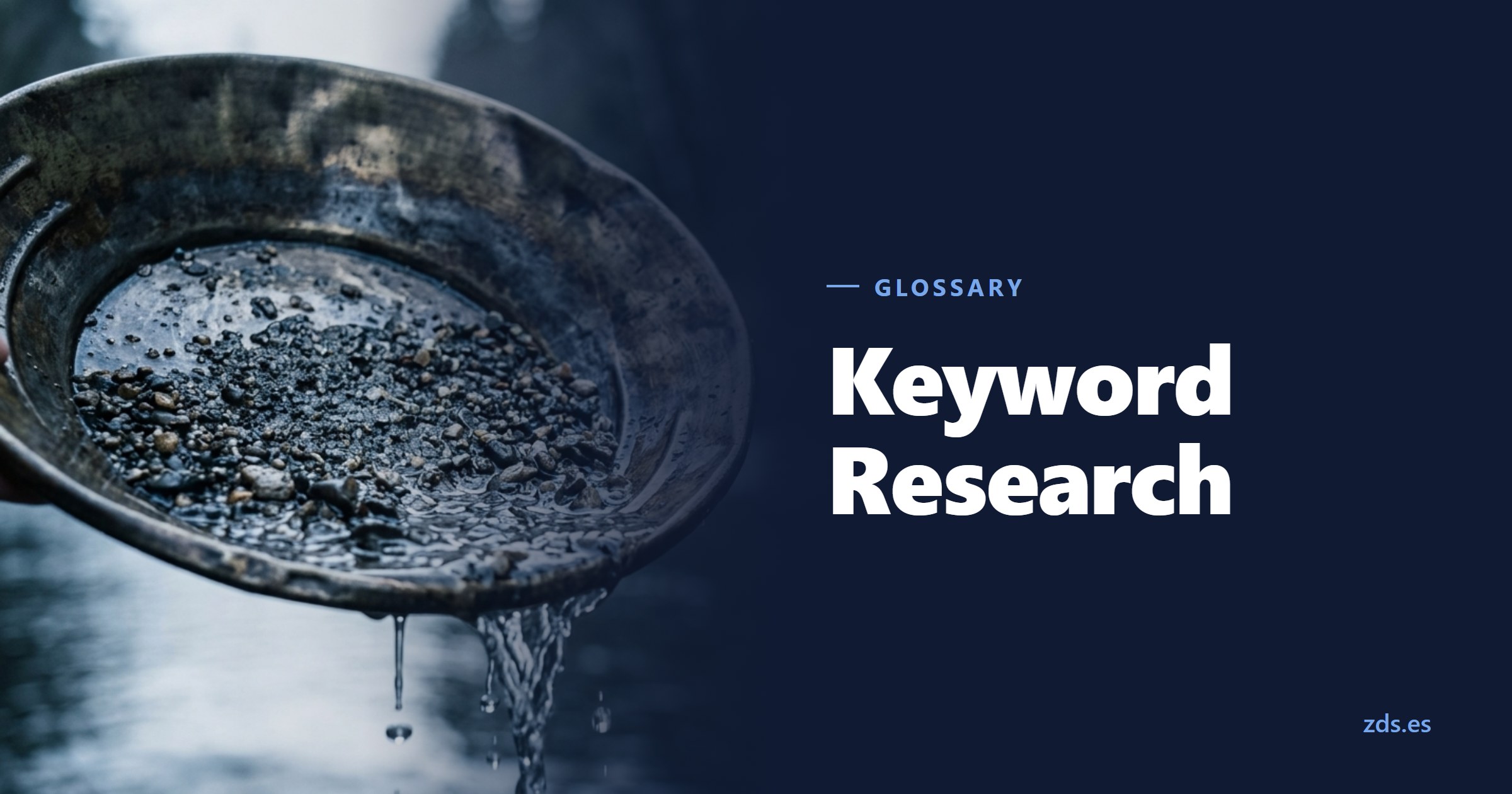
A metal panning pan of wet gravel with water running off — beside the title Keyword Research
You wash gravel until only the heavy part stays
On this page 5
  1. The starting point: seed keywords and research tools
  2. The four types of search intent
  3. How generative answers are changing what "ranking" even means
  4. Best practices for keyword research
  5. Common keyword research mistakes
In brief

Finding keywords used to mean collecting terms with high search volume. As Google and generative answers resolve more questions directly inside the results page, what matters more is clustering keywords by intent and prioritizing the ones that still earn a real click.

A metal panning pan of wet gravel with water running off — beside the title Keyword Research
You wash gravel until only the heavy part stays

The starting point: seed keywords and research tools

The starting point hasn't changed: a list of seed keywords, the most obvious terms tied to a product or business. Someone selling running shoes starts with "running shoes" or "shoes for jogging." From there, tools like Google Keyword Planner, Ahrefs, Semrush or Google's own autocomplete expand that list with variations, related questions and phrases people actually type. A handful of seed keywords can spin off hundreds of long-tail variants this way, longer, more specific phrasings with lower individual volume that, added together, can account for a sizeable share of the traffic actually within reach.

Every keyword that surfaces gets measured against three basics. Search volume shows how often a term is searched monthly, though it's an estimate, not a hard number: tools bundle variants together and round figures. Keyword difficulty (KD) measures how hard it is to compete against the domains already ranking. Cost per click, borrowed from Google Ads, works as a rough proxy for how much commercial value that search carries for the person typing it.

With those three numbers, the classic move is to find the sweet spot between volume and difficulty: terms with enough demand but without impossible competition. That's a necessary step, but it stops short. Two keywords with identical volume can be worth wildly different amounts to a business, depending on what the searcher actually wants. That's what the next section covers.

The seed keyword list is rarely complete on the first pass. The "People also ask" section Google shows directly in the results, an analysis of which keywords already send traffic to direct competitors, and above all the query report inside Search Console are three sources that almost never come up empty. Search Console has the advantage of showing exactly what people type when they already find your domain, including searches you rank for without realizing it.

The four types of search intent

Search intent is the real reason behind a query, and the standard classification splits it into four types. Informational intent wants an answer or explanation: "what is keyword research" or "how to descale a coffee machine." Navigational intent wants to reach a specific site: "gmail login" or "zds glossary." Commercial intent compares options before deciding: "best keyword research tools" or "ahrefs vs semrush." Transactional intent is ready to act: "buy ahrefs subscription" or "semrush price."

Two keywords with near-identical volume can be worth very different amounts to a business. "What is SEO" pulls a lot of informational traffic, but most people searching it aren't close to hiring anyone. "SEO agency for ecommerce" pulls far less volume and brings someone with a clear purchase intent instead. Prioritizing by volume alone builds content that attracts traffic without converting it; sorting by intent lets you decide which terms deserve a sales page, which deserve a blog post, and which aren't worth the resources at all.

Intent also dictates the format Google expects. When a query's top results are mostly comparison pages and pricing lists, Google has already classified it as commercial, not informational. A long theoretical guide won't match what the engine already knows the searcher wants. Checking which formats currently rank for a keyword is, in practice, the most reliable way to confirm its real intent.

A concrete example makes this easier to see. A project management software company might find that "what is project management" brings 10,000 monthly searches, almost all informational, while "project management software price" brings only 800, almost all commercial or transactional. If the goal is long-term brand awareness, the first keyword makes sense inside a broad content strategy. If the goal is leads on a tight budget, the second brings far less volume but a much more direct return.

Four search intents and how to recognise them

How generative answers are changing what "ranking" even means

What's changed over the past few years isn't the mechanics of keyword research; it's what "ranking" even means for a slice of these queries. When Google (or ChatGPT, Perplexity, Gemini) answers the question directly inside the results page, the searcher no longer needs to click anything to resolve it. This hits informational intent hardest: questions like "what is X" or "how do you do Y" are exactly the ones a generative system can answer most completely without sending traffic anywhere.

The available data shows the scale of it. Pew Research Center analyzed close to 69,000 real Google searches from nearly 900 US adults in March 2025: when the result included an AI Overview, only 8% of visits ended in a click to an organic result, versus 15% for searches without an AI-generated summary. A direct click on a link inside the AI Overview itself happened in just 1% of visits. The share of searches ending with no click at all rose from 16% to 26% when an Overview appeared.

The practical consequence isn't dropping informational keywords; it's treating them differently instead of as one group. A high-volume question with a short, closed answer ("how many grams in a cup of rice") is easy territory for a complete generative answer. A similarly phrased question that requires comparison, nuance or a judgment call ("which keyword tool suits a small ecommerce store") leaves more reason to keep searching and click through. Keyword research in 2026 needs to tell those two apart: volume and difficulty alone won't decide it anymore.

None of this means informational traffic has disappeared or that those searches should be written off entirely. It means that, beyond deciding whether to pursue a keyword, there's a second decision: how to show up for it, as a clickable link in a classic organic result, as a cited source inside an AI Overview or a ChatGPT or Perplexity answer, or both. That second path, showing up as a cited source inside the generative answer itself without needing a click, is the territory GEO (Generative Engine Optimization) covers, and it's why more SEO teams now track more than just rankings and clicks.

Measuring this effect on your own site is simpler than it sounds. Google Search Console separates impressions from clicks per query; if a keyword holds or grows its impressions while CTR drops over time, that's a reasonable signal that an AI Overview or another generative answer is capturing part of those clicks before they reach the site. It isn't definitive proof, since CTR also shifts for other reasons (ranking changes, new competitors, algorithm updates), but cross-checking that drop against the appearance of AI Overviews for the same queries helps separate a real ranking loss from a click drop caused by a changed result format.

Best practices for keyword research

  • Build clusters, not standalone lists. Group related keywords by intent around a pillar page and several supporting pages, instead of building a separate page for every variation.
  • Prioritize by intent ahead of raw volume. A commercial keyword with 200 monthly searches can be worth more than an informational one with 5,000.
  • Check which format already ranks. Before writing, look at the current top results: comparison pages, listicles or videos show what format Google expects for that keyword.
  • Prioritize questions with real click incentive. Comparisons, purchase decisions and specific product questions still bring traffic despite AI Overviews; generic definition questions increasingly don't.
  • Cross-check your own keywords in Search Console. Third-party tools estimate volume; Search Console shows actual impressions and clicks for your domain, including the AI Overview effect on your own traffic.
  • Revisit clusters every few months. A keyword's intent and dominant format shift over time; a cluster that worked a year ago may need adjusting.

Common keyword research mistakes

  • Chasing volume alone. Picking keywords by the highest number without checking who's searching or what they expect to find.
  • Treating every keyword as its own page. Without a cluster structure, sites end up with duplicate or competing content (keyword cannibalization). Once that problem already exists, the usual fix is folding the weaker page into the one that ranks better and redirecting the leftover URL.
  • Copying a competitor's keyword list without checking intent. A competitor with a different business model can rank for keywords that won't convert on your site.
  • Ignoring AI Overviews when planning. Pouring the content budget into generic informational questions when the click-through drop there is already documented.
  • Never revisiting the list. Treating keyword research as a one-time exercise instead of a recurring process. Search behavior, tools and SERP formats shift faster than most editorial calendars account for.
Manuel Riveiro Rodriguez CEO & Digital Strategist

A technical audit covers this and everything else in one pass.

Request an audit

Frequently asked

What's the difference between keyword research and search intent?

Keyword research is the whole process of finding and prioritizing search terms. Search intent is one of the criteria used inside that process: it classifies each keyword by what the searcher actually wants.

What tools are used for keyword research?

Google Keyword Planner and Search Console are free and pull data directly from Google. Ahrefs, Semrush and Ubersuggest add difficulty estimates, competitor analysis and related keyword suggestions. The choice comes down to budget: for a small site, Keyword Planner and Search Console are usually enough; for a strategy spanning several clusters and competitor tracking, a paid tool earns back its cost.

Are informational keywords still worth targeting with AI Overviews around?

It depends on the question. Ones with a short, closed answer lose most of their click-through. Ones that require comparison, nuance or a decision still bring traffic, even when an AI-generated summary appears. A quick test: if the target keyword already triggers an AI Overview that fully answers the question, the click incentive drops sharply; if it doesn't, or the Overview stays incomplete, the keyword still deserves the research effort.

How many keywords does a content cluster need?

There's no fixed number. A working cluster usually has one pillar page and 5 to 15 supporting pages, depending on how many related questions the topic actually raises. The pillar page links to each supporting page and back, so Google reads them as one topical block.

How often should keyword research be repeated?

At least once a year for an active site, sooner in industries where tools or search vocabulary shift fast, like technology, marketing or healthcare. A noticeable drop in organic clicks despite stable rankings is another good trigger: it's worth checking whether the search intent or SERP format for that keyword has shifted.