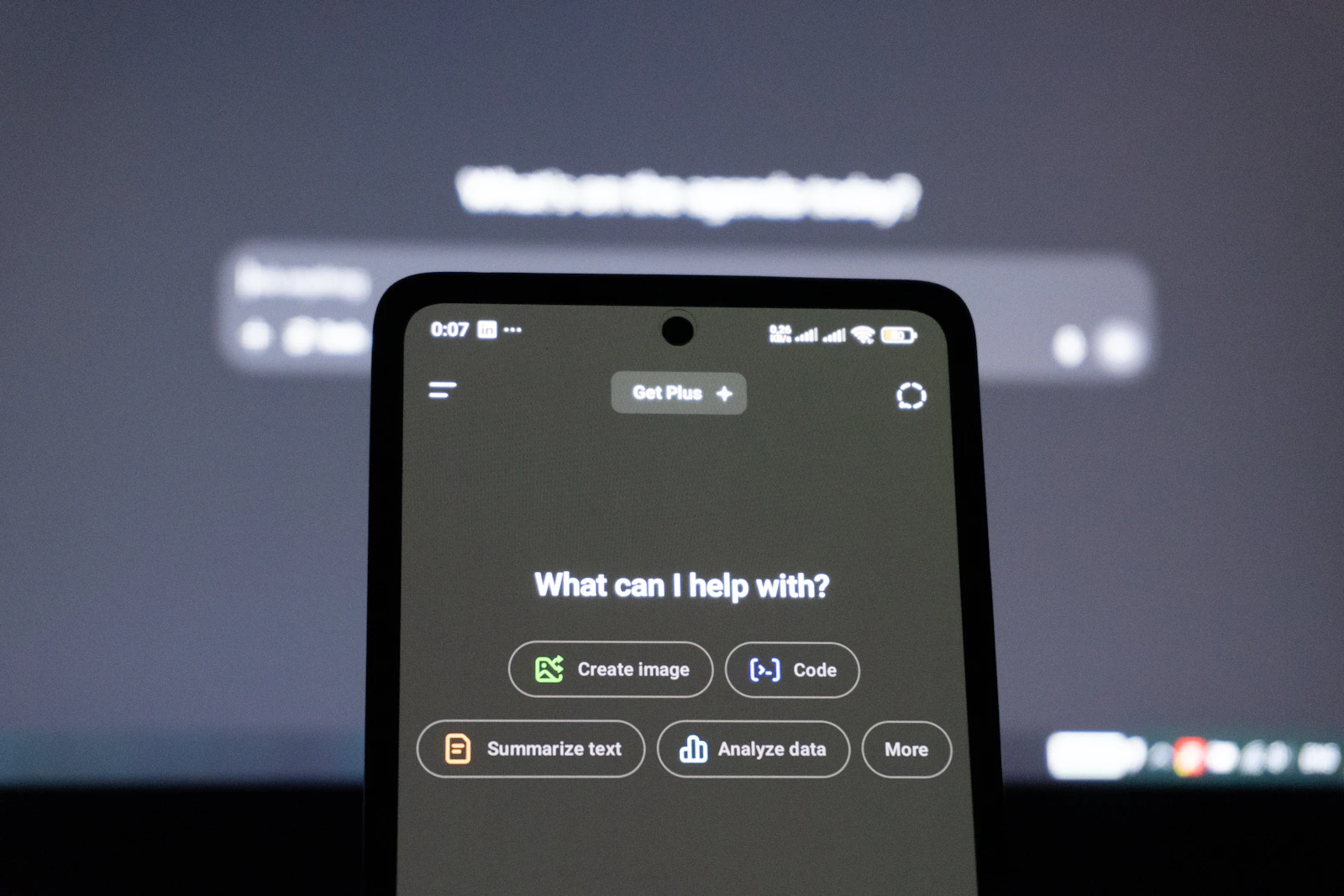
The new reality: users ask AI before Google
Something has quietly but profoundly changed in 2025 and 2026: millions of people no longer search on Google. Instead, they ask ChatGPT
, Gemini, Perplexity, or Claude directly. When a user asks, "What's the best SEO agency in Barcelona?" or "Which tool should I use to monitor my brand in AI?", the model's response might mention your brand… or it might not.
The question is no longer just, "Am I on the first page of Google?" but also: "Does ChatGPT recommend me?"
This transition from "searching" to "asking" represents a fundamental shift in consumer behaviour. According to Statista studies from 2025, over 40% of internet users in key markets like the US and Europe have used an AI chatbot to find information at least once a month. This figure is projected to exceed 60% by the end of 2026. For brands, optimisation for traditional search engines (SEO) must now be complemented by a new discipline: Generative Engine Optimisation (GEO).
At ZDS Digital, we have witnessed this change firsthand. Clients who previously relied exclusively on organic Google traffic are now asking us how they can ensure their brand is recommended by these new AI assistants. Visibility in these environments is not just a matter of volume but of trust and authority. If an AI model recommends your brand, the user perceives it as a high-level validation.
How LLMs decide which brands to mention
Language models like ChatGPT (GPT-4), Gemini, or Claude don't work like Google. They don't have a web page index to rank. They have been trained on billions of texts — and the brands that appear most frequently, in the most authoritative sources, and in the most relevant contexts, are the ones these models learn to recommend.
These models do not "browse" the web in real-time in the same way a traditional search engine does. Their knowledge is based on the data they were trained on (a "snapshot" of the internet up to a certain date, although more recent models have real-time browsing capabilities). Therefore, your brand's "digital footprint" within this training corpus is vital. This includes not only your website but also all external mentions, reviews, press articles, and publicly available structured data.
Key factors
- Presence in authoritative sources: If your brand appears on Wikipedia, in press articles, industry studies, professional directories, and reference publications, LLMs will associate it with authority. In our experience with B2B clients, a mention in a Gartner or Forrester report from 2025-2026 carries significantly more weight than dozens of mentions in niche blogs.
- Message consistency: If all sources say the same thing about your brand (what you do, what you're good at, what differentiates you), the model builds a clear representation and mentions it confidently. Any inconsistency can create ambiguity and make the model hesitate to recommend you. For example, if your company presents itself as a "leader in project management software" on your website, but in a directory it appears as a "general IT solutions provider," the model may struggle to categorise you accurately.
- Structured data: Schema.org helps AI crawlers (like ChatGPT Browse or Google AI Overviews) understand who you are, what you offer, and what your speciality is. Implementing Schema for your organisation, your products/services, and your reviews is fundamental. This provides models with a "technical data sheet" of your brand that they can process and cite directly.
- Recent reviews and mentions: Models with real-time search access (Perplexity, ChatGPT with browse) prioritise recent sources. A 2026 article weighs more than a 2020 one. Reviews on platforms like Trustpilot, Capterra, or Google My Business are pure gold, especially if they are recent and detailed. Models can cite snippets from these reviews to justify a recommendation.
- Topical authority: If your website demonstrates deep expertise in a specific topic (e.g., "AI Visibility" or "SEO for e-commerce"), models will associate you with that topic. This is built through comprehensive, well-researched, and constantly updated content that covers all aspects of a niche. Google's Helpful Content Update of 2023-2024 reinforced the importance of this approach, and LLMs value it even more.
- E-E-A-T (Experience, Expertise, Authoritativeness, Trustworthiness): Although it's a Google concept, LLMs also apply it de facto. Demonstrating real experience (detailed case studies, author profiles with credentials), expertise (deep and accurate content), authority (expert mentions, quality backlinks), and trustworthiness (clear policies, web security, positive reviews) is key.
Practical strategies to appear in ChatGPT
1. Build your Google Knowledge Panel
Google Knowledge Panels are a direct signal that an entity is recognised. If your company has a Knowledge Panel, LLMs are more likely to mention it. To achieve this: presence on Wikipedia (or Wikidata), a complete Google Business Profile, Schema Organisation, and press mentions. At ZDS, we have seen how obtaining a Knowledge Panel for a startup in Barcelona in 2025 boosted its visibility in AI responses, as the model was able to extract verified and concise information from a high-authority source.
Quick Win: Ensure your Google Business Profile is 100% complete and up-to-date, including opening hours, services, high-quality photos, and a detailed description. Encourage your customers to leave reviews. This not only helps with the Knowledge Panel but also with local AI.
2. Publish content that AIs can cite
LLMs prefer citable content: concrete data, proprietary statistics, clear definitions, structured lists. An article that says "organic traffic grew by 50.4%" is more citable than one that says "traffic significantly improved."
Think of your content as a set of information "nuggets" that an AI model can extract and use. Use tables, numbered lists, bold text for key concepts, and concise summaries. For example, instead of a long paragraph, you could use: "According to our 2026 study, the top 3 barriers to AI adoption in SMEs are: 1) Implementation cost (45%), 2) Lack of specialised talent (30%), 3) Privacy concerns (25%)." This is easily processable by an LLM.
3. Appear in sources that AI consults
Models with internet access consult: Reddit (especially for recommendations), Stack Overflow, industry forums, press articles, studies, and specialised directories. If your brand appears in these sources answering real questions, models will discover it.
Actively participating in relevant communities is key. Answer questions in forums, offer solutions on Stack Overflow, and if you are a B2B brand, look for specific directories in your sector (e.g., Capterra, G2, Clutch). Ensure your company profile on these sites is complete and well-optimised. Positive reviews on these platforms are an important trust factor for LLMs.
4. Optimise your website for AI crawlers
In addition to Googlebot, there are now specific AI crawlers: GPTBot (OpenAI), Google-Extended (Gemini), ClaudeBot (Anthropic). Ensure your robots.txt allows them access. You can also create an llms.txt file in your root directory that tells models which content is most relevant on your site.
The llms.txt file is a recent innovation, similar to sitemap.xml for search engines. It allows LLM developers to understand which parts of your site are most relevant to their models, or which content you prefer they NOT use for training. An example of use could be: Allow: /our-services/seo-for-ai/ or Disallow: /confidential-internal-data/. Consult OpenAI and Google documentation on how to effectively implement this in 2026.
Important consideration: Core Web Vitals and INP. Your website's speed and user experience (measured by metrics like Interaction to Next Paint – INP, which replaces FID as the main interactivity metric in 2024) are fundamental. A fast and accessible website helps AI crawlers process your content efficiently and reinforces the perception of a modern, trustworthy brand.
5. Monitor your AI Visibility
You cannot improve what you do not measure. Tools like ZDS's AI Visibility Tracker allow you to make automated queries to ChatGPT, Gemini, and Perplexity to see if your brand appears, how it is described, and how often compared to competitors.
This monitoring is critical. It allows you to identify if your efforts are bearing fruit, where there are information gaps, or if models are "misinterpreting" your brand. For example, if ChatGPT recommends you for a service you no longer offer, you can take steps to update the information in the sources it consults. At ZDS, we have developed a system that not only tracks mentions but also analyses the sentiment and accuracy of recommendations, providing actionable insights to our clients.
6. Develop a "Privacy-First" Content Strategy
With growing privacy concerns (GDPR, CCPA, etc.) and how LLMs use data, your content strategy must be "privacy-first." This means being transparent about how you collect and use data, and ensuring your content does not infringe on third-party privacy. LLMs, especially those with real-time web access, are being programmed to be more cautious with personally identifiable information (PII). Ensure your website complies with all current privacy regulations in 2026 and that your privacy policies are clear and accessible.
7. Optimisation for GA4 and AI attribution
The complete transition to Google Analytics 4 (GA4) in 2023-2024 has changed how we measure traffic and attribution. For AI visibility, configure GA4 to track the impact of AI mentions. While it's difficult to directly attribute a sale to a ChatGPT recommendation, you can monitor spikes in direct or brand traffic after "AI Visibility" campaigns, or segment users arriving from AI referral URLs if available. The key is to have a robust data infrastructure to correlate your GEO efforts with business performance.
What NOT to do
- AI content spam: Publishing hundreds of AI-generated articles without supervision does not improve your visibility — it can worsen it. AI models are increasingly sophisticated at detecting low-quality or repetitive content. Google, with its "Helpful Content" updates, already penalises such practices.
- Keyword stuffing for LLMs: Models do not work with keywords like Google. Repeating "best SEO agency Barcelona" 50 times will not make ChatGPT mention you. Focus on semantics, topical authority, and overall content quality.
- Buying mentions: LLMs detect artificial patterns. Mentions must be organic and in relevant contexts. Trying to "trick" models with paid links or mentions is not only ineffective in the long run but can lead to your brand being deprioritised or even "blacklisted" by the models.
- Ignoring context: Thinking that a mention is a mention, regardless of context. A negative mention or one in an irrelevant context can be more damaging than no mention at all.
The future: SEO + GEO = total visibility
SEO and GEO are complementary. Good SEO (quality content, authority, structured data) is the foundation that also drives AI visibility. But GEO adds a new strategic layer: understanding how models process and present information, and optimising for that specific context.
Companies that master both disciplines will have a competitive advantage that is hard to match. At ZDS Digital, our over a decade of experience in SEO, combined with our research and development in GEO since 2024, positions us to help brands navigate this new landscape. Integrating optimisation for traditional search engines with optimisation for generative engines is a strategic necessity for any business looking to maintain and expand its online visibility from 2026 and beyond.
Do you want to know if ChatGPT recommends your brand? Request a free AI Visibility analysis and we'll show you exactly how AI models talk about your company.
Case studies and success stories at ZDS Digital
At ZDS Digital, we have successfully applied these strategies for various clients. For a B2B software company in Barcelona, we implemented a content strategy based on structured data and the publication of proprietary market studies (2025). This not only improved their Google ranking for key terms but also led to ChatGPT and Perplexity starting to cite their statistics and recommend their software as one of the "best solutions for project management in SMEs" in their responses to relevant queries. The result was a 35% increase in brand referral traffic in the following six months, according to our GA4 analyses.
Another success story was with an e-commerce brand for sustainable products. By optimising their product descriptions with Schema.org and securing mentions in authoritative sustainability blogs (2025-2026), we noticed that Gemini began including their products in lists of "eco-friendly shopping options" when users asked for specific product recommendations. This not only generated qualified traffic but also reinforced the brand's perception as a leader in its sustainable niche.
Common mistakes to avoid in AI optimisation
- Relying solely on traditional SEO: Good SEO is the foundation, but it's not enough. LLMs interpret information differently.
- Not having a clear "digital identity": If your brand has multiple descriptions or contradictory messages on different platforms, AI will struggle to form a coherent picture.
- Ignoring reviews and online reputation: LLMs value user opinions. A poor reputation or lack of reviews can be a major obstacle.
- Not updating information: Models with real-time web access prioritise fresh information. Outdated content can lead to erroneous recommendations.
- Not participating in communities: AI "listens" to what is being said in forums, Reddit, and social media. Not participating means losing a valuable source of visibility and authority.
Visibility in the era of generative AI requires a holistic approach that combines SEO best practices with a deep understanding of how language models acquire, process, and present information. It is a challenge, but also an immense opportunity for brands willing to adapt and innovate.