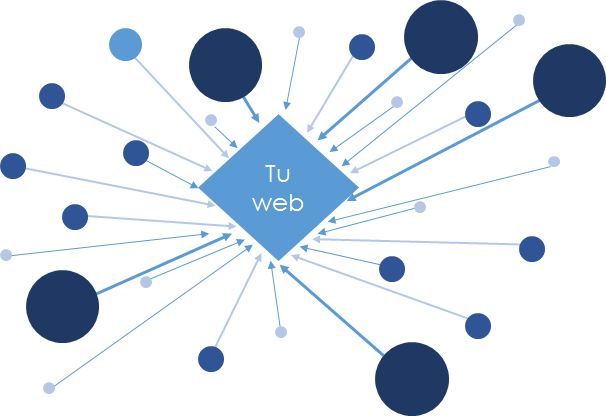
External links are a significant element in search engine optimisation. They contribute decisively to improving and strengthening our website's visibility and, consequently, our ranking in Google's search results. However, they can also have a detrimental effect if they are external links located on disreputable websites. Hence the importance of building a quality backlink network.
Since Google implemented its Penguin update in 2012, it has refined its ability to discriminate between quality links and poor-quality links that worsen the user experience. Penguin put an end to the indiscriminate insertion of external links that many online portals were guilty of. In fact, some websites, such as directories, whose sole purpose was to publish links to other pages, have long fallen out of favour for resorting to unnatural SEO practices, considered as spam. What was an emerging trend in the fight against spam in 2012, is now, in 2026, a consolidated and fundamental standard for any serious SEO strategy.
Organic Links or Natural Links
The external link par excellence in the eyes of the almighty Google is the organic link or natural link. This is a type of link that arises independently of us. Any link inserted on another website that points to our site is considered a natural link. The natural or organic link appears within content that, due to its theme, is related to our website; it is, therefore, a relevant link that provides added value to the user. These types of links are the ones we would all like to have pointing to our websites, especially if they are links inserted on sites with a high volume of traffic and constant activity on their social media.
The relevance of organic links has been accentuated with the latest Google updates, such as the «Helpful Content Update» of 2022-2024, which prioritises useful and original content. An organic link is a vote of confidence from one website to another, indicating that the linked content is valuable and pertinent to its own users. In our experience at ZDS Digital, sites that manage to attract high-quality organic links not only improve their ranking but also experience a significant increase in referral traffic, which often translates into higher conversion rates. For example, a 2024 Ahrefs study revealed that websites with a predominantly organic backlink profile are 70% more likely to rank in the top 3 on Google for competitive keywords.
Linkbuilding: What it is and What it's Used For
As quality external links are not always generated so easily, generally because our site has a reduced volume of traffic and is not well known, the solution is to resort to linkbuilding. Linkbuilding basically consists of locating websites that address similar or related topics to our site and commissioning them to write a quality article with a link pointing to one of our landing pages.
These types of quality links contribute greatly to improving the visibility of our website, as they are considered authoritative references, coming from sites that are well-regarded by Google. A solid backlink structure does not depend as much on the quantity, but on the quality of the links pointing to our site.
When looking for blogs and websites to commission a link from, it is important to follow a series of criteria. First, it must be a website that addresses topics related to our site, that regularly publishes articles, if it receives comments, has a careful design and structure, etc.
It should also receive a certain volume of traffic. If we get a link to a blog that barely has visitors, we will have wasted resources. A website that can be useful for obtaining an estimated figure about the traffic it receives is Similarweb.
It is also advisable to take a look at the website's social media. Not only is the size of the community decisive, but also its interaction with the posts that are published.
Finally, it is recommended to check the SEO visibility of the site in question. For this, one of the best professional tools currently on the market is Searchmetrics.
Key Criteria for Effective Linkbuilding in 2026
- Thematic and Semantic Relevance: Beyond the theme, Google, with its advanced semantic understanding (thanks to AI), values that the content of the link is contextually relevant. A link from a recipe blog to a car parts store, although both are «commerce», lacks semantic relevance. Tools like Surfer SEO or Semrush (Keyword Magic Tool) can help identify related thematic clusters.
- Domain Authority (DA/DR): While not an official Google metric, Moz's Domain Authority or Ahrefs' Domain Rating are still good indicators of a domain's overall strength. Aim for sites with a high and growing DA/DR. A 2025 Backlinko study showed that 90% of top-ranking pages have backlinks from sites with a DR higher than 70.
- Organic Traffic and Visibility: The volume of traffic is crucial. Not just the overall traffic, but the organic traffic received by the article or section where the link will be inserted. You can use tools like Semrush, Ahrefs, or Similarweb to estimate this traffic. A site with low organic traffic, even if it has a high DA, could indicate quality problems or penalties.
- Quality of Link Content: The article where your link is inserted must be high quality, well-researched, original, and provide value to the user. Google values «Helpful Content», and a link from poor content can be detrimental. At ZDS Digital, we always review content before accepting any link publication.
- Domain Link Profile: Analyse the backlinks of the linking domain. Does it have a natural link profile? Does it receive links from quality sites or link farms? A domain with a toxic link profile can transfer that toxicity to your site. Tools like Semrush's «Backlink Audit» or Google Search Console's «Disavow Tool» are essential for this.
- E-E-A-T (Experience, Expertise, Authoritativeness, Trustworthiness): With Google's latest guidelines, E-E-A-T is more important than ever. Look for sites that demonstrate these attributes. A link from a recognised industry expert will carry much more weight than one from an anonymous blog.
- Core Web Vitals and INP: Google penalises slow sites or those with a poor user experience. Make sure the site linking to you has good Core Web Vitals. The Interaction to Next Paint (INP) metric, which replaced FID in March 2024, is key to measuring interactivity. A site with poor INP might not be the best linkbuilding partner.
Common Mistakes in Linkbuilding Strategies
Although linkbuilding is a powerful strategy, it's easy to make mistakes that can be counterproductive:
- Prioritising Quantity over Quality: This is the biggest mistake and the one Google Penguin sought to eradicate. A single link from a high-authority and relevant site is worth more than hundreds of links from low-quality sites.
- Over-optimised Anchor Texts: Always using the exact same anchor text with your target keyword is a sign of manipulation for Google. Vary anchor texts, use variations, synonyms, branded links, and generic ones.
- Ignoring Link Context: A link embedded in a paragraph that has nothing to do with the topic is useless and even harmful. The link must flow naturally within the content.
- Buying Links in Bulk: Google explicitly disapproves of the mass purchase of unnatural links. While linkbuilding often involves an exchange of value (content, time, etc.), the indiscriminate purchase of «follow» links is a Black Hat practice.
- Not Diversifying Sources: Relying on a single type of link source (e.g., only guest blogs) can be risky. Seek diversity in domains, site types, and authority.
- Not Monitoring Backlinks: It is crucial to regularly audit your backlink profile. Links can disappear, or quality sites can turn into spam. Tools like Ahrefs, Semrush, or Majestic SEO allow you to track this.
Black-hat Links
There is a third group of external links that often falls within Black-hat SEO. Black-hat links generally come from the aforementioned directories, comments in forums that include links, or press releases with optimised anchor texts. We recommend avoiding this type of link, especially when it is very evident that its objective is commercial or promotional, and in general, they do not appear natural.
In 2026, Black Hat SEO practices are even riskier. Google's artificial intelligence is increasingly sophisticated at detecting unnatural patterns. Low-quality article directories, link farms, spam comments on blogs and forums, and private blog networks (PBNs) are clear examples of Black Hat tactics that can lead to severe penalties. A manual Google penalty can be devastating for a website's visibility, and recovering from it is a long and costly process. It is preferable to invest in ethical and sustainable linkbuilding strategies rather than shortcuts that compromise the reputation and future of your domain.
Link Earning: The Evolution of Linkbuilding
Beyond proactive linkbuilding, the concept of Link Earning has gained traction as the pinnacle of a healthy link strategy. It involves creating content so exceptional and valuable that other websites will want to link to it naturally, without being asked. This aligns perfectly with Google's «Helpful Content Update» philosophy.
Link Earning Strategies:
- Creation of Evergreen and Superior Quality Content: Original research articles, comprehensive guides, case studies, infographics, interactive tools, or unique data. This type of content becomes an information «hub» that others turn to and link to.
- Digital Public Relations (Digital PR): This involves creating interesting stories or unique data that may be of interest to media outlets, influential bloggers, or journalists. If your content is newsworthy, it will generate high-authority links.
- Own Data Studies: Publishing analyses based on internal data from your company or sector can position you as an authority and generate links from specialised media.
- Active Community Participation: Contributing to relevant forums (with value, not spam), participating in debates, or being cited as an expert in your field can lead to mentions and natural links.
- Content Marketing: A robust content marketing strategy, focused on solving your audience's doubts and needs, will increase the likelihood of your content being shared and linked to.
At ZDS Digital, we have seen how focusing on Link Earning, combined with strategic and ethical linkbuilding, produces sustainable long-term results, improving not only SEO but also overall brand authority. For example, by developing a comprehensive guide on «SEO for E-commerce in 2026», we managed to attract over 50 natural links from digital marketing blogs and universities in the first year.
The Impact of AI on Backlinks (2026)
The emergence of Artificial Intelligence in search (AI Search) with platforms like ChatGPT, Perplexity, or Google SGE (Search Generative Experience) is redefining how users find information. Although these platforms sometimes synthesise answers without directing the user to a specific source, backlinks remain crucial.
- Sources for Generative AI: AI responses are based on the most authoritative and reliable information available on the web. A strong and quality backlink profile is a key indicator of this authority. Sites with solid E-E-A-T and good backlinks will be the preferred «sources» for AI models.
- Content Discovery: For AI to «learn» from your content, it must first discover it. Backlinks remain a fundamental driver for the crawling and indexing of new pages by search engines.
- Direct Referral Traffic: Even if AI responds directly, there will always be users who want to delve deeper or verify the information. Direct links from these platforms (when sources are cited) or from traditional search results will continue to be a vital source of traffic.
- Trust Signals: In a world with a proliferation of AI-generated content, trust and authority signals become even more valuable. Backlinks from reputable sites act as a quality seal that AI and users value.
Privacy Considerations and GA4 in Backlink Analysis
With increasing privacy concerns (Privacy-first) and the full transition to Google Analytics 4 (GA4) in 2023, the analysis of backlink impact has evolved.
- Referral Traffic Analysis in GA4: GA4 offers a more granular view of referral traffic. You can set up custom explorations to see which backlink sources are generating more users, sessions, and, most importantly, conversions. Pay attention to traffic quality: do users from those links stay on your site, interact, or bounce quickly?
- Attribution Models: GA4 uses a data-driven attribution model by default, allowing for a better understanding of how backlinks contribute to the conversion path, even if they are not the last click.
- Impact on Local SEO: For businesses with a local component, backlinks from quality local directories, local media, and business associations are crucial. Ensure your NAP (Name, Address, Phone) information is consistent across all of them.
Ask Us…
Are you considering linkbuilding to improve your website's SEO visibility? We have extensive experience in building quality backlink structures. We would be delighted to advise you. Our team of experts can help you find the most suitable sites for your website's profile. Email us at [email protected] or call us directly on +34 935 329 378. You can also visit our SEO services page or read more insights on our blog to discover how we can boost your online presence.