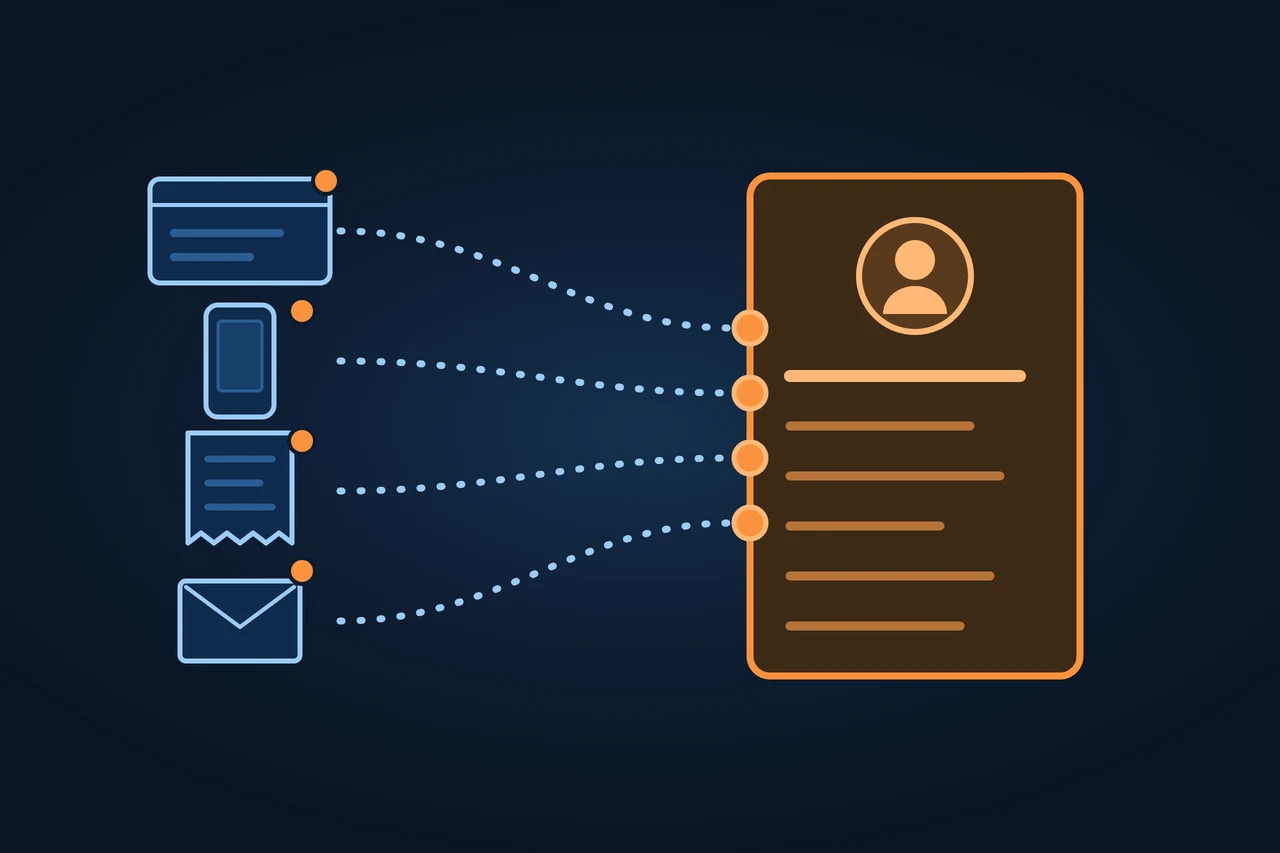
A customer data platform (CDP) is software that gathers customer data from a company's systems, links each piece to the right person and keeps a unified, persistent profile that other systems can use. That is how the CDP Institute defines it in its 2026 version. The same letters stand for CDP (Carbon Disclosure Project), an environmental reporting organisation with no link to marketing.
A CDP joins customer data from many sources into one profile per person and shares it with other systems. Origin, types and when you don't need one.
Origin of the term
David Raab of Raab Associates proposed the term in his Demand Gen Report column of 30 April 2013, where he saw "an entirely new category of system: the Customer Data Platform (CDP)". His definition had three parts: a customer-level database that links the identifiers of one person (email address, browser cookies, customer account), predictive models built almost automatically, and real-time answers to the systems that deal with customers. According to Raab, the CDP does not replace CRM or marketing automation and feeds them data and recommendations.
According to the CDP Institute, Raab named the category in a blog post in April 2013. Spanish and German have translations (plataforma de datos de clientes, Kundendatenplattform), but searches in both languages mostly use the English name.
History and development
Raab's version included predictive models and decisioning; the current definition centres on the profile. Dates according to the CDP Institute:
September 2013: Raab publishes the first industry report on CDPs, profiling eleven systems.
2016: the CDP Institute is founded, and CDPs appear on the Gartner Hype Cycle for the first time.
Since 2020: the Institute has expanded internationally and now has regional chapters, including one for Iberia.
2021: its definition speaks of "packaged software", bought and controlled by business users, as opposed to a data warehouse built by IT.
2025: the Institute becomes part of the Customer Data Alliance.
2026: the new definition drops "packaged" and names three architectures: own-store, warehouse-native (composable) and hybrid.
How it works
According to Gartner, a CDP must collect first-party customer data, online and offline, in real time or near real time. The flow has five steps:
Collection: web and app events, purchases, CRM and in-store data.
Identity resolution: deciding which identifiers belong to the same person.
Profile: each customer's history, kept in full detail for as long as the company chooses, according to the CDP Institute.
Segments: groups built by rules or by calculated values such as trends or model scores.
Activation: profiles and segments for other systems, through APIs, queries or file extracts, according to the Institute.
From many sources to one profile
Steps according to Gartner and the CDP Institute
Web
App
Purchases
CRM
In-store
Collection
Identity resolution
Which identifiers belong to the same person?
Profile
each customer's history
Segments
by rules or calculated values
Activation
for other systems
Orange: the step where two different people can end up in one profile.
Where do many identifiers become one person?
Gartner names two kinds of identity resolution, deterministic and probabilistic. Deterministic matching links records when an identifier matches; Adobe documents that its Identity Service creates a link when the identity namespace and the value both match. Probabilistic matching estimates a match from signals that carry no certainty, and it can merge two different people.
Deterministic matching fails too. Twilio Segment describes a shared iPad in a store: if several customers sign up on it, their events carry the same device ID and, without rules, end up in one profile. Segment also describes a hard-coded test value in the user_id field that reaches production and merges hundreds of profiles by mistake.
Types and variants
The CDP Institute sorts vendors into four types. Each type includes the functions of the one before.
Type
What it adds
Institute's note
Data CDP
Gathers data, links it to identities and makes it available to other systems
Minimum the definition requires; some began as tag management or web analytics tools
Analytics CDP
Segmentation and sometimes predictive modelling or attribution
Often automates sending data to other systems
Campaign CDP
Different treatments for individuals within a segment
Often orchestrates actions across channels
Delivery CDP
Message delivery by email, web, app, CRM or advertising
Many started as delivery systems
Source: CDP Institute, "What is a CDP?", section "Types of CDPs" (accessed 13.11.2026).
By architecture, an own-store (packaged) CDP keeps its own copy of the data; a composable CDP works on the company's data warehouse with components from several vendors; a hybrid does both. According to the CDP Institute, advocates argue that the composable approach avoids another copy of the data and gives more control; the Institute warns that most data warehouse technology handles real-time updates poorly, which may require copying the data.
Examples
In an example from Adobe's documentation, a person logs in to an online shop from a laptop, and the system receives their customer ID and the browser's ID. Later they log in from a phone and a second browser ID arrives. Because both events share the customer ID, the identity graph links all three.
An illustrative case: a UK retail chain with a website, an app and stores. A customer buys in the app with her email address and pays in a store with a loyalty card tied to the same address. The CDP joins both trails, and the chain can leave her out of acquisition campaigns, provided it has a lawful basis for that purpose.
Advantages and disadvantages
A CDP pays off when several of these conditions apply:
Customer data sits in several sources, such as the website, app, stores and CRM.
Customers buy or interact through more than one channel.
There is a reliable identifier, such as a customer ID or a verified email address.
A team defines the use cases and maintains the integrations.
With one source and one channel, a CRM with an email tool covers the need. The costs are integration work and the risk of merging different people; the composable variant, according to the CDP Institute, takes more engineering effort.
How it differs from related concepts
System
What data it holds
What it is for
CDP
Data from every source, mainly first-party data about identified people, in full detail
Unified profiles for other systems
CRM
Sales and service interactions, mostly from its own system
Day-to-day work of staff
DMP
Mostly anonymous segments, largely built on third-party data kept for limited periods
Advertising
Data warehouse
General-purpose data, managed by technical teams
Storage and analysis
Source: CDP Institute, "What is a CDP?", section "How a CDP Differs from CRM, DMP and Data Warehouses" (accessed 13.11.2026).
The difference from a DMP lies in the kind of data: first-party data about identified customers against anonymous third-party segments.
Tools
Products their makers describe as CDPs, in alphabetical order, without ranking.
Tool
Vendor
Architecture, according to the vendor
Adobe Real-Time CDP
Adobe
Own profile; activates warehouse data without copying it
Hightouch Composable CDP
Hightouch
Composable, on the data warehouse, without copying data
Salesforce Data 360 (formerly Data Cloud)
Salesforce
Own profiles; "Zero-Copy" integrations with warehouses such as Snowflake or BigQuery
SAP Customer Data Platform
SAP
Profiles of consumers and accounts, with a native ERP connection
Segment
Twilio
Own profiles; sends data to the data warehouse or other destinations
Tealium
Tealium
Data in Tealium, in the customer's warehouse, or both
Source: each vendor's product page (accessed 13.11.2026).
The CDP Institute keeps a directory of more than 240 vendors.
Criticism and limits
The reference definition comes from an institute that, according to its FAQ, is funded by CDP vendors and companies with related products. Its RealCDP certification is audited by an independent third party and paid for by the vendor.
The line between CDP and data warehouse keeps moving. Gartner writes that CDPs operate in alignment with enterprise data platforms, often using federated or zero-copy access. According to the CDP Institute, if the warehouse lacks many capabilities, a conventional CDP is often more effective.
In July 2026 Gartner Peer Insights summarised lessons from CDP users (minimum of 75 responses): document use cases, clarify pricing before deployment, cleanse data before migrating and roll out in phases.
Legal framework
In the EU, a CDP processes personal data under the GDPR: every processing purpose needs a lawful basis (Article 6), people may object at any time to direct marketing, including profiling (Article 21(2)), and when data is erased (Article 17), the controller must tell each recipient, unless that proves impossible or involves disproportionate effort (Article 19); in a CDP, those recipients are the connected systems. In the UK, regulation 6 of PECR, as substituted on 5 February 2026, restricts storing or accessing information on a user's device, subject to the exceptions in Schedule A1.
How to apply it, step by step
Write down the use cases before you look at vendors.
List your data sources and the identifier that links them.
Check the lawful basis and consent for each source and each purpose.
Choose the architecture based on the state of your data warehouse and your technical team.
Start with one use case and one or two sources.
Decide before launch how you will measure the result.
Best practices
Normalise identifiers before loading them, for example email addresses in lower case.
Block test or default values as identifiers, as Segment recommends.
Connect data erasure to every system that receives profiles.
Common mistakes
Buying the platform before defining the use cases.
Assuming every CDP treats identifiers the same way: according to their documentation, Adobe is case-sensitive and Segment is not.
Using probabilistic matching for purposes that need certainty about the person.
How this entry was made
This entry was written in November 2026 with the help of AI. The information comes from David Raab's 2013 column, the CDP Institute, Gartner, vendor documentation and product pages, and the legal texts. It was reviewed before publication and contains no client data.
Manuel Riveiro RodriguezCEO & Digital Strategist
A technical audit covers this and everything else in one pass.
In marketing, customer data platform. The same letters stand for CDP (Carbon Disclosure Project), an environmental reporting organisation.
What is the purpose of a CDP?
To join a customer's data from several systems into one profile and use it to segment, personalise and measure results per person.
What is the difference between a CDP and a CRM?
According to the CDP Institute, a CRM stores sales and service interactions for staff to work in; a CDP takes in every source and shares the profiles.
Do I need a CDP if I already have a CRM?
Not always. With one data source and one channel, a CRM with an email tool is enough; a CDP helps with several sources and channels and a shared identifier.
What is a composable CDP?
A CDP that builds profiles on the company's data warehouse, with components from several vendors, instead of keeping its own copy of the data.