
Skip to content

Glossary Customer Journey

What Is a Customer Journey?

  • PPC / Ads / CRO
Definition

A customer journey is the full set of touchpoints a person moves through, from first noticing a problem or need to buying a solution, and often afterward too, when they repurchase or recommend the brand.

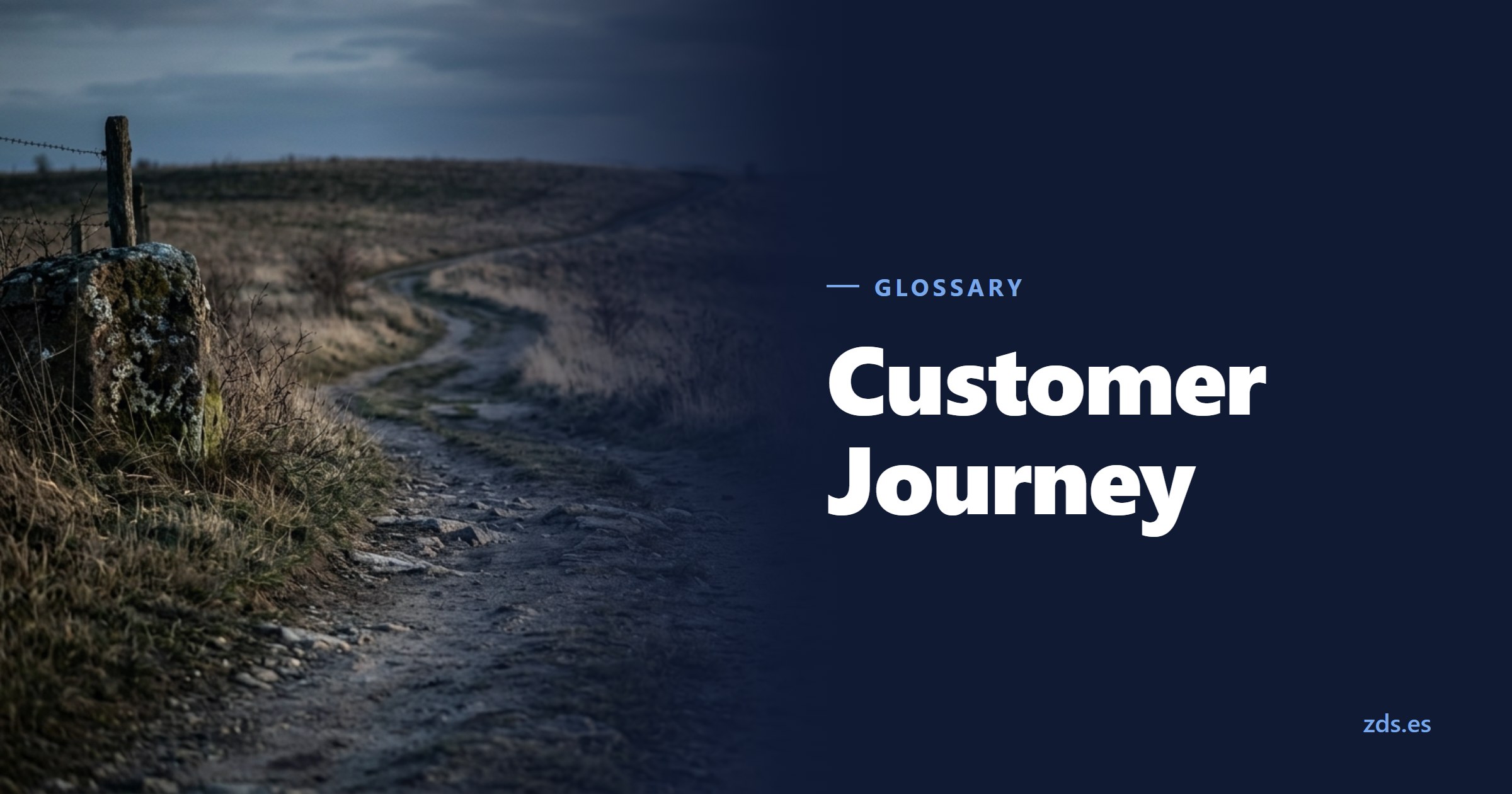
A dirt path that bends and disappears over a rise — beside the title Customer Journey
The path bends; the report draws it straight
On this page 6
  1. What is the customer journey?
  2. The stages of the customer journey
  3. How it works
  4. Why it matters
  5. Best practices
  6. Common mistakes
In brief

The classic phase model buyers move through, why the real path is rarely linear, and what gets lost when conversions are measured by last click alone.

A dirt path that bends and disappears over a rise — beside the title Customer Journey
The path bends; the report draws it straight

What is the customer journey?

A customer journey is the full path a person follows, from first noticing a problem or a want to deciding to buy, and often what happens after that purchase too. It covers every touchpoint with a brand: an ad glimpsed in passing, an article read on a phone, a review checked before deciding, a call to customer support.

The term is often confused with buyer persona, but it answers a different question. The persona describes who buys: their name, motivations, frustrations. The customer journey describes what path that person takes, which channels they cross, and in what order. A company might have two or three buyer personas and, for each one, a somewhat different journey, because not every buyer reaches a decision by the same route.

The concept builds on the idea of a target audience as a starting point, but it goes beyond a demographic segment: it maps the real experience, detours and doubts included, all the way to the purchase decision itself.

The stages of the customer journey

StageWhat the person doesTypical content and SEO angle
AwarenessNotices a problem or a need and searches for general informationBlog articles and guides; informational search intent
ConsiderationCompares options, reads reviews and comparisonsComparison pages and use cases; commercial search intent
DecisionPicks a specific option and moves to purchaseProduct pages and pricing pages; transactional search intent
RetentionUses the product, rates the experience, and may recommend itFAQ, email and cross-selling offers

Each stage calls for a different targeting approach: showing a cross-selling offer to someone who doesn't even know the product yet misses the point.

How it works

In practice, the journey rarely follows a funnel's clean order. Google's own research into purchase decision-making describes a messy middle phase where people bounce between exploring new options and evaluating ones they already know, jumping from organic search to social media, then to a brand email, then back to search, sometimes within minutes.

That multi-channel reality complicates measurement. Simpler attribution models, like last click, give a conversion's full credit to the channel a person used right before buying and ignore every earlier touchpoint. A blog post read during the awareness stage might have set up the decision weeks in advance, but if the person later returns through a brand search, that post gets no credit. Google Analytics offers data-driven attribution models to correct part of that distortion, though last click still applies as the default for several conversion metrics. This matters most for longer purchase cycles, where weeks can pass between first contact and purchase.

For a content strategy, that means each piece serves a distinct purpose depending on the stage it targets, even though how much any single piece contributed to the final conversion can't always be measured exactly. That's exactly why it pays to track intermediate signals too, like newsletter sign-ups or repeat visits, alongside the final conversion.

Why it matters

Understanding the customer journey keeps content from being written only for the immediate conversion. A page built for the decision stage needs different language than an awareness-stage article, and chasing only transactional keywords leaves the earlier stage orphaned, where most search traffic actually competes. Without that map, a team tends to write only product pages and skips the content that attracts traffic before any purchase intent exists.

The relationship with the buyer persona is direct: the persona defines who takes the journey, the customer journey defines which path they take. Without that second layer, the content team knows who it's talking to but not at what point in their decision that person stands.

In technical SEO, mapping the journey helps decide site architecture: which pages link to each other, which need a comparative approach and which a purely transactional one. It also clarifies which target audience deserves priority in each campaign, since not every segment enters the journey at the same point. That mapping also cuts paid campaign costs, since budget gets allocated to the actual stage each segment is in rather than a rough guess.

Best practices

  • Document the journey with real analytics data and customer interviews instead of internal assumptions.
  • Define specific content per stage: informational at awareness, comparative at consideration, transactional at decision.
  • Review the journey for each buyer persona separately, since not every segment follows the same route.
  • Use a data-driven attribution model instead of last click alone, to give early touchpoints fair credit.
  • Tailor cross-selling offers in the retention stage to actual purchase history, not a generic message.
  • Align each campaign's targeting with the journey stage it's meant to reach.

Common mistakes

  • Treating the journey as a straight line when most users jump between channels and circle back.
  • Measuring success by last click alone and ignoring the content that set up the decision.
  • Building one generic customer journey instead of one per relevant target audience.
  • Publishing only transactional content and neglecting the awareness stage, where most organic traffic originates.
  • Forgetting the stage after purchase, where retention and cross-selling opportunities play out.
Manuel Riveiro Rodriguez CEO & Digital Strategist

A technical audit covers this and everything else in one pass.

Request an audit

Frequently asked

How is the customer journey different from a conversion funnel?

A funnel simplifies the journey into single, linear steps moving top to bottom. The customer journey allows for back-and-forth: a person can move from consideration back to awareness before deciding, something a classic funnel doesn't capture because it assumes a single path with no backtracking.

How many stages does a customer journey have?

The most common model uses three or four: awareness, consideration, decision, and often retention after purchase. There's no fixed number: some companies add intermediate stages depending on how complex the product is or how long a purchase decision typically takes.

Why isn't last click enough to measure the customer journey?

Because it assigns a conversion's full credit to the last channel before purchase and ignores earlier touchpoints. An article read weeks earlier might have been decisive, but under a last-click model it gets no recognition for the eventual conversion it helped bring about.

Are customer journey and buyer persona the same thing?

No. The buyer persona describes who buys: motivations, context, frustrations. The customer journey describes what path that person takes toward a purchase, which channels they cross, and in what order. They work together but answer different questions within the same strategy.

How does the customer journey connect to SEO?

Each stage of the journey matches a different search intent: informational at awareness, commercial at consideration, transactional at decision. Aligning content and keywords with that intent keeps a site from chasing only purchase-ready searches and losing the traffic that arrives earlier.

Sources

  1. 27.08.2025 Nielsen Norman Group: Customer Journey Maps: When and How to Create Them: explains what a journey map is, how it's built stage by stage, and what it's used for in experience design
  2. Google Analytics: Get started with attribution: documents how last-click attribution models give a conversion's full credit to the final channel and ignore earlier touchpoints.
  3. Think with Google: Navigating purchase behavior and decision-making: describes the "messy middle" model, the non-linear middle phase where people toggle between exploring and evaluating options before buying. Published 2020.