
Skip to content

Glossary Target Audience

What Is a Target Audience?

  • PPC / Ads / CRO
Definition

A target audience is the group of people defined by demographic, psychographic, or behavioral criteria that a company directs a product, a campaign, or an advertising budget toward, because their profile signals a higher likelihood of buying.

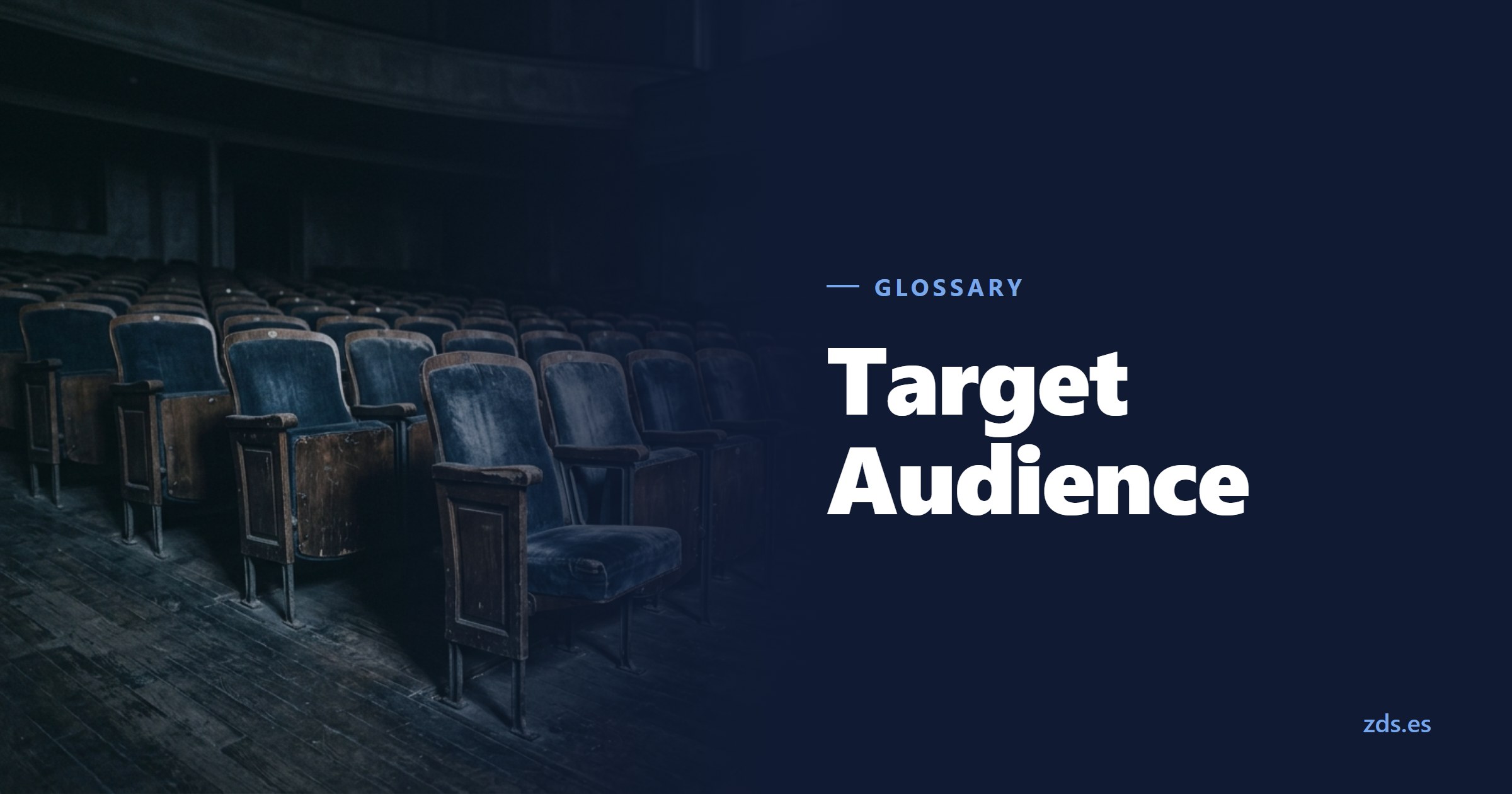
Rows of empty theatre seats seen from the stage — beside the title Target Audience
The seats are empty, yet you know whom you address
On this page 6
  1. What is a target audience?
  2. Target audience vs. buyer persona
  3. How to determine it
  4. Why it matters
  5. Best practices
  6. Common mistakes
In brief

What criteria define a target audience, how it differs from a buyer persona, and how to determine it with real data instead of guesswork.

Rows of empty theatre seats seen from the stage — beside the title Target Audience
The seats are empty, yet you know whom you address

What is a target audience?

A target audience is the group of people a company directs a product, an ad message, or a marketing budget toward, chosen because their profile signals a higher likelihood of buying or of showing real interest. Within the entire potential market, the brand prioritizes this specific segment with its resources instead of treating every visitor the same way.

The boundaries usually rest on three types of criteria that get combined with each other. Demographic data covers age, gender, income level, and location. Psychographic traits cover values, interests, and lifestyle. Observed behavior adds purchase history and actual use of the product or website. A running-shoe store, for instance, might combine buyer age with running frequency and interest in specific marathons.

The more precise the target audience, the more each euro spent on acquisition returns, because the message reaches someone who can actually turn it into a sale. A poorly defined audience, whether too broad or too narrow, explains a large share of campaigns with strong creative that still underperform. That's exactly why defining the target audience belongs at the start of any media plan, not as an afterthought tacked on later.

Target audience vs. buyer persona

ConceptWhat it isLevel of detail
Target audienceStatistical segment defined by demographic, psychographic, and behavioral criteriaA group, with no specific name or face
Buyer personaFictional individual profile built from the target audience's dataA specific character with a name, motivations, and objections

The target audience supplies the statistical base: how many people, within what age range, with what buying behavior. The buyer persona translates that data into a single character that helps marketing and sales write a specific message, rather than addressing an abstract percentage of the population.

How to determine it

The most reliable way to define a target audience combines market research with real behavioral data; the marketing team's gut feeling rarely holds up on its own. Surveys among existing customers, industry studies, and a look at what direct competitors already offer give the first rough sketch of the segment.

Analytics tools add the layer of actual behavior. A Google Analytics 4 dashboard shows the age, gender, and location of visitors to each page, plus the path they follow before buying. That path is part of the customer journey and helps identify the point where part of the audience drops off. CRM data rounds out the picture with the real purchase history of existing customers, not just self-reported profiles. Age data on its own rarely tells the full story, only pairing it with actual buying behavior makes the picture solid enough to act on.

All this collection of behavioral data requires the user's consent, required under the GDPR before any analytics cookie or third-party tracking pixel can run. Without that consent, a large share of the behavioral data a target audience definition relies on stays out of reach.

Once the target audience is defined with this data, targeting decides which channels carry the message and what technical segmentation delivers it. The target audience answers who to reach, targeting answers how to reach them in practice.

Why it matters

A well-defined target audience concentrates the marketing budget on the people most likely to actually buy, instead of spreading it across visitors who were never going to convert. That concentration lowers acquisition cost and lifts the conversion rate of every campaign.

The most common risk is miscalibrated breadth. An audience defined as "anyone who shops online" is so broad that no message really connects with anyone in particular, and the creative team ends up writing for an imaginary reader with no real traits. The opposite mistake, an audience defined too narrowly, rules out real potential customers simply because they don't fit a profile that's too rigid.

The target audience also sets the tone, channel, and format of the content. A campaign aimed at CFOs at industrial companies doesn't use the same language or the same channel as one aimed at individual fashion shoppers, even when the underlying product is similar.

Best practices

  • Combine demographic data with real purchase behavior, an audience defined only by age and location falls short.
  • Review the target audience every six to twelve months, the market shifts, and a two-year-old definition can miss the customers buying the most today.
  • Build a buyer persona from the target audience once the content team needs a specific profile to write for, not the other way around.
  • Cross-check the demographic data from Google Analytics 4 against the CRM before treating a survey-only definition as settled.
  • Document the target audience per project or campaign, a business with several product lines almost never has one single audience valid for all of them.
  • Check that targeting on each channel, Google Ads, Meta, LinkedIn, uses criteria consistent with the target audience definition rather than whichever is cheapest to activate.

Common mistakes

  • Defining the target audience as "anyone who might be interested," a description too broad to guide any real decision.
  • Copying a competitor's target audience without checking whether your own customer base actually resembles theirs.
  • Confusing target audience with buyer persona and treating the two terms as synonyms in a campaign brief.
  • Treating an old definition as still valid without checking whether buying behavior has shifted since then.
  • Launching targeting campaigns without verifying the consent needed to use the behavioral data the target audience definition relies on.
Manuel Riveiro Rodriguez CEO & Digital Strategist

A technical audit covers this and everything else in one pass.

Request an audit

Frequently asked

What's the difference between a target audience and a target market?

The target market is the business segment a company chooses to serve with its entire offering, defined by industry and need. The target audience narrows that market down to a group of people defined by age, behavior, and interests, the group that actually receives each campaign or ad message.

How many target audiences can one company have?

It depends on how many products or business lines the company runs. A company with a single product usually works with one or two well-defined target audiences. A company with several product lines or geographic markets needs a separate target audience for each, with its own data and its own message.

Can you define a target audience without analytics tools?

Yes, through customer surveys, interviews, and outside market research, though the result stays limited to what people report about themselves. Cross-checking that data against web analytics and CRM records gives a more reliable picture, because it adds real purchase behavior alongside stated opinion.

What happens when the target audience is poorly defined?

The marketing budget gets spread across people with a low real chance of buying, acquisition cost rises, and conversion rate falls. A poorly defined target audience also makes the creative team's job harder, since it ends up writing generic messages with no clear recipient in mind.

Is the target audience the same across every marketing channel?

The underlying target audience usually stays the same, but each channel needs to adjust how it reaches them. An audience defined for social media often needs finer interest-based segmentation than the same definition applied to a Google search campaign, even though both start from the same demographic and behavioral data.