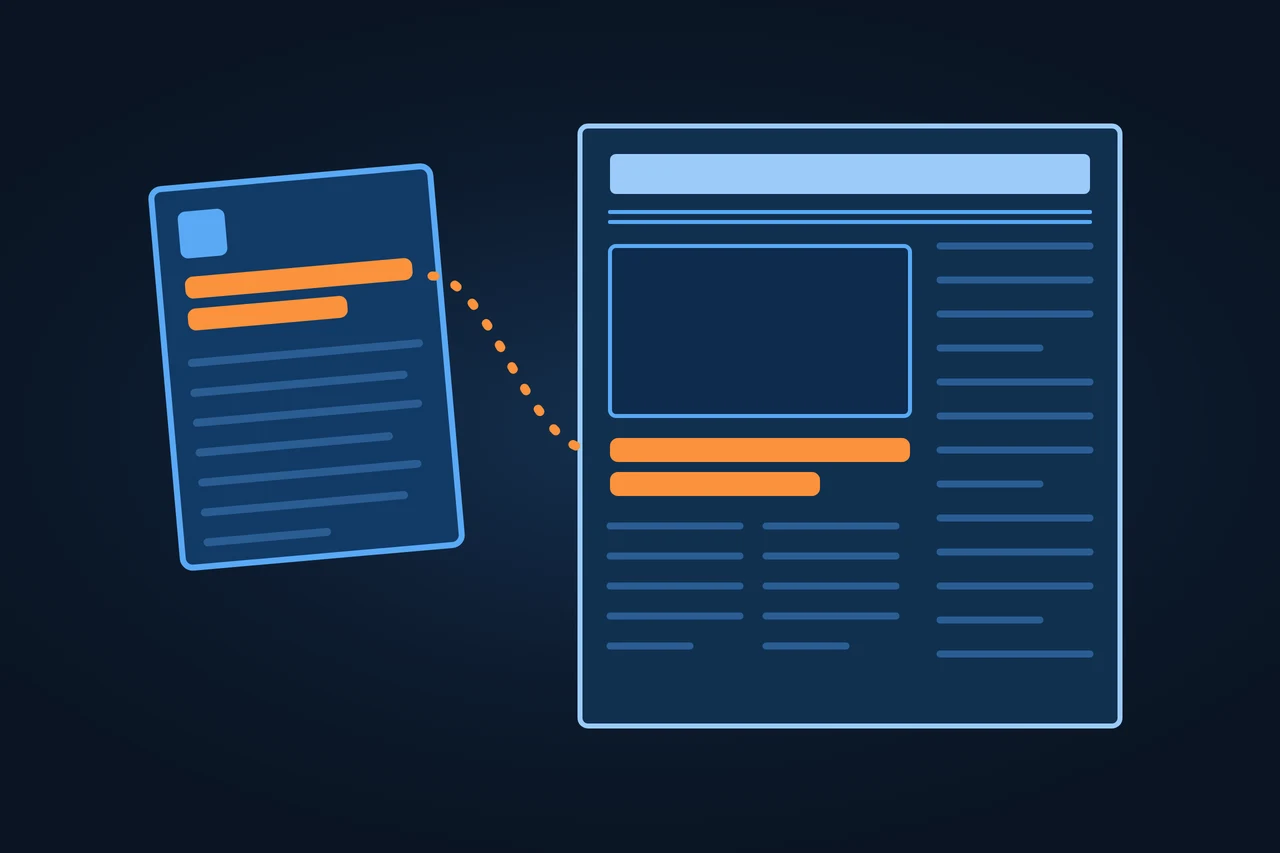
A press release is a text that a company, public body or organization sends to the media to announce news, so that it is published or used as the basis for a journalist's own report. It is written in the third person and in news style, with the most important facts first. It is also called a news release or media release; the Cambridge Dictionary defines it as a public statement given to the press to publish if they wish.
A press release is a text written for newsrooms. Format, origin, a real example broken down, embargoes, measurement, distribution and US and EU rules.
Origin of the term
Release here means handing something over for publication: the text is released to the press. Etymonline dates the phrase press release to at least 1918.
The best-known account of the format's origin begins with the Atlantic City train wreck in New Jersey on October 28, 1906, which killed 53 people according to the next day's papers. According to the Museum of Public Relations in New York, Ivy Lee, an adviser to the Pennsylvania Railroad, persuaded the company to give reporters its own statement, and The New York Times printed it unchanged on October 30, which is why it is often called the first modern press release. Associated Press reports carried by two South Carolina newspapers on October 31 tell it differently: the railroad's general manager, W. W. Atterbury, declined to make any statement until the investigation was complete.
History and development
1906. The Atlantic City wreck and the Pennsylvania Railroad statement credited to Ivy Lee.
1954. On March 8, according to the company, PR Newswire sends the first electronic corporate news release to 12 New York media outlets.
1961. On October 2, Lorry Lokey founds Business Wire in San Francisco, opening with 16 media outlets and seven clients.
1989. Carl-Eduard Meyer founds news aktuell, the German distribution service behind ots and Presseportal, which the German news agency dpa buys in 1994.
2006. Journalist Tom Foremski publishes "Die! Press release! Die! Die! Die!", calling for releases to be broken into tagged components, and SHIFT Communications, by its own account, starts on the social media press release around the same time.
2010. AMEC, the international association for communication measurement, adopts the Barcelona Principles, which reject advertising value equivalency as a measure. New versions follow in 2015 and 2020.
How it works
A press release is read from the top down, and each block has a job:
Embargo, if there is one: a line giving the date and time before which the release must not be published. Journalists get the news early and have time to prepare.
Headline: the news in one sentence, with the organization's name and a concrete fact.
Subhead or key points: two or three sentences or bullets for readers who stop there.
Dateline: the city and date at the start of the first paragraph.
Lead: the first paragraph answers who, what, when, where, why and how.
Body: the details, from most to least important, following the inverted pyramid. If an editor cuts from the bottom, the least important part goes.
Quote: one or two sentences from a named person with a title, ready to be used in quotation marks.
Boilerplate: a fixed closing paragraph on what the organization does.
Media contact: name, email and phone, plus a link to the press room with images.
End mark: US releases sometimes close with "###" or "-30-".
Listed companies may add a forward-looking statements section to limit liability for forecasts, as Pfizer and BioNTech do in the example below.
From the top down, from most to least important
Embargo, if there is onedate and time before which it must not be published
Headlinethe news in one sentence
Subhead or key pointsfor readers who stop there
●
Datelineat the start of the first paragraph
Leadwho, what, when, where, why and how
Bodyfrom most to least important: the inverted pyramid
Quotea named person with a title
Boilerplatea fixed paragraph on the organization
Media contactname, email, phone and press room
###
End marksometimes, in US releases
Which block is missing from your press releases today?
Types and variants
Type
When it is used
What sets it apart
Product launch
A new product or service
Price, availability and an image
Corporate news
Quarterly results, appointments, acquisitions
For listed companies, securities rules apply
Study or research
Own data or scientific results
Sample and method, so the newsroom can check
Media advisory
A press conference or event
Place, time and speakers; it does not tell the story
Crisis statement
Accident, failure, dispute
Speed and a single authorized voice
Material disclosure
Information that can move the share price
A legal duty with a deadline
Government release
Agencies, ministries, city halls
Spain's government has published its ministries' releases since 2006
Source: own compilation based on the examples in this entry.
Examples
A real example from the US: Apple's release of January 9, 2007 introducing the iPhone, still on Apple's newsroom.
Block
What Apple wrote
Headline
"Apple Reinvents the Phone with iPhone"
Dateline
MACWORLD SAN FRANCISCO and the date, January 9, 2007, set off by dashes
Lead
"Apple® today introduced iPhone, combining three products…"
Quote
"iPhone is a revolutionary and magical product…," said Steve Jobs, Apple's CEO
Price and availability
June 2007, at 499 and 599 dollars
Boilerplate
A closing paragraph about the company
Media contact
"Press Contacts", today the Apple Media Helpline
Source: Apple Newsroom, accessed 07.11.2026.
The contact block and boilerplate shown are those of the current newsroom page and may differ from the 2007 version. A second example with every block, including forward-looking statements and two boilerplates, is the joint release by Pfizer and BioNTech of November 9, 2020 on the first interim analysis of their COVID-19 vaccine, whose English version was filed with the SEC as an exhibit.
Template with no real company, for reuse:
Headline: Bakery chain opens first store in Austin, creating 12 jobs.
Dateline: AUSTIN, Texas, March 3, 2027.
Lead: The bakery chain opens its first store outside Dallas on Monday on Congress Avenue, with 12 employees hired locally.
Body: opening hours, investment, plans for more stores, where the flour comes from.
Quote: the CEO explains why the company chose Austin.
Boilerplate: year founded, number of stores and employees.
Media contact: name, email and phone; link to photos cleared for use.
How to measure it
Metric
Formula
Limit
Pickups per release
Stories that use the release / releases sent
Says nothing about tone or placement
Share of target outlets
Pickups in the chosen outlets / chosen outlets
Requires a list fixed in advance
Reach
Sum of the audiences of the outlets that ran it
Outlets' own figures, with overlaps counted twice
Brand searches and visits
Searches for the name and press room visits in the days after, against the week before
Other campaigns mix into the figure
Mentions in AI answers
AI assistant answers that cite the news or the brand / questions tested
Small sample, answers vary
Source: own compilation.
The metric no longer recommended is advertising value equivalency (AVE), which calculates what the same space would have cost as an ad. AMEC's Barcelona Principles have rejected it since 2010, and the 2020 version calls it a flawed measure. Instead they ask for the quality of coverage to be assessed, negative results included.
Advantages and disadvantages
Use case
Advantage
Disadvantage
Verdict
Real news for trade media
The journalist gets data and a quote ready to use
Competes with many other releases that day
Good fit
Local news
Local newsrooms are small and use nearby stories
Reach limited to the area
Good fit
Product news with no news value
Quick and cheap to send
Nobody runs it, and it uses up journalists' attention
Use another channel
Listed company
Meets the duty to inform the market
Timing and content are set by law
Required
Source: own assessment.
Whether journalists still use press releases has mainly been surveyed by companies in the industry. Cision, which sells distribution and media monitoring, asked more than 3,000 journalists in 19 markets in 2025, and 72% called the press release the most useful resource PR teams can offer. A 2018 survey of more than 500 journalists by Muck Rack and Zeno Group, reported by PR Daily, found that 53% in the US and 41% elsewhere did not use press releases to find new story ideas, and only 3% relied on them heavily.
How it differs from related concepts
Concept
What it is
Difference from a press release
Press kit
A pack with the release, images, company facts and bios
The release is one piece of it
Media advisory
Notice of a press conference or event
It invites; the release tells the news
Press conference
An event where the organization takes journalists' questions
Work with media and creators to earn mentions and links
The release is one of its tools
Advertorial
Paid content in article form
Paid for and labeled as advertising; a release is not paid placement
Form 8-K and Reg FD disclosure
Mandatory disclosure by a US public company
The law requires it and sets the timing
Source: own compilation.
Tools
Route
Examples
Note
Own press room
A page on the company website with releases, images and contacts
The archive anyone can find, including search engines and AI
Own media list
Email to selected contacts
Contact data falls under privacy law
Wire services
Business Wire and PR Newswire (US), news aktuell and Presseportal (Germany), APA-OTS (Austria), Europa Press Comunicados (Spain)
Publish and distribute on their own terms
Online distribution services
EIN Presswire, GlobeNewswire
Post the release on their site and distribute it
Media monitoring
Cision, Meltwater, Muck Rack
Track where the release ran
Source: the services' websites, accessed 07.11.2026; no ranking, countries in the order of this entry. Google's rule applies to every route: links with optimized anchor text in press releases distributed on other sites count as link spam.
Criticism and limits
Part of what the media publish comes from press releases with little change. For a study published in 2008, Justin Lewis, Andrew Williams and Bob Franklin analyzed 2,207 items from five British newspapers and 402 broadcast reports from two weeks in 2006 and found extensive reliance on PR material and agency copy.
In 2006 Tom Foremski wrote that press releases were nearly useless, created by committees and edited by lawyers. He proposed breaking the release into tagged components that each outlet could assemble itself.
For SEO, the press release is not a link source. Google counts links with optimized anchor text in press releases distributed on other sites as link spam, and asks for paid links to be marked rel="sponsored" or rel="nofollow". What a release can do is carry news that other outlets cover and link to on their own.
AI adds a further risk: a release is quick to draft, but a wrong figure or a quote nobody said reaches newsrooms just the same. The sender is responsible for what the release says.
Legal framework
In the US, Regulation FD requires a public company that discloses material nonpublic information to certain market professionals or shareholders to make it public simultaneously if the disclosure is intentional and promptly if it is not (17 CFR 243.100), by filing a Form 8-K or by another method reasonably designed to provide broad, non-exclusionary distribution (17 CFR 243.101(e)). In the EU, issuers must disclose inside information that directly concerns them as soon as possible (Article 17 of the Market Abuse Regulation (EU) 596/2014); since June 5, 2026, intermediate steps in a protracted process are exempt and only the final event must be disclosed (Regulation (EU) 2024/2809). Photos sent with a release are protected too: in the US, copyright in a photograph protects the photographer's artistic choices (Copyright Office Circular 42), so the sender needs the rights to every image it supplies.
How to apply it, step by step
Check that there is news: something new and concrete that the outlet's readers care about, not just your company.
Write the lead first, answering who, what, when, where, why and how.
Derive the headline from it, with a concrete fact.
Order the body from most to least important and leave out what adds nothing.
Add a quote with a name and title that says something the text does not already say.
Close with the boilerplate and the media contact.
Attach or link images you hold the rights to, with captions and credits.
Decide whether to set an embargo, and if you do, give the date, time and time zone.
Choose the recipients: your own list, a wire service or both, and post the release in your press room.
If you draft with AI, check every figure, name and quote yourself before sending.
Answer questions quickly, and follow up only where there is likely to be real interest.
With an embargo, the newsroom has the release before it may publish it
Your company
the release, with images you hold the rights to
Sending
your own lista wire serviceor both
and the release, posted in your press room
Newsrooms
receive the release and have time to prepare
Embargo, if you set onedate, time and time zone: it must not be published before then
Publication in the outlet
Who do you send your press releases to today?
Best practices
One story per release.
A headline under one line, without self-praise.
Figures with a source and date, so journalists can check them.
The release in the body of the email and on the website, not only as a PDF attachment.
A contact person who answers the same day.
Common mistakes
Sending a release without news, just to get the name out.
Burying the main fact in the third paragraph.
Filler quotes such as "we are very proud".
Sending to the whole list without checking what each journalist covers.
Stuffing the release with SEO links and optimized anchor text.
Attaching images without rights or credits.
How this entry was made
This entry was written in November 2026 with AI assistance. It started from an analysis of the top ten search results in Spain, the US and Germany, in order to add what they leave out: the origin with sources from 1906, a real release broken down, the difference from a press kit and a media advisory, measurement without advertising value equivalency, and the legal framework. The examples are releases published by the companies themselves. It was reviewed before publication and contains no client data.
Manuel Riveiro RodriguezCEO & Digital Strategist
A technical audit covers this and everything else in one pass.
Writing one and posting it in your own press room or emailing it to your own list costs nothing but time. Wire services and online distribution services charge for distribution on their own terms, which they publish. A paid service guarantees distribution, not coverage: whether a story runs is the newsroom's decision.
Why is -30- at the end of a press release?
It is an end mark, like ###: it tells the editor that the text ends there and nothing is missing. Some US releases still use it.
What are the different types of press releases?
The common ones are product launches, corporate news such as results or appointments, research findings, media advisories for events, crisis statements and mandatory disclosures by listed companies. Each has its own essentials, set out in the table above.
What is an embargoed press release?
One that journalists receive before it may be published, with a date and time until which they agree to wait. It is used for studies, results and launches so that reporters can prepare. The time should include the time zone.
Do press releases help with backlinks?
Not as a link tactic. Google treats links with optimized anchor text in distributed press releases as link spam. If the news is good and outlets write about it, the links they choose to add are the ones that count.