
Skip to content

Glossary outbound marketing

What Is Outbound Marketing?

  • Content Marketing
Definition

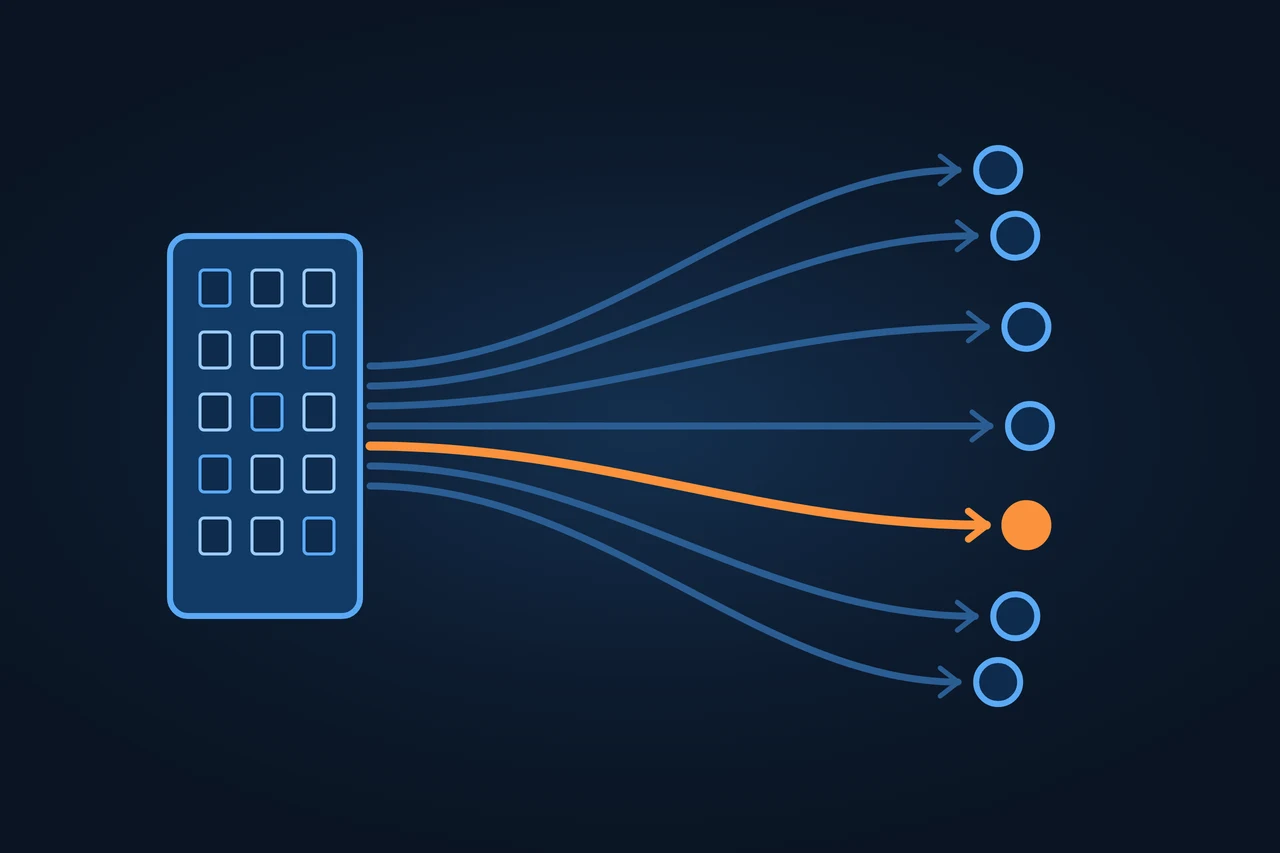
Outbound marketing is advertising and outreach that the company starts without the recipient having asked for it: media ads, direct mail, sales calls, cold email or direct messages. The company decides who it contacts and when. Its opposite is inbound marketing, where people come to the company on their own, for example through a search.

A building on the left with several lines leaving it, all going outward to points on the right; one line and its point are orange, on a dark blue ground.
On this page 15
  1. Origin of the term
  2. History and development
  3. How it works
  4. Types and variants
  5. Examples
  6. How to measure it
  7. Advantages and disadvantages
  8. How it differs from related concepts
  9. Tools
  10. Criticism and limits
  11. Legal framework
  12. How to apply it, step by step
  13. Best practices
  14. Common mistakes
  15. How this entry was made
In brief

Outbound marketing is contact the company starts. Origin, history, channels, real examples, metrics with formulas, tools and the law in the US and UK.

A building on the left with several lines leaving it, all going outward to points on the right; one line and its point are orange, on a dark blue ground.

Origin of the term

"Outbound" comes from telephone sales, which separated outgoing calls from incoming ones. The FTC's Telemarketing Sales Rule still defines an "outbound telephone call" as a call initiated by a telemarketer to induce the purchase of goods or services or to solicit a charitable contribution.

As the name for a way of doing marketing, the term spread as the counterpart of "inbound marketing". On 27 November 2007, HubSpot co-founder Brian Halligan published "Outbound vs. Inbound Marketing" on the company blog. He called trade shows, seminar series, email blasts to purchased lists, cold calling, outsourced telemarketing and advertising "outbound marketing", where a marketer pushes the message out far and wide and hopes it reaches the needle in the haystack. In the Internet Archive copy of HubSpot's homepage from 2 November 2007, "inbound marketing" doesn't appear. In the copy from 4 December it appears three times. Halligan and Dharmesh Shah's book Inbound Marketing, published in 2009, used the same pair of terms.

The idea is older. In Permission Marketing (1999), Seth Godin called advertising that interrupts what people are doing to get their attention "Interruption Marketing". "Push marketing" is used as a near synonym.

History and development

  • 1951. Ingvar Kamprad puts together the first IKEA catalogue: 68 pages in Swedish, 285,000 copies distributed in southern Sweden.
  • 2003. On 27 June the US National Do Not Call Registry opens, where consumers list their numbers to stop telemarketing calls at home.
  • 2007. Halligan sets "outbound" against "inbound" on the HubSpot blog (27 November), and in December "inbound marketing" reaches the company's homepage.
  • 2016. The IKEA catalogue peaks at 200 million copies in 69 versions, 32 languages and more than 50 markets.
  • 2018. On 25 May the EU's GDPR starts to apply, governing the data of every contact in the EU.
  • 2020. On 7 December IKEA announces that the 2021 catalogue will be the last in its familiar form, because media consumption and customer behaviour have changed.
  • 2023–2024. On 3 October 2023 Google announces new requirements for anyone sending more than 5,000 messages a day to Gmail addresses, enforced from February 2024.
  • 2026. From 17 October, companies covered by Spanish law may make sales calls only from numbers with the 400 prefix.

Two trends run through the list. Mass channels remain but lose ground to digital, as the catalogue did. And every direct channel, phone or email, keeps gaining rules on who may be contacted and how.

Which of these rules already apply to your campaigns?

How it works

An outbound campaign follows the same order, whether it's a TV campaign or an email sequence to forty companies:

  • Audience: who you want to reach. In consumer markets that's segmentation by age, region or habits. In B2B it's companies by industry, size and country, and the roles inside them.
  • Data or media: in mass media you buy space where that audience is. For direct outreach you build a list and check it against the suppression lists the law requires.
  • Message: why this person is getting this message, made clear in a few seconds.
  • Channel and timing: the channel, the frequency and, in B2B, a possible sequence of email, call, LinkedIn message and a second email a few days later.
  • Contact and follow-up: replies are sorted into interested, "not now", no, and unsubscribe.
  • Handover: anyone who shows interest goes into the CRM as an opportunity and reaches sales with everything known about them.

In mass media the steps are split between the brand, the creative agency and the media agency. In B2B outbound, an in-house sales team can do the contacting. When a company splits the work, the first conversation is held by a sales development representative (SDR) or business development representative (BDR), whose job is to book meetings. An account executive then closes the deal. Companies don't use the two titles the same way: in some, SDRs handle inbound leads and BDRs find new ones, in others both titles name the same job.

Where marketing ends and sales begins also varies. If the two sides don't agree on what counts as a qualified contact, sales gets names it can't use and marketing can't tell what worked.

At which step do you lose your contacts today?

Types and variants

Outbound is mainly told apart by channel.

ChannelTypical useStrengthLimit
TV, radio, print, out-of-homeBuilding awareness of a brand or launchBroad reach in a short timeMuch of the audience isn't the target; hard to attribute
Display and paid socialAds to audiences defined by dataFine targeting, click-based measurementBanner blindness and ad blockers
Direct mailCatalogues, coupons, letters to customers or businessesA physical object that stays aroundCost per piece and mailing list
Cold callingFirst conversation in B2B, booking meetingsImmediate responseRejection and strict rules
Cold emailB2B sequences to specific rolesLow cost per contactSpam filters and each country's law
Trade shows and eventsMany buyers from one industry at onceFace-to-face conversationCost of stand, travel and time
LinkedIn direct messageDecision makers at chosen companiesThe sender's profile is visiblePlatform limits; templates show

Source: own compilation based on the channels Halligan lists (HubSpot, 2007) and the sources of this entry.

Search ads are a borderline case. They're paid, but they only appear when someone searches, so they respond to demand, and some authors count them as outbound while others count them as inbound. Trade shows are similar: the company pays to be there, but visitors choose to come. By audience, people distinguish mass outbound through media from targeted outbound, which picks companies or people one by one and comes close to account-based marketing.

Examples

US Marketing Mail (fiscal 2025). The US Postal Service delivered 56,756 million pieces of Marketing Mail in fiscal year 2025, against 57,520 million the year before, for revenue of $15,734 million. Advertising mail is still a mass channel, with volume edging down.

The IKEA catalogue (1951–2020). For 70 years IKEA sent households a catalogue nobody had asked for, the classic case of outbound by mail. In 2016 the print run reached 200 million. In December 2020 IKEA announced its end, citing changes in media consumption, and pointed in the same release to growth in online sales.

MWC Barcelona (2026). The Mobile World Congress drew nearly 105,000 attendees from 207 countries and territories and around 2,900 exhibitors, sponsors and partners in March 2026, according to the organiser, the GSMA. For a B2B exhibitor, a show like this brings buyers from a whole industry together in a few days. The exhibitor pays to be present and goes looking for conversations, even though the visit itself is voluntary.

How to measure it

The metrics follow the funnel: how many messages arrive, how many get a reply, how many turn into a meeting and how many into a customer.

MetricFormulaWhat it's for
Delivery rateMessages delivered / messages sentSpotting lists and domains with problems
Reply rateReplies / contacts reachedChecking that message and audience fit
Meetings per 100 contactsMeetings / contacts × 100Comparing channels and teams on one scale
Funnel conversionLeads / contacts; opportunities / leads; customers / opportunitiesSeeing where people drop out
Cost per leadCampaign cost / leadsComparing with other acquisition channels
Customer acquisition costMarketing and sales cost / new customersChecking that a customer pays back what it cost
Unsubscribe and complaint rateUnsubscribes or complaints / messages deliveredWatching the sender's reputation

Source: own compilation; see also customer acquisition cost.

Open rates mislead, because some email clients load images automatically and an "opened" email may not have been read. What counts is replies, including the negative ones and unsubscribes, which are worth counting separately.

With TV, radio or out-of-home there's no click linking the ad to the sale. One proxy is to compare branded searches and direct visits in regions with the campaign against regions without it. In 2011 Google described such a method for its search ads (Vaver and Koehler): non-overlapping regions are split into a group with the campaign and one without. The same logic sits behind an incrementality test. Without a control group, sales that would have happened anyway get credited to the campaign.

Advantages and disadvantages

What outbound delivers depends on the situation, so the table sorts pros and cons by use case.

CaseAdvantageDisadvantageAssessment
B2B niche with few possible customersEvery company in the market can be approached by nameEach contact costs a person's timeGood fit, especially targeted
New product nobody searches for yetReaches people who don't know the solution existsYou explain the problem before the productWithout searches, inbound has little to catch
Mass consumer marketFast reach through mediaMuch of the audience isn't the target; hard to attributeGood for awareness, weaker for direct sales
Local businessLeaflets, local radio or posters cover the exact areaSmall budgets rarely buy enough repetitionDepends on choosing area and frequency well

Source: own compilation.

Two points hold in every case. The company sets the pace, deciding when to start and whom to reach without waiting for anyone to search. And it pays for every campaign: when spending stops, the flow of contacts stops too, while a well-ranked article keeps bringing visitors.

How it differs from related concepts

ConceptWho starts the contactGoalDifference from outbound
Inbound marketingThe person, who searches or finds contentWinning people who are already interestedIts opposite; the full comparison is in that entry
Account-based marketingThe company, at chosen accountsWinning specific accountsTargeted outbound, which can be combined with inbound content
Lead generationEither sideGetting contact details from interested peopleThe goal; outbound is one way there
Email marketingThe company, to subscribersKeeping the relationship and sellingWith prior sign-up it isn't cold outreach
Push and pull marketingPush: the company; pull: the customerTaking the product to the customer or drawing them inPush is close to a synonym for outbound

Source: own compilation based on the linked entries.

Email is where the line blurs. The same channel is outbound when you write to someone who asked for nothing, and email marketing when the recipient has subscribed. Permission separates the two, which is why the law treats them differently.

Tools

Outbound tools cover four jobs: finding contact data, sending sequences, calling, and checking that email arrives. Within each job they're listed alphabetically. The list isn't complete and isn't a recommendation.

JobExamplesFunction
B2B contact dataApollo, Cognism, LushaCompany and contact data, filterable by industry and role
Sequences and follow-upHubSpot Sales Hub, lemlist, OutreachEmail and tasks across channels, connected to the CRM
Prospecting on LinkedInLinkedIn Sales NavigatorSearching for buyers and accounts inside LinkedIn
Sales telephonyAircall, RingoverCloud phone system integrated with the CRM
DeliverabilityGoogle Postmaster ToolsSpam rate, reputation, authentication and delivery errors at Gmail

Source: manufacturers' pages, accessed 6 November 2026.

Before using a contact database in Europe or the UK, ask the provider where the data comes from and on what legal basis it's processed: a name and a work email address are still personal data. The CRM sits at the centre: it records who got what, who replied and who asked not to be contacted again.

Criticism and limits

Wasted reach. In mass media much of the audience isn't in the target group, and you pay to reach them too.

Banner blindness. People learn not to look where they expect ads. In a 2018 eyetracking study, Nielsen Norman Group saw 26 participants read a page's text and barely look at the ads in the top banner and right rail. One user made 148 fixations on a page and only one landed in the right rail, 0.8% of her attention in the content area, although the rail took up 25% of that area.

Mailbox filters. Gmail requires every sender to set up SPF or DKIM and keep the spam rate below 0.3%. Anyone sending more than 5,000 messages a day needs SPF and DKIM together, plus DMARC and one-click unsubscribe in marketing messages. A badly configured send can miss the inbox even when it's legal.

Rejection. On 30 September 2025 the US Do Not Call Registry held 258.5 million active numbers, and the FTC received 2.6 million complaints that fiscal year, which it notes are unverified. In Germany, the Bundesnetzagentur received 39,842 written complaints about unauthorised telephone advertising in 2025, 6% more than in 2024, and imposed fines of more than €1.099 million. These figures concern unwanted or illegal calls, not compliant outbound, but they describe the mood any sales call lands in.

Measurement. Without a control group, outbound gets credit for sales that would have come anyway, and with media that has no click the link between ad and sale stays indirect.

How to apply it, step by step

  • Define the audience with checkable criteria: industry, size, country and role, or region and profile in consumer markets.
  • Check what the law allows for each channel and destination country before building the list.
  • Build the list from data of known origin and screen it against the Do Not Call Registry and other suppression lists.
  • Write a message that says in the first sentence who is writing and why to this person.
  • Set up SPF, DKIM and DMARC on the sending domain and add it to Postmaster Tools.
  • Plan the sequence: channels, number of touches and days between them.
  • Hold back a comparable group you don't contact, so you can measure the real effect.
  • Log every reply and unsubscribe in the CRM and pass interested contacts to sales.
  • After two weeks, review meetings, unsubscribes and complaints, and adjust message or audience.

Best practices

  • Start with a few well-chosen accounts before widening the list.
  • Send cold email from a separate domain or subdomain and watch its reputation.
  • Personalise with a real fact about the company or role, not only the first name in the subject line.
  • Offer an easy opt-out and act on it at once.
  • Agree with sales on what counts as a qualified contact.
  • Count complaints and unsubscribes next to meetings and sales.

Common mistakes

  • Using a US cold email template unchanged in Germany or Spain.
  • Assuming work email addresses are outside the law everywhere.
  • Calling consumers without scrubbing the list against the Do Not Call Registry.
  • Buying a list without knowing where the data came from.
  • Measuring opens or dials instead of meetings and sales.
  • Sending thousands of emails from the main domain without authentication or warm-up.
  • Crediting the campaign with sales that would have come anyway.

How this entry was made

This entry was written in November 2026 with AI assistance. It started from an analysis of the top ten search results in the US, Spain and Germany, to add what they leave out: a dated origin of the term, its development, metrics with formulas, tools and the legal framework. The HubSpot dates come from Internet Archive copies of its blog and homepage. It was reviewed before publication and contains no client data.

Manuel Riveiro Rodriguez CEO & Digital Strategist

A technical audit covers this and everything else in one pass.

Request an audit

Frequently asked

What are outbound campaigns?

An outbound campaign is a planned series of contacts that the company starts: a TV or radio flight, a direct mail drop, or a sequence of calls, emails and LinkedIn messages to chosen companies. It has a defined audience, message, channel and time frame. Its success shows in meetings and sales compared with a group that wasn't contacted, not in the number of messages sent.

What are the differences between inbound and outbound marketing?

In outbound, the company decides whom to contact and when. In inbound, people arrive on their own because they're already looking for a solution, and the company makes sure it's found. The differences in cost, speed and measurement follow from that. The full comparison is in the inbound marketing entry, and the two approaches can be combined.

What are examples of outbound marketing?

Examples are TV, radio, print and out-of-home ads, display and paid social, direct mail, cold calls, cold emails, trade show stands and LinkedIn messages. A long-running case is the IKEA catalogue, sent to households for 70 years and printed in 200 million copies in its peak year, 2016.

What tools are used for outbound marketing?

Outbound teams combine tools for four jobs. Contact databases such as Apollo, Cognism or Lusha supply company and contact data, sequencing tools such as HubSpot Sales Hub, lemlist or Outreach send and track the touches, and cloud phone systems handle calls. Google Postmaster Tools shows whether Gmail treats the sending domain as spam. All of it feeds the CRM.

What does an outbound marketing specialist do?

An outbound specialist plans and runs contacts the company starts. That means defining the audience, building or buying lists within the law, writing messages and sequences, setting up tools and email authentication, and measuring meetings and pipeline. In B2B the role can overlap with sales development, where SDRs and BDRs book meetings for account executives.

Is B2B cold calling legal?

In the US, the FTC's Telemarketing Sales Rule exempts calls between a telemarketer and a business, although its bans on misrepresentation still apply and calls selling nondurable office or cleaning supplies aren't exempt. The Do Not Call Registry was set up for calls to consumers at home. In the UK, PECR regulation 21 bars sales calls to subscribers who have told the caller not to call or whose number is on the register, which corporate subscribers can also join. In Germany, calls to businesses need at least presumed consent.

Sources

  1. 16 CFR § 310.2, definitions of the FTC Telemarketing Sales Rule. Source of the definition of "outbound telephone call".
  2. Brian Halligan, "Outbound vs. Inbound Marketing", HubSpot blog, 27 November 2007, Internet Archive copy. Source of the use of the term and the list of methods.
  3. HubSpot homepage, copy of 2 November 2007. No "inbound marketing".
  4. HubSpot homepage, copy of 4 December 2007. "Inbound marketing" appears three times.
  5. CXL, "Brand-Owned Terms", 17 January 2019. Source of Halligan and Shah's 2009 book and of the telemarketing origin of the terms.
  6. Seth Godin, first chapter of Permission Marketing (1999) on his blog. Source of "Interruption Marketing".
  7. IKEA, press release of 7 December 2020. Source of 1951, 2016 and the end of the catalogue.
  8. FTC, press release of 27 June 2003. Source of the opening of the Do Not Call Registry.
  9. European Commission, legal framework of EU data protection. Source of 25 May 2018.
  10. Google, announcement of 3 October 2023. Source of the 5,000 messages and February 2024.
  11. Google, Gmail email sender guidelines. Source of SPF or DKIM, 0.3%, DMARC and one-click unsubscribe.
  12. Google, set up Postmaster Tools. Source of what the dashboards show.
  13. GSMA, MWC26 closing press release, 6 March 2026. Source of the 105,000 attendees, 207 countries and 2,900 exhibitors.
  14. USPS, fiscal year 2025 results, 14 November 2025. Source of Marketing Mail volume and revenue.
  15. Jon Vaver and Jim Koehler, "Measuring Ad Effectiveness Using Geo Experiments", Google, 2011. Source of the method with regions with and without a campaign.
  16. Nielsen Norman Group, "Banner Blindness Revisited", 22 April 2018. Source of the 26 participants, the 148 fixations and 0.8%.
  17. Bundesnetzagentur, press release of 26 January 2026 (in German). Source of the 39,842 complaints, 6% and €1.099 million.
  18. FTC, press release of December 2025. Source of the 258.5 million numbers.
  19. FTC, Do Not Call Registry Data Book 2025. Source of the 31 days, automated calls, the 2.6 million complaints and the note that they're unverified.
  20. Ley 34/2002 (LSSI), article 21 (in Spanish).
  21. Spanish digital ministry, press release of 16 October 2026 (in Spanish). Source of 17 October and the 400 prefix.
  22. UWG, section 7 (in German).
  23. FTC, CAN-SPAM Act: A Compliance Guide for Business. Source of the requirements, 10 business days and $53,088.
  24. Apollo, manufacturer page.
  25. Cognism, manufacturer page.
  26. Lusha, manufacturer page.
  27. HubSpot Sales Hub, manufacturer page.
  28. lemlist, manufacturer page.
  29. Outreach, manufacturer page.
  30. LinkedIn Sales Navigator, manufacturer page.
  31. Aircall, manufacturer page.
  32. Ringover, manufacturer page (in Spanish).
  33. 16 CFR § 310.6(b)(7), exemption for business-to-business calls in the Telemarketing Sales Rule.
  34. PECR, regulation 21, unsolicited calls for direct marketing.
  35. PECR, regulation 26, the register of numbers, including corporate subscribers.
  36. Privacy and Electronic Communications (EC Directive) Regulations 2003, regulation 22. Source of the UK rule for marketing email.