Product information management (PIM) is the software in which a company collects the data on its products, completes it and publishes it to every channel: the online store, marketplaces, shopping feeds, print catalogs and resellers. Each product has a single record in the PIM, and each channel takes what it needs from there. The same acronym also stands for Privileged Identity Management, the IT security practice of managing privileged access (Microsoft Entra ID has a service of that name), and for personal information managers such as calendar and contact apps.
A PIM system holds product data and sends it to the store, marketplaces and feeds. How it works, GTIN, classification, PIM vs ERP, DAM and MDM, tools.
Origin of the term
It is not known who first used the term. The oldest analyst definition on record is Gartner's from December 2005: a PIM creates a single view of the product for the whole enterprise, stores master data and product attributes, and can act either as the system where the data is created or as the system other applications look it up in. Gartner described PIM as the key technology that had emerged for managing product content and data, so the term was already in circulation.
The website of an early vendor shows how the name replaced an older one. Heiler Software, founded in Stuttgart in 1987, described itself in 2003 as a supplier of electronic catalog management solutions for SAP environments. By 2008 its page title read Product Information Management, Catalog Management and E-procurement. What had been catalog management was now PIM.
History and development
1987. Heiler Software is founded in Stuttgart, one of the first catalog software vendors.
1998 and 1999. Fraunhofer IAO and the University of Essen publish BMEcat 1.01, a format for exchanging product data and catalogs between businesses. Version 1.2 is developed with BME, the German purchasing association. The current version is BMEcat 2005.2.
2000. The ECLASS association is founded in Cologne to maintain a product classification that follows ISO/IEC standards. Contentserv starts in Germany the same year.
2005. On December 30, Gartner publishes its first Magic Quadrant for PIM and finds no clear leader.
2007. In June the second Magic Quadrant puts software revenue at about 214 million dollars in 2005 and over 300 million in 2006.
2013. Akeneo is founded in Nantes. On June 5, SAP announces it will buy hybris, and Informatica reports that it owns all of Heiler.
2024. The EU adopts the Ecodesign Regulation (EU) 2024/1781, which creates the digital product passport. In December the General Product Safety Regulation (EU) 2023/988 starts to apply, with fixed information requirements for online offers.
2025. In February Centric Software, part of Dassault Systèmes, acquires Contentserv. In November Salesforce completes its acquisition of Informatica.
2026. On October 12, Gartner publishes a Magic Quadrant for PIM solutions with 16 vendors. Syndigo, one of them, calls it the inaugural edition, although Gartner had published PIM Magic Quadrants in 2005 and 2007.
How it works
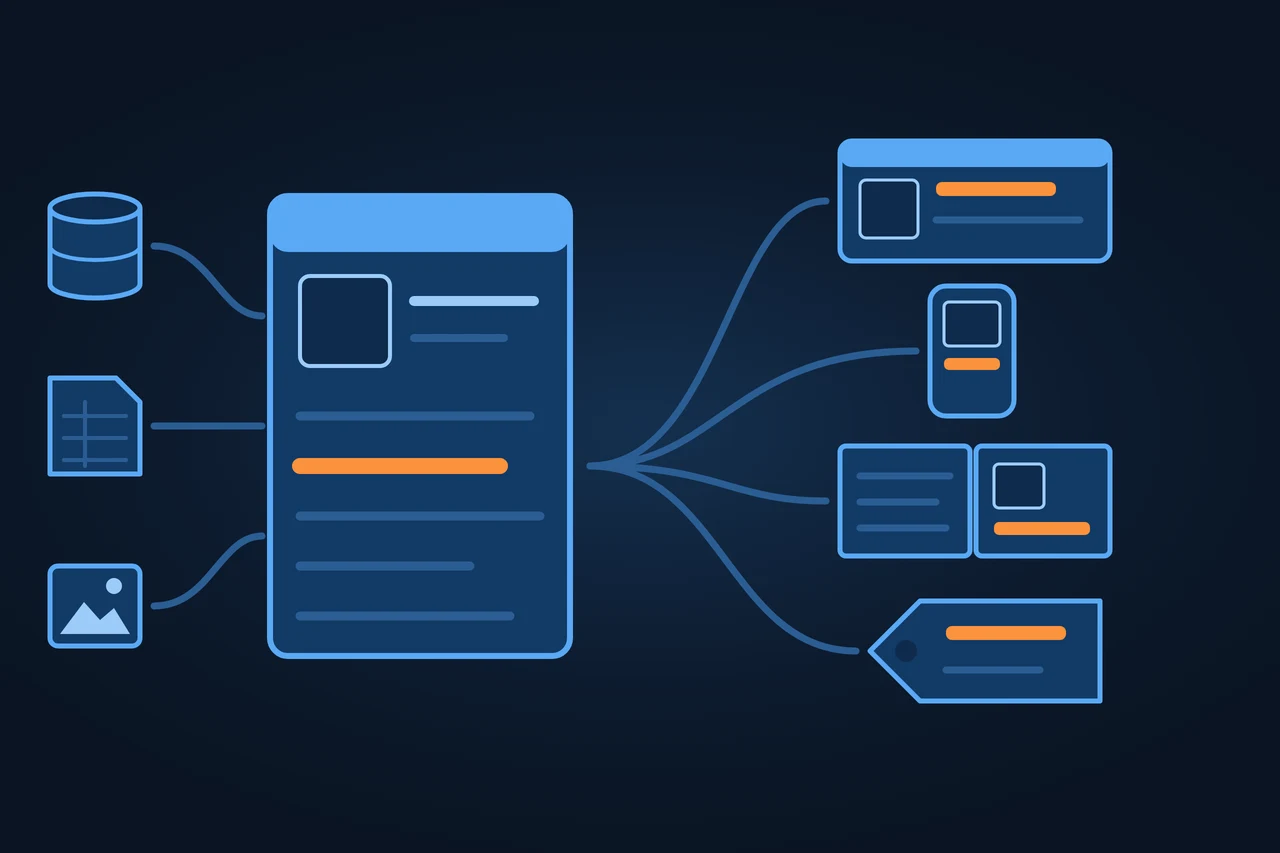
A PIM takes in data from several sources, organizes it in a data model, enriches it and delivers it to each channel in the format that channel asks for.
Import. Basic data such as the item number, internal name and cost can come from the ERP. Suppliers send spreadsheets or BMEcat files, and marketing or an agency supplies copy and images. The PIM assigns every value to a product.
Data model and classification. Each product belongs to a family, and each family has its own attributes: a drill has voltage and torque, a T-shirt has size and fabric. The key that links all the data on one item across the supply chain is the GTIN, the GS1 number for any product that is priced, ordered or invoiced. So that a reseller can read the attributes without re-keying them, the product is classified against a standard: ETIM for electrical and installation products, ECLASS in industry, or the GS1 Global Product Classification (GPC) in consumer goods.
Enrichment. Descriptions, translations, images and documents are added to the technical data. Images can sit in a digital asset management system (DAM), with the PIM holding the link to each file.
Approval. Before anything is published, a workflow checks that every required field for the channel is filled and that someone has reviewed the copy. Akeneo, for example, sets required attributes per product family, locale and channel and shows what percentage of them has a value.
Syndication. Each channel gets its own version: the online store, marketplaces, a product feed for Google Merchant Center, a BMEcat file for a B2B customer or a print catalog. The same data feeds schema.org/Product markup, with fields such as gtin, mpn and sku, and through it reaches AI shopping assistants (agentic commerce).
Many sources in, each channel gets its own version
Sources
ERPcan supply the item number, internal name and cost
Suppliersspreadsheets or BMEcat files
Marketing or agencycopy and images
DAMimages can sit here, the PIM holds the link
→
In the PIM
Importassigns every value to a product
Data model and classificationfamily and attributes, the GTIN as the key, ETIM, ECLASS or GPC
Enrichmentdescriptions, translations, images and documents
Approvalrequired fields for the channel, copy reviewed
→
Syndication: one version per channel
Online store
Marketplaces
Product feed for Google Merchant Center
BMEcat file for a B2B customer
Print catalog
schema.org/Product markupthrough it the data also reaches AI shopping assistants
How many places does your product data come from today?
Types and variants
Type
Suited to
Example, as the vendor describes it
Standalone PIM
Companies with an ERP and a store that want a system for product data only
Akeneo, Inriver
Open source or community edition
Teams with their own developers who want to adapt the data model
Pimcore Community Edition, Akeneo Community Edition
PIM inside a master data platform
Large groups that also manage customer, supplier and location data
Stibo Systems, Informatica Product 360
PXM (product experience management)
Brands selling on many marketplaces that track how their listings look on each
Salsify, Syndigo
PIM with built-in DAM
Small and mid-sized stores that want data and images in one place
Plytix
Source: compiled from the vendors' websites (accessed 07.11.2026).
Examples
Worked example, with no data from any real company: a tool maker adds a new cordless hammer drill.
In the PIM, the product gets its 13-digit GTIN, an internal item number, the brand and its ETIM or ECLASS class. The drill family has twelve attributes, among them battery voltage (18 V), maximum torque (60 Nm), chuck capacity (13 mm), weight with battery (1.6 kg) and number of speeds (2). The sales copy and the data sheet exist in English, German and Spanish, and four images are linked from the DAM.
That one record produces three outputs:
The product page in the online store shows the long title, the sales copy, the four images and a table with the twelve attributes in the visitor's language.
The feed for Google Merchant Center carries the fields Google requires for every product (id, title, description, link, image link, availability and price), plus brand and GTIN. The title may not exceed 150 characters, so the PIM keeps a short version.
The BMEcat file for a distributor holds the item number, the GTIN, the ETIM or ECLASS class and the attributes as standardized features, without sales copy.
If a product revision changes the weight, the manufacturer corrects it once in the PIM, and all three outputs pick up the change with the next export.
One record, three outputs with different fields
Record in the PIM
Cordless hammer drill
13-digit GTINinternal item numberbrandETIM or ECLASS classsales copy and data sheet in English, German and Spanishfour images linked from the DAM
Twelve attributes, among them
battery voltage 18 Vmaximum torque 60 Nmchuck capacity 13 mmweight with battery 1.6 kgnumber of speeds 2
produces three outputs
Product page in the online store
long titlesales copythe four imagestable with the twelve attributes
in the visitor's language
Feed for Google Merchant Center
idtitle · short version, max. 150 charactersdescriptionlinkimage linkavailabilitypricebrandGTIN
plus brand and GTIN
BMEcat file for a distributor
item numberGTINETIM or ECLASS classattributes as standardized featureswithout sales copy
How many times do you type the same value in different places today?
How to measure it
Metric
Formula
What it shows
Completeness per channel
Required attributes with a value / required attributes of the family for that channel and locale × 100
Which products are ready to publish
Disapproved items in the feed
Disapproved items in Merchant Center / items submitted
Missing or wrong data
Time to publish
Publication date − date the product was created
How long a new item takes to reach the store
Returns due to description
Returns with the reason "not as described" / orders
What a wrong product page costs
Source: own compilation; completeness follows Akeneo's definition (required attributes per family, locale and channel).
Figures on how product data affects buyers, with a known sample, are scarce. Syndigo, a PIM vendor, surveyed more than 8,500 consumers in the US, the UK, France, Germany, Brazil and Mexico in 2025. According to its report, 21% had returned a product that did not match what its product content promised, and 44% had abandoned a purchase because there was not enough information. It is a vendor study, and the full method is only in the download.
Advantages and disadvantages
Use case
Advantage
Disadvantage
Verdict
Store with 200 products in one language
Everything in one place
Setting up the PIM can take more work than keeping the pages in the store itself
The store and a spreadsheet may be enough
Manufacturer with 20,000 items and a dealer network
One correction reaches every channel and reseller
Long project: data model, migration, training
The case a PIM is built for
Wholesaler receiving data from hundreds of suppliers
Imports BMEcat and classifications like ETIM without rebuilding each file
The data is only as good as the supplier's
Fits where the industry has a classification standard
Seller on several marketplaces
Each marketplace gets its required fields from one record
Every platform changes its rules, and the mappings need upkeep
Pays off from several channels with different requirements
Source: own assessment.
How it differs from related concepts
Concept
Manages
Difference from PIM
DAM (digital asset management)
Images, video, audio, documents
Holds the files; the PIM holds the product data and links to the files
MDM (master data management)
Master data on customers, suppliers, locations and products
Covers all master data; PIM covers only the product and, according to Informatica, is driven by sales or marketing
ERP
Orders, stock, prices, purchasing, accounting
Leads on what is sold and at what price; the PIM on how it is described
PLM (product lifecycle management)
Development, design, manufacturing
Follows the product until it goes into production; the PIM from the point of sale
Source: own compilation; DAM and MDM after Gartner's glossary, PIM vs MDM after Informatica.
Tools
Tool
What the vendor offers
Note
Akeneo
PIM as the single source of truth for product information
Founded in Nantes in 2013; has a community edition
Centric PXM (formerly Contentserv)
PIM and PXM
Contentserv started in Germany in 2000; part of Centric Software since 2025
Informatica Product 360
PIM within master data management
Informatica has belonged to Salesforce since 2025
Inriver
AI-powered PIM for complex product data
Pimcore
Platform for PIM and MDM, DAM, CMS and commerce
Has a community edition
Plytix
PIM and DAM
Sales Layer
PIM for B2B and B2C
Vendor based in València, Spain
Salsify
PXM platform with PIM
Stibo Systems
Master data management and PIM
Syndigo
PXM, PIM, MDM and data exchange over GS1 GDSN
Source: vendor websites, accessed 07.11.2026; alphabetical. All except Sales Layer appear in the vendor list of Gartner's October 2026 Magic Quadrant.
Criticism and limits
A PIM organizes data; it does not create it. If a supplier sends empty or wrongly measured attributes, the PIM distributes them as quickly as correct ones. Completing and checking records remains work for people, and it can cost more than the software.
A second difficulty is deciding which system leads on which field. If the price or the product name can be changed in both the ERP and the PIM, two versions of the same value appear. Before rollout, each field needs one agreed source system.
The market itself has changed a great deal. In 2005 Gartner warned of immature products and of the risk that small vendors would not survive, and it forecast that IBM, Oracle and SAP would hold more than half of PIM license revenue by 2009. None of the three is among the 16 vendors on the 2026 list. Many early names no longer exist as independent companies: Heiler went to Informatica, hybris to SAP and Contentserv to Centric Software.
Legal framework
For products sold in the EU, the General Product Safety Regulation (EU) 2023/988 has required since December 13, 2024 that every online offer shows at least the manufacturer's name with postal and email address, the responsible person in the EU where the manufacturer is based outside it, information identifying the product including a picture, its type and any other identifier, and the warnings and safety information (Article 19). The Ecodesign Regulation (EU) 2024/1781 creates the digital product passport: once a delegated act requires one for a product group, those products may only be placed on the market if the passport is available, including in distance selling (Article 9), and the possible data includes the GTIN, the customs commodity code and the declaration of conformity (Annex III). The Commission's working plan of April 2025 schedules these acts for iron and steel in 2026, textiles and tires in 2027 and furniture in 2028. The Batteries Regulation (EU) 2023/1542 requires a separate battery passport from February 18, 2027 for electric vehicle batteries, light means of transport batteries and industrial batteries above 2 kWh.
How to apply it, step by step
Count what you have: items, languages, channels and the suppliers who send data.
Decide which system leads on each field: price and stock in the ERP, description and attributes in the PIM.
Choose the data model: product families, attributes per family and your industry's classification (ETIM, ECLASS or GPC).
Define the required fields per channel, starting with those of Google Merchant Center and each marketplace.
Give every item its GTIN and check that it is unique.
Pilot with a single category and measure completeness before and after.
Connect the channels one at a time and clear the disapprovals of the first feed before adding the next.
Best practices
Store each value once and let the channels pull it from the PIM.
Use standardized units and values (60 Nm, not "60 newton meters" on one item and "60Nm" on the next).
Link each image to the product by GTIN or item number, not by file name.
Translate inside the PIM, so that a change to the original flags the translation as outdated.
Review completeness per channel and disapproved items every month.
Common mistakes
Choosing the classification after the data is loaded and having to rebuild the attributes.
Maintaining the price in two systems at once.
Copying supplier descriptions unedited, so that every reseller ends up with the same text.
Measuring only whether a record exists, not whether it has every field each channel requires.
Buying the software before deciding who will maintain the data.
How this entry was made
This entry was written in November 2026 with AI assistance. It started from an analysis of the top ten search results in Spain, the US and Germany, in order to cover what they leave out: the GTIN and classification, the Google Merchant Center feed, the digital product passport and a metric with a formula. The dates come from Gartner's reports, archived websites in the Internet Archive and the official texts on EUR-Lex. It was reviewed before publication and contains no client data.
Manuel Riveiro RodriguezCEO & Digital Strategist
A technical audit covers this and everything else in one pass.
In retail and marketing, PIM stands for product information management. In IT it can also mean Privileged Identity Management, the security practice of controlling privileged access (Microsoft Entra has a service of that name), or a personal information manager, the type of app that holds calendars, contacts and notes.
What does a PIM system do?
It keeps one record per product with all its attributes, copy, translations and image links, checks that each channel's required fields are filled, and sends each channel the data in the format it needs: the online store, marketplaces, shopping feeds, B2B catalog files or print.
What is a PIM database?
It is the data store behind a PIM system. Products are grouped into families, each family has defined attributes, and each attribute can hold a value per language and channel. The database also keeps the GTIN, the classification and links to images held in a DAM.
Do I need a PIM if I already have an ERP?
The ERP runs orders, stock, purchasing and prices. The PIM holds the product description: attributes, copy, translations and images for each channel. With few products and one channel, the ERP and the store can be enough. With many items, several languages and channels that each have their own required fields, maintaining all that in the ERP becomes hard.
Is there open-source PIM software?
Yes. Pimcore and Akeneo offer community editions that can be downloaded and self-hosted. Installing, running and adapting them to a company's data model takes a technical team.