Meeting user needs and expectations to the fullest. While this has always been Google's core premise – and the principle behind continuous changes to its algorithm – the desire to increase ad revenue in Palo Alto now seems to overshadow this goal.
At least, this is how one of the latest innovations introduced by the tech multinational is being interpreted. The colourful lettered giant has begun testing the insertion of four ads at the top of the first page of its search results, for certain keywords and in specific countries (previously, a maximum of three sponsored entries were displayed).
Tests in Various Countries and the Evolution of the SERP
One of the first to report on these tests was Search Engine Land. According to an article published on their site, they had been receiving reports for two months from people who claimed to have encountered this new SERP format. These users also emphasised that when this occurred, the ads usually found in the right-hand column were not displayed.
Search Engine Land stated that most of these notifications came from outside the United States. Germany, Brazil, Denmark, the Netherlands, and India were reportedly the territories from which most alerts were received. What was an emerging trend in 2016 is now a consolidated reality in 2024: the removal of right-hand sidebar ads is standard across most Google SERPs (Search Engine Results Pages).
Google has also started testing its new ad distribution in Spain, as shown in this screenshot:
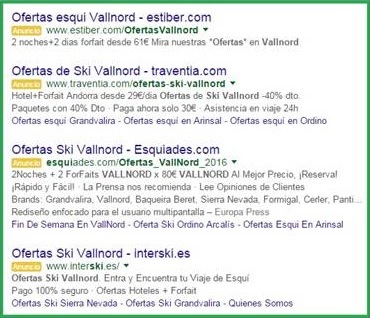
This screenshot, although from 2016, illustrates a key moment in SERP evolution. Today, the presence of four ads at the top is common for searches with high commercial intent, and the results page structure is much more dynamic, incorporating elements like local packs, image carousels, videos, and direct AI responses (AI Overviews).
The Impact of Artificial Intelligence on the Current SERP (2024-2026)
With the advent of generative artificial intelligence, especially models like ChatGPT and Perplexity, Google has responded with its own AI integration into search, known as "AI Overviews" or "SGE" (Search Generative Experience). These AI-generated responses often appear at the top of the SERP, even above traditional ads, adding another layer of complexity to organic and paid visibility. According to a 2024 BrightEdge study, over 60% of searches in the US already show some form of generative AI element in the results, and this figure is expected to rise to 85% by 2026.
Ads Taking Up More Space: The Fight for Visibility
Despite everything, this new format was still a minority in 2016. Experts believed that the appearance of four ads only occurred in 1% of searches tested with tools like MozCast. However, in 2024, for highly competitive keywords with clear transactional intent, the presence of 3 or 4 ads at the top is the norm. This is especially true in sectors like finance, insurance, travel, and e-commerce, where the CPC (Cost Per Click) can be very high.
Another observation made by specialists at the time concerned an increase in the visibility of ad placements. In some cases, they claimed, ads occupied a large proportion of the computer screen, which inevitably pushed the first organic search results down (thus moving them out of users' line of sight). This trend has drastically accelerated. On mobile devices, it is common for the first organic results not to be visible without scrolling, which underscores the importance of an integrated SEO and SEM strategy.
In tests conducted so far, these four ads do not occupy the space previously reserved for three ad entries, but an even larger area: Google expands them as it deems appropriate, without removing relevant information that could affect the click-through-rate (CTR) of the advertising. This expansion has manifested in richer ad formats, with site link extensions, call extensions, location extensions, price extensions, and structured snippets, which take up even more space and offer more information directly in the SERP, reducing the need to click for basic details.
What Does Google Intend? Evolution of Monetisation and User Experience
Behind this strategy shift, Google's desire to boost its AdWords service might be hidden, facing competition and strong bidding for certain keywords. This remains a fundamental truth. Google, as a publicly traded company, seeks to maximise its advertising revenue. Competition from platforms like Amazon Ads, TikTok Ads, and Meta Ads has pushed Google to innovate and optimise its ad formats to maintain market share.
The deployment of this new way of displaying sponsored links increases the chances of internet users clicking on these ads, which translates into more revenue for the Californian giant. According to Alphabet's (Google's parent company) earnings reports, search advertising revenue continues to be the main pillar, with consistent year-on-year growth, exceeding 200 billion dollars in 2023. Optimising ad visibility is a key strategy to maintain this growth.
Some experts saw this novelty as an indication of what search engine advertising could be in the medium term: a scenario where ads dominate the first page of search results, and organic suggestions are shown from the second page onwards. If this prediction comes true, the manoeuvring room for SEO experts would narrow, forcing companies to pay to increase their visibility. This prediction has largely come true. For many commercial searches, users must scroll considerably to see organic results, leading to increased SEM investment and a re-evaluation of SEO strategies to focus on search intent and content formats that can appear in "AI Overviews" or "featured snippets."
Google has shown four ads in test mode, as it conducted a similar experiment in 2010. This history of tests and evolutions demonstrates Google's constant quest to optimise its business model, always balancing monetisation with user experience, although the pendulum sometimes swings more towards revenue.
User Reaction: The Main Hurdle and the Importance of Experience
When deciding whether the new distribution will systematically apply to all Google searches, the tech multinational must consider users' opinions. This premise remains valid and has, in fact, intensified with updates like the "Helpful Content Update" and the focus on E-E-A-T (Experience, Expertise, Authoritativeness, Trustworthiness), which aim to reward high-quality, useful user content. If users perceive results to be saturated with irrelevant ads, their trust in Google diminishes.
If this SERP is adopted, users would be forced to scroll more – especially on mobile devices – something they would hardly appreciate, and which could progressively push them to adopt other search engines, such as DuckDuckGo. Mobile experience is critical. With most searches conducted on smartphones, loading speed (Core Web Vitals, now with INP - Interaction to Next Paint as a key metric in 2024), usability, and content relevance are more important than ever. An excess of ads that slow down loading or hinder navigation can negatively impact user retention.
Any eventual annoyance could lead them to opt for more drastic measures. For example: systematically resorting to ad blockers, an area where Google is having more than one headache with companies like AdbLock. Ad blockers continue to be a threat to Google's business model. Although Google has tried to mitigate their impact through the "Coalition for Better Ads" initiative and the integration of a blocker in Chrome for intrusive ads, the end-user has the final say. A 2023 Statista study indicates that 42.7% of global internet users use some type of ad blocker.
SEO and SEM Strategies (2024-2026): Tips and Tools
In this constantly evolving SERP landscape, companies must adopt more sophisticated strategies to ensure their visibility. It is no longer enough to optimise for keywords; understanding search intent and user context is fundamental.
SEO: Beyond Keywords
- Optimisation for "AI Overviews" and Featured Snippets: Structure your content with clear questions and answers, use lists and tables, and ensure your content is concise and direct to increase the chances of appearing in these direct response formats. Tools like Semrush or Ahrefs can help you identify opportunities.
- E-E-A-T (Experience, Expertise, Authoritativeness, Trustworthiness): Demonstrate the credibility of your site and authors. Include expert biographies, citations from reliable sources, and keep your content updated and accurate. This is crucial for "Your Money Your Life" (YMYL) topics.
- Core Web Vitals and User Experience: Ensure your website loads quickly and offers a smooth experience, especially on mobile devices. Pay attention to INP (Interaction to Next Paint), which measures site responsiveness. Use Google PageSpeed Insights and Lighthouse to audit and improve.
- Quality and Relevant Content (Helpful Content): Create original, in-depth content that genuinely answers user queries, rather than superficial, SEO-generated content. Google's "Helpful Content Update" penalises low-quality content.
- Local SEO: For physical businesses, optimising your Google Business Profile is more important than ever, as local packs often appear above traditional organic results.
SEM: Maximising Ad Investment
- Ad Quality Optimisation: It's not just about bidding more. Google Ads values ad relevance to the keyword and the quality of the landing page. A high "Quality Score" can reduce the cost per click and improve ad position.
- Ad Extensions: Utilise all relevant extensions (site links, callouts, structured snippets, call, location, price, promotion) to occupy more SERP space and provide more information to the user.
- Smart Bidding Strategies: Leverage Google Ads' automated bidding strategies (such as Maximise Conversions, Target CPA, Target ROAS) that use machine learning to optimise performance.
- Advanced Segmentation: Use audience, location, device, and time-of-day segmentation to show your ads to the right people at the right time.
- Data Analysis with GA4: With the full transition to Google Analytics 4 (GA4), it is crucial to understand how users interact with your site after clicking your ads. GA4 offers more advanced attribution models and a user-centric view, essential for optimising campaigns.
- Privacy and Consent: In a "privacy-first" world, ensure your Google Ads campaigns comply with privacy regulations (GDPR, CCPA) and that data collection is based on user consent. Implementing "Consent Mode v2" is mandatory for ad personalisation in the EEA from 2024.
In our experience working with clients at ZDS Digital, companies that achieve the best results are those that integrate their SEO and SEM strategies. For example, using paid keyword data to inform organic content creation, or improving the landing page experience for ads, which in turn benefits SEO. The synergy between both channels is fundamental for competing in the current SERP.
Get the Most Out of AdWords (Google Ads) and Your Digital Strategy
Do you know how this change would affect your company's AdWords ad placements? Would you like to optimise the results of your campaigns on this platform and ensure your organic visibility in an increasingly competitive environment?
At ZDS Digital, we understand the complexity of today's search ecosystem. From optimising for "AI Overviews" to implementing advanced bidding strategies in Google Ads, our team stays abreast of the latest trends and Google algorithm updates. We have helped numerous companies navigate these changes, achieving significant increases in their organic traffic and ROI from their advertising campaigns.
Do not make the common mistake of viewing SEO and SEM as separate entities. A holistic strategy is key. For example, a frequent error is neglecting page loading speed optimisation (Core Web Vitals), which not only affects organic ranking but can also increase the cost per click in Google Ads due to a lower Quality Score.
If you are looking for a partner to help you maximise your presence on Google, both through organic results and paid campaigns, and to guide you in the age of AI and privacy, do not hesitate to contact us via our form or call us without obligation on (+34) 93 532 93 78. We will be delighted to assist you and guide you with personalised solutions for your business, based on data and our extensive experience in the Spanish and international markets. Also, visit our services section to learn more about how we can help you.