The Expedia.com Case in the US:
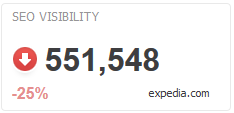
19.01.2014
As outsiders, we simply don't know the exact cause of Expedia's current situation, or if the domain will recover soon, or even lose more visibility. We will investigate this by interpreting Searchmetrics data and examining the domain in detail. At first glance, the signs point to a Google™ penalty due to the creation of many unnatural links to the domain's main URLs.
By the way:
You can check the current SEO visibility of expedia.com or any other site yourself at: http://suite.searchmetrics.com/en/research/domains/organic?url=expedia.com&cc=US. Alternatively, contact us for more details on this case or questions about potential website penalties and how we can help you solve the problem by emailing [email protected].
Back to the topic: We've decided to split this post into several parts. We start by presenting an in-depth analysis based on Searchmetrics data, indicating that the expedia.com domain has suffered a severe drop in its SEO visibility. In the second part, we'll gather some examples that could be the cause of this drop. Finally, we'll provide some tips on how websites affected by a Google™ penalty can recover, and how best to avoid a severe drop in visibility and, consequently, traffic before it happens.
Data: What Current KPIs Show
First, let's look at the current SEO visibility chart:

It's clear that the domain experienced good growth over the last 4 years, but after peaking on 20.10.2013, it suffered a drop of over 50%, settling at 498,391 points.
Short, Generic Keywords with High Search Volume Were Most Affected
At first glance, we can see that expedia.com has lost a large part of its good ranking for strong keywords and generic terms like "flights", "hotels", and "plane tickets". Most of the ranking losses occurred on the homepage or in the main categories. Here is a selection of losing keywords affected by the drop:

When we display this data structured by the URLs that lost the most traffic, we get the following table:

Long-tail Keywords Also Affected
Not only "short head" keywords (up to two words: traffic index -374,208; an average of 16 positions lost for a total of 2,523 keywords) have been affected, but even more long-tail keywords have lost positions (more than two words: traffic index -256,944; an average of 8.4 positions lost for 3,236 keywords):

Consequently, a possible conclusion (without official Google™ confirmation) is that a penalty occurred for several keywords on some linked pages, and this sanction affected the related landing pages and their ranked keywords.
Why Did This Happen?
Primary possible cause:
The drop may be caused by excessive use of highly optimised anchor texts, i.e., focused on precisely those keywords mentioned earlier that Expedia wanted to rank for (typically high search volume or high CPC keywords). Strategies of this type, as a method to improve the link profile and thus a domain's visibility, have been used quite frequently in SEO; in fact, some Spanish companies still "optimise" their websites this way. Many webmasters or SEO employees actively encouraged other domain owners or bloggers to link to their website using a keyword as anchor text.
Although an anchor text composed solely of keywords is quite "natural" (= not manipulated) within a backlink profile, its high repetition can appear at least a little suspicious, as these links are known to be artificially acquired. We know this was the strategy for many victims recently penalised by a Google algorithm update. Specifically, the algorithm change known as the "Google Penguin Update" sank numerous domains, and this long-effective strategy was the reason for the penalty.
A High Number of Links with Very "Specific" Anchor Text

We are not saying that expedia.com has definitely manipulated its link profile (by themselves) – as we do not know. In fact, they have a large number of very high-quality (brand) links using "Expedia" or its URL "expedia.com" as anchor text, but it is also true that their profile reveals a large number of high-value "money keywords" repeated over and over again.
Let's take a deeper look at the link profile, reviewing only the backlinks and their anchor texts from one of the main categories and URLs of the page: www.expedia.com/Flights:

As you can see, most incoming links specifically use high-volume keywords. Since the keywords that lost rankings are very frequently used in the link's anchor text, it seems there is a connection between the anchor text, the keywords, and the URLs that have lost their visibility:

Related keywords used in the anchor text have also suffered a huge drop in ranking, such as "flight ticket", "book a flight", or "renting a car".
Losses in "Money Keywords" Cause Collateral Damage to the Entire Domain
This type of "collateral damage" is very likely to appear when a domain loses visibility. As URLs – especially the homepage – lose positions (and therefore traffic), they also transmit their "link power" obtained from their backlinks to hierarchically subordinate pages. Consequently, subordinate pages also lose visibility when this link power is reduced.
Looking further, the URLs that primarily lost visibility were those with the highest number of backlinks from different domains.

We can see that the URLs offering the highest number of backlinks are among the URLs that primarily lost positions, indicating this is one of the main reasons for the recent drop.
Over the past three years, Google has greatly improved its processes for discovering bad link profiles and thus cleaning search results of low-quality or system-abusing sites. The main instruments of this development (among others) are the Penguin updates, which targeted link profiles, and the Panda update, which largely focused on content quality. Thanks to these changes and their numerous updates, many irrelevant and abusive domains have disappeared from search results. On the other hand, many brand domains have gained in visibility, even if they haven't been highly "optimised".
It's possible this fact explains why expedia.com wasn't directly affected by direct algorithm updates, but then suffered a manual action from Google.
Conclusion: Probable Google Penalty Due to Excessive Use of Keywords as Anchor Text
We believe the preceding analysis leads to the following conclusions, summarising the data and examples provided:
- Expedia.com lost positions for high-volume keywords, consequently losing 25% of its visibility in one week, and over 50% to date.
- Analysing the main KPI data for some link examples, it appears to be a keyword penalty due to unnatural linking that has affected the ranking of the entire domain.
- The main reason seems to be the use of keywords in a large proportion of anchor texts.
How to Recover from a Penalty? – What Should expedia.com Do Now?
We want to remind you of "Webmaster Tools", especially the articles on link schemes:
…
"Below are some examples of link schemes that can negatively affect a site's ranking in search results:
[…]
- Links with optimised anchor text in articles or press releases distributed on other sites
- Using automated programs or services to create links to your site
- Links widely distributed in the footers of various sites"
…
Indeed, we found a considerable number of examples corresponding to these previously mentioned points within expedia.com's link profile.
Expedia is not the first domain to suffer a loss of SEO visibility. In fact, other domains have been even more severely affected, either by an update or a manual penalty. However, Expedia is a well-known brand with a large domain. They have a lot of high-quality content, and there are numerous examples of highly successful recoveries across the web. They don't always return to their previous level of visibility, but it's better to recover and grow from that level than to remain penalised and potentially continue losing.
We think it should be quite clear to them what they need to do. If they have actively forced the creation of links with specific anchor texts, acquired blog entries with keywords as anchor text, or carried out any other strategy that Google clearly considers a violation of its webmaster guidelines (which we, of course, don't know), as a first step, they must stop executing this strategy (if they haven't already).
It's also possible that Expedia has been working with an agency that continues to use these techniques. It could also be that Expedia was a victim of "negative SEO", but we consider this option highly unlikely.
Whatever the definitive reason, they must next create a list of all these suspicious links and try to remove them (if not possible, use the "disavow tool") and ask Google to re-evaluate their situation, explaining the events that occurred – whether self-inflicted or not. For this, expedia.com must submit a reconsideration request once the link profile has been cleaned. We are quite sure they will recover if they follow these steps.
What About Expedia.es in Spain?
A reminder (in Spanish) about unnatural/paid links and that we’re willing to take action on them:http://t.co/uTBdJpRNbw
— Matt Cutts (@mattcutts) 10. März 2014
Four days after Google published a blog post stating it would take action against link networks in Spain and Italy, Matt Cutts tweeted that such measures had already been taken.
(Translation: we’ve taken action on Spanish and Italian link networks that violate our quality guidelines.)
— Matt Cutts (@mattcutts) March 14, 2014
Consequently, and in line with what happened in the US, the following graph is not a big surprise:

Exactly one week after Matt Cutts' statements, the expedia.es curve began to fall, reaching 27% below its visibility on March 20th by April 24th.
Let's look again at the losing keywords, and just like in the US, many high-volume, short, and generic keywords appear:

For some keywords like "viaje" (travel), "viajar" (to travel), or "hotel madrid", expedia.es has even been excluded from search results.
At First Glance: A More "Natural" Link Profile Than expedia.com

This might be why expedia.es wasn't directly affected by algorithm changes: its link profile appears more natural than expedia.com's. However, the percentage of links targeting high-volume keywords remains very high. We found many of the penalised keywords in this table.
We didn't stop there and took a closer look at the links with "hotels" anchor text:

At first glance, the differences between the article's topic and the anchor text used are striking. An article about Alicante links to hotels in Mallorca. What immediately stands out are the links from very similar pages like www.ylondres.com or www.ynuevayork.com.
Clear Violations of Google's Guidelines
We compared some of the points Google considers unnatural links with the links to expedia.es:
- Links with optimised anchor text in articles or press releases distributed on other sites. For example:
There are many wedding rings on the market. When you celebrate your wedding, you will have to choose the best ring. You will also have to buy flowers and find a wedding dress."

On each homepage of ylondres.com, ynuevayork.com, or yalicante.com, there are texts with links to Expedia and their other portals. All pages belong to the same person and appear to have a single objective: to create links to Expedia pages. We don't know if this was an intentional strategy by Expedia or their agency, but if we can already see that all these pages belong to the same person, that person has their own agency, and all domains are under the same IP, we can be sure that Google will also detect it.
We know that Google dislikes link networks and has penalised them in the past (http://searchengineland.com/googles-matt-cutts-weve-taken-action-large-guest-blog-network-187028).
If we are right, the consequences should also be visible on the other pages belonging to Expedia. A look at hotelopia.es confirms our predictions:

Indeed, a much more severe drop occurred than in the expedia.es case. The result is a drop of over 75% in its visibility.

Another example of the unnatural use of the keyword "cheap hotels" in the homepage header.
Many of the links we investigated show characteristics of unnatural links. In particular, we found many links from unrelated texts, always using the keyword as anchor text.

While we are writing this article, some of the links found by Searchmetrics have disappeared, which may indicate that Expedia has reacted and started to remove suspicious links. Using web page archives like the well-known WaybackMachine, we detected that these links still existed recently. All links will have to be checked, one by one, to see if they violate Google's guidelines.
Update:
It seems that what is described also happened to logitravel.com, which has so far lost more than 30% visibility since March. The drop occurs within the identical timeframe as expedia.es.

If you need help in case of a Google penalty, contact us and discover how to solve the problem and, most importantly, prevent it from happening again.