One of the new features introduced by Google Adwords to facilitate the tracking and measurement of online advertising campaign success relates to URLs. The world's most used search engine introduced an update with significant advantages. This reduces the time needed to manage URL tracking information and decreases the frequency with which the search engine crawls websites.
The URL update came into effect in July 2015. If you regularly use Adwords ads to promote your business, you should have adapted your campaigns as soon as possible. Even if you weren't using tracking codes, Google recommended starting to use final URLs. But what exactly did Google's new URL policy entail?
New tracking options
Currently in Adwords (now Google Ads), your destination URLs are used to track important information about the behaviour and impact of your ads. For example, it allows you to see which Keyword or device generated more conversions. From July 2015, tracking and redirect information was no longer included in the destination URL. To define these tracking parameters, Google established a specific section with fields, accessed via advanced URL options.
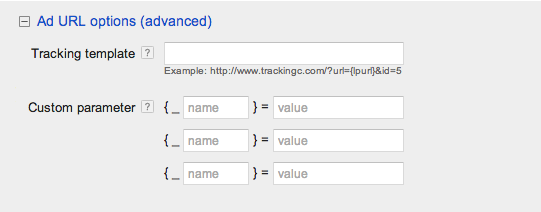
The great advantage is that the template with the tracking parameters no longer affects the destination URL. Therefore, when modifications are made, the ad is not interrupted, as it does not have to go through the approval process again. Google Adwords' Value Track function is useful for understanding user behaviour with campaigns. It can also be used as a complement to other tracking software. Familiarise yourself with the latest developments.
The evolution of tracking: from ValueTrack to GA4 and beyond
What was new in 2015 is now standard. ValueTrack implementation laid the groundwork for more granular and efficient tracking in Google Ads. With the full transition to Google Analytics 4 (GA4), the interconnection between Google's platforms is deeper. GA4, focused on events and the user lifecycle, provides a 360-degree view of post-click behaviour, integrating seamlessly with Google Ads data. We recommend our clients set up a robust link between Google Ads and GA4 to maximise attribution and data-driven optimisation capabilities. In our experience, those who migrated and correctly configured GA4 before 2024 gained a significant advantage in interpreting their advertising campaigns.
In addition to GA4, tools like Supermetrics or Funnel.io allow consolidating data from multiple sources (Google Ads, GA4, social media, CRM) into a single dashboard, facilitating more complex analysis and identifying performance patterns not visible with native tools alone. This is crucial for an integrated marketing approach in 2026.
URL-related updates
Google's updated URLs feature separate fields within AdWords for different parts of the URL. What was previously the “Destination URL” field is now called the “Landing Page”. In this box, you can enter either a final URL or a destination URL, which is the landing page users reach when they click on the ad. Google recommends setting the final URL from the outset.
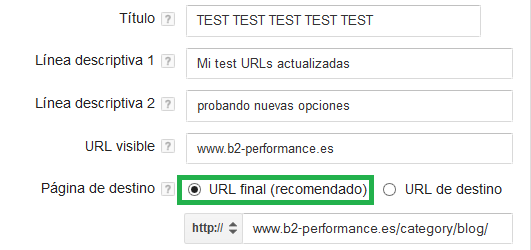
URL options in Adwords ads
The ad's visible URL must offer the user precise information about the destination page they will access if they click on it. Google places importance on this aspect, as it directly impacts user experience. Furthermore, the domain of the visible URL must be the same as that of the landing page, even in case of redirection.
As with the tracking code, Google has enabled the option to modify all visible URLs and destination pages at once. If you modify the URL of a specific ad, the original will disappear and a new one will be created, which will have to be approved first and will generate new statistics from scratch. Consult the Google Adwords help page for detailed information on how to edit URLs. This update is imminent. It will apply from early July. All ads that do not comply with the new guidelines will disappear. If you haven't yet modified the URL settings and tracking codes for your campaigns, don't wait any longer.
User experience and Core Web Vitals in 2026
Google's insistence on consistency between the visible URL and the landing page reflects its commitment to user experience, a critical factor for ad performance and SEO. In 2026, user experience is evaluated through metrics such as Core Web Vitals. While in 2015 we talked about loading speed, today we measure Interaction to Next Paint (INP), which replaces First Input Delay (FID) as the main interactivity metric since March 2024. A high INP indicates that the page does not respond quickly to user interactions, which can lead to a high bounce rate and lower campaign performance. Ensuring that your ad landing pages meet these standards not only improves your Quality Score in Google Ads but also contributes to better organic Ranking, as Google rewards sites that offer an excellent experience.
Furthermore, the relevance of the landing page is key for Google's algorithm and for the user. A 2023 WordStream study revealed that landing pages specifically optimised for the ad's search intent can increase Conversion Rates by up to 30%. This means it's not enough to drive traffic to a generic page; the page must be highly relevant and offer the content the user expects to find.
E-E-A-T and Helpful Content: Pillars for credibility and performance
The content of landing pages is key. In 2026, the concepts of E-E-A-T (Experience, Expertise, Authoritativeness, Trustworthiness) and Google's Helpful Content Update are more important. Google seeks to reward content created by people, for people, that demonstrates experience, deep knowledge, authority on the topic, and is trustworthy. This applies both to organic SEO and, indirectly, to ad performance. A landing page that adheres to E-E-A-T principles and offers useful, original content will be more likely to retain the user, reduce bounce, and convert.
At ZDS Digital, we have observed in our campaigns that landing pages incorporating expert testimonials, detailed case studies, or clear and verifiable contact information, not only improve their organic Ranking but also see an increase in user trust and, consequently, in Google Ads Conversion Rates. Avoiding duplicate or automatically generated content without added value is crucial, especially with the rise of AI in content creation. Google is increasingly sophisticated in detecting AI “spam”.
The impact of AI on search and advertising (2024-2026)
The emergence of Artificial Intelligence in Search (AI Search) with tools like ChatGPT, Perplexity AI, or Google's own Search Generative Experience (SGE), redefines how users interact with information and, by extension, with ads. In 2026, it is likely that a significant portion of searches will be resolved directly in the AI interface, which could reduce direct clicks to websites. This does not mean the end of ads, but an evolution. The relevance and quality of landing pages will be even more critical, as AI could directly quote fragments of your content or recommend your site if it considers it the best source of information.
To adapt to this landscape, we recommend:
- Optimisation for direct answers: Structure landing page content to be easily digestible by AI, using lists, tables, and FAQs.
- Reinforcing authority: AI will tend to reference sources with high authority and E-E-A-T. Investing in your brand's and content's credibility is a long-term strategy.
- Niche and in-depth content: Offer unique and specialised information that AI cannot easily synthesise from multiple sources.
- Contextual ads and new formats: Google Ads is already experimenting with ad formats that appear within AI-generated responses. Staying abreast of these developments will be key.
Privacy first: a key factor in URL and data management
Growing concern for user privacy has led to significant changes in how data is collected and used. Regulations like GDPR in Europe and CCPA in California, along with the gradual elimination of third-party cookies by browsers like Chrome, make URL management and tracking more complex and, at the same time, more responsible. In 2026, a “Privacy-first” approach is a necessity.
This implies:
- Clear consent: Ensure users give explicit consent for data tracking, often through a Consent Management Platform (CMP).
- Data modelling: With less availability of third-party cookie data, conversion modelling in GA4 becomes essential to fill gaps and gain a more complete picture of performance.
- Server-side tracking: Consider implementing server-side tracking for greater accuracy and control over data, reducing reliance on browser cookies.
- Privacy audits: Conduct regular audits of your tracking systems and URLs to ensure compliance with privacy regulations and avoid potential penalties.
At ZDS Digital, we assist our clients in adapting to this new paradigm, ensuring their campaigns are not only effective but also ethical and compliant with current legislation. User trust is an invaluable asset.
Ask us…
If you need help with these adjustments, ZDS Digital will support you and optimise your Google Ads campaigns. Our team of SEM and SEO experts will make the necessary adjustments to optimise your campaigns, improve your Conversion Rate, and ensure your digital strategy aligns with the latest trends and technical requirements of 2026. Email us at [email protected] or call us directly on +34 935 329 378. You can also visit our services section to learn more about how we can help you achieve your goals.