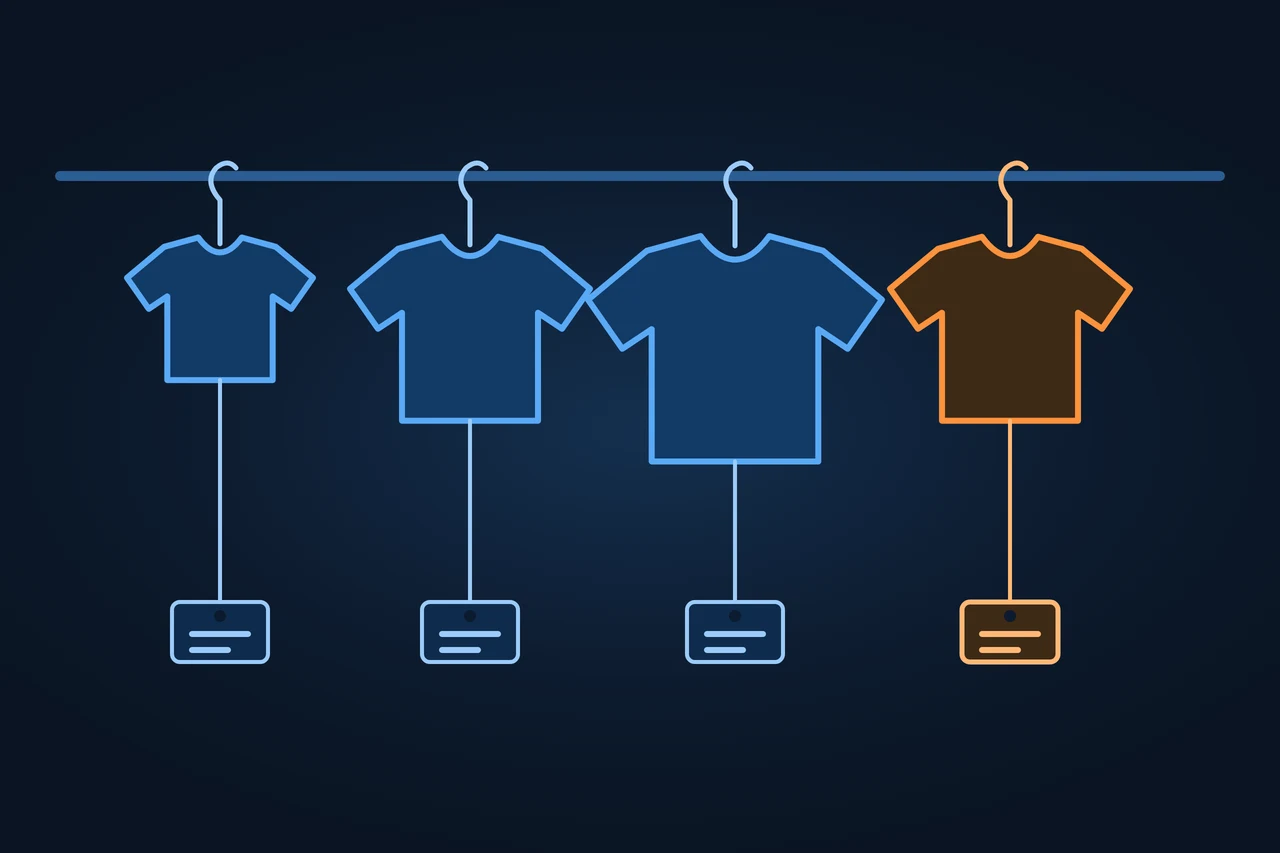
A SKU (Stock Keeping Unit) is an internal code that a retailer or manufacturer assigns to each product or variant it sells, so that every item stored, ordered and sold can be identified without doubt. GS1 US describes the SKU as strictly internal: each business creates its own, while the GTIN identifies the same product across the entire market.
A SKU is the internal code a business assigns to each variant it sells. How to build one, how it differs from a GTIN and where it goes in feeds and markup.
Origin of the term
SKU is the abbreviation of "stock-keeping unit", according to Merriam-Webster. The abbreviation is the form that shop systems and feeds use: Google Merchant Center refers to the "product SKU", and schema.org names its property sku.
How it works
Each business decides how it builds its SKUs. GS1 Germany recommends starting with the most important information and ending with the least relevant, and lists possible contents such as product features, supplier, season, cost or storage location. One possible scheme: category, model and variant.
A SKU works when every system uses the same one. A product starts in the warehouse or ERP, moves into the PIM, reaches the online store and from there the product feed and the markup on the page. With the same SKU at each step, stock, orders and product pages all refer to the same item.
One code, five steps
Fields according to Google Merchant Center and schema.org
Warehouse or ERP
SHI-421-BLU-M
PIM
SHI-421-BLU-M
Online store
SHI-421-BLU-M
Product feed
ID [id]SHI-421-BLU-M
item group ID [item_group_id]: the parent SKU
Markup on the page
skuSHI-421-BLU-M
the value the page shows
Orange: the same code for the same variant in every system.
Where the SKU has a fixed field name
In Google Merchant Center, the SKU belongs in the ID [id] attribute. Google's help page recommends using the product SKU as the value, allows 1 to 50 characters and recommends ASCII only: letters, digits, underscores and dashes. For variants, Google suggests submitting the parent SKU in item group ID [item_group_id] and, in ID [id], a unique value for each variant based on that parent SKU.
On the page, schema.org defines the sku property as "a merchant-specific identifier". Google's documentation on merchant listing structured data lists sku among the recommended Product properties: one value, no whitespace and, as a recommendation, ASCII characters only. Google's general guidelines say not to mark up content that is not visible to readers, so the SKU in the markup should be the one the page shows (product structured data). Variant URLs are covered under faceted navigation.
Types and variants
Parent SKU and variant SKU. A model that comes in sizes and colors can have a parent SKU for the family and one SKU per combination. The sources do not fix the level: in its UPC guide, GS1 US describes a retailer that creates a single SKU for a pair of shoes with a different UPC for every color and size, while Google asks Merchant Center users for a unique ID per variant and keeps the parent SKU for item_group_id.
Marketplace SKU. According to GS1 Germany, Amazon, eBay and other platforms use the SKU to link a seller's stock to the product detail page. On Amazon, each SKU may exist only once per seller account, and one ASIN can carry several SKUs, for example one offer fulfilled by Amazon (FBA) and another shipped by the seller. If the seller does not enter a SKU, Amazon assigns a random one. The FNSKU (Fulfillment Network Stock Keeping Unit) is the code Amazon uses for FBA logistics.
A second meaning. In Microsoft Azure documentation, "SKU" refers to versions of a service, such as the "v1 SKU" and "v2 SKU" of Application Gateway.
Examples
Worked example: a store sells a shirt in 3 colors (blue, white and black) and 4 sizes (S, M, L and XL). That makes 3 × 4 = 12 combinations and, with one SKU per variant, 12 SKUs. With the sample scheme in the table, the blue shirt in size M would be SHI-421-BLU-M, and the white one in XL, SHI-421-WHT-XL.
Part
Example
Purpose
Category
SHI
Groups shirts in reports and in the warehouse
Model
421
Separates this model from others in the category
Color
BLU
First attribute of the variant
Size
M
Second attribute of the variant
Source: sample scheme for this entry; according to GS1 US, each business decides its own format.
A spreadsheet that combines the columns is enough to generate all 12 codes.
How to measure it
The SKU is also a unit of count. A range of 100 SKUs means 100 distinct variants for sale, whether that is a few models in many sizes or many models without variants; the shirt in the example adds up to 12 SKUs from a single model. Stock, sales and turnover are calculated per SKU because each variant sells out at its own pace.
Advantages and disadvantages
For internal management, GS1 Germany lists these benefits of a well-designed SKU: it identifies products quickly, helps find their storage location, makes the performance of each item easy to track and brings sales from several platforms together.
Its limit is scope. According to GS1 US, several retailers may sell the same item with the same GTIN, and each assigns it a different SKU. To compare a product across retailers, the SKU is of no use; that is the job of the GTIN.
How it differs from related concepts
Code
Assigned by
Valid where
Used for
SKU
The business itself
Only inside that business
Internal stock, orders and sales
GTIN (UPC-A or EAN-13 as a barcode)
The company, using a prefix allocated by GS1
Worldwide
Identifying the product across the supply chain
MPN (Manufacturer Part Number)
The manufacturer
Among that manufacturer's products
Telling a product apart within its range
ASIN
Amazon
Only on Amazon
Amazon's catalog and detail pages
Source: GS1 US, "What is a GTIN?"; GS1, "General Specifications", release 26.0; Google Merchant Center Help, "MPN [mpn]"; GS1 Germany, "SKU, GTIN, EAN & ASIN" (accessed 14.11.2026).
According to the GS1 General Specifications, a GS1 member organization allocates the company prefix and the company itself assigns the item reference. GS1 US writes on its GTIN page that the GTIN is "issued exclusively by GS1". According to GS1 US, the GTIN-12 is encoded in the UPC-A barcode, used mainly in North America, and the GTIN-13 in the EAN-13 barcode, used mainly outside it. Google says each variant typically has its own MPN; the exception it names is apparel sizes, which may share one. "Item number" is a field name, and each system decides whether it holds the SKU or the GTIN. The full comparison is in the GTIN entry.
Criticism and limits
No standard defines the format of a SKU. GS1 US describes it as a flexible code each business creates for its own inventory. The guidance in this entry consists of recommendations.
The sources disagree on what a SKU should contain. GS1 Germany suggests including data such as supplier or cost. Google Merchant Center Help asks for a stable ID: changing it overwrites the product and its history. A SKU that contains the supplier and changes with it loses that history if it is the feed ID.
How to apply it, step by step
Define the scheme once, document what each part means and fix a length.
Give every variant sold separately its own SKU: color, size, pack.
Use only uppercase letters, digits and dashes.
Format the SKU column as text in any spreadsheet before pasting or importing.
Carry the same SKU into the ERP, the PIM, the store and the marketplaces.
In Merchant Center, use the SKU as ID [id] and the parent SKU as item_group_id.
In the markup, put the same value in sku as the product page shows.
Best practices
Keep the scheme in a shared document.
Leave out of the code anything that can change, such as price or supplier, if the SKU serves as the feed ID.
Before creating a SKU, check that it has not existed before.
Common mistakes
Mixing letters and digits that are easy to confuse when reading or typing, such as O and 0 or I and 1.
Telling SKUs apart only by upper and lower case. Google warns that "abc123" and "ABC123" may be treated as the same product.
Using spaces or special characters. For the ID, Google recommends only letters, digits, underscores and dashes and strips extra spaces; in markup, sku must not contain whitespace.
Opening a list of all-digit SKUs in Excel. According to Microsoft, Excel removes leading zeros and converts long numbers to scientific notation, such as 1.23E+15.
Reusing the SKU of a discontinued product. Google asks merchants not to recycle IDs.
Submitting the SKU in the gtin field of the feed. Google asks merchants not to make up a GTIN and, for products without one, to submit brand and MPN.
How this entry was made
We wrote this entry in November 2026 with AI assistance. The facts come from GS1 and its US and German member organizations, Google's help pages and documentation, schema.org, Merriam-Webster and Microsoft. We reviewed it before publication and it contains no client data.
Manuel Riveiro RodriguezCEO & Digital Strategist
A technical audit covers this and everything else in one pass.
Stock keeping unit: the internal code a business assigns to each variant it sells.
How do I find a product's SKU?
In the back end of the store or ERP, in the product feed and, if the store displays it, on the product page. The barcode on the packaging carries the GTIN.
Is a SKU the same as a UPC or barcode?
No. The barcode carries the GTIN, the same in every store. Each retailer creates its own SKU for its inventory.
How many SKUs does a product with variants have?
With one SKU per variant, as Google asks for the feed ID, one per combination: a shirt in 3 colors and 4 sizes has 12. GS1 US also describes retailers that use a single SKU for all variants.
Can I use the SKU instead of a GTIN?
Not in the feed. Google asks merchants not to make up a GTIN; without one, submit brand and MPN. The SKU goes in the ID [id] attribute.