Skip to content

Glossary Online marketplace

What is an online marketplace? Models and examples

  • SEO Basics
Definition

An online marketplace is a platform where many sellers list products or services and buyers pay without leaving the site or app. The goods belong to third-party sellers. The operator runs the storefront, the internal search and the rules, charges sellers fees or a commission on each sale, and may also sell on its own account. EU law uses the term "online marketplace" for a service that lets consumers conclude distance contracts with traders or other consumers.

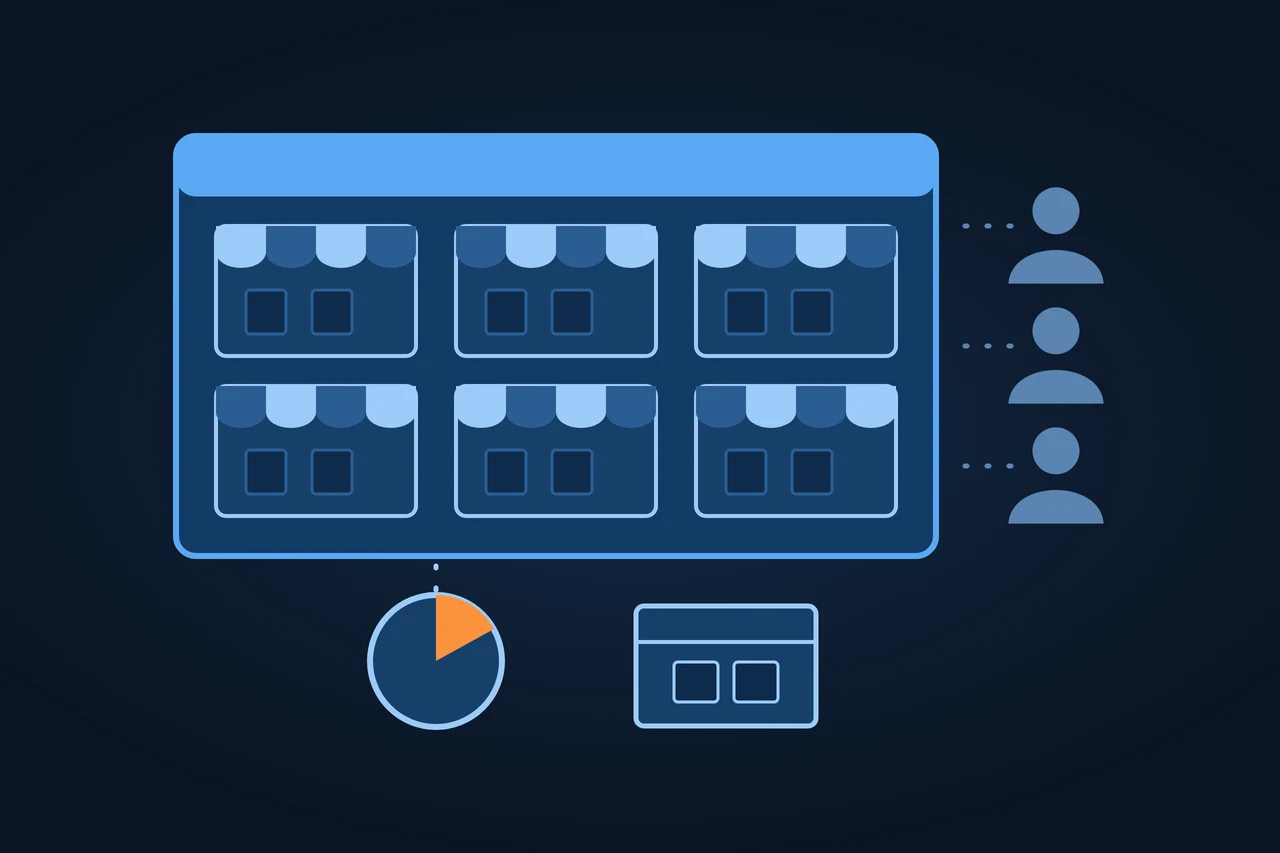
A large hall with six stalls from different sellers, each with its own awning; on the right, three buyers with dotted paths to the hall; below, a coin from which the platform cuts an orange slice and, next to it, its warehouse with two boxes, on a dark blue ground.
On this page 13
  1. Origin of the term
  2. History and development
  3. How it works
  4. Types and variants
  5. Examples
  6. Advantages and disadvantages
  7. How it differs from related concepts
  8. Criticism and limits
  9. Legal framework
  10. How to apply it, step by step
  11. Best practices
  12. Common mistakes
  13. How this entry was made
In brief

What an online marketplace is, how it makes money, the main types, sourced examples, and what the EU's DSA and P2B Regulation require.

A large hall with six stalls from different sellers, each with its own awning; on the right, three buyers with dotted paths to the hall; below, a coin from which the platform cuts an orange slice and, next to it, its warehouse with two boxes, on a dark blue ground.

Origin of the term

A marketplace was a town square where traders sold their goods; online, the word moved to platforms with many sellers. EU consumer law defined the "online marketplace" in Directive (EU) 2019/2161, the Omnibus Directive.

Facebook Marketplace shares the name but worked differently from the start. When Facebook launched it on 3 October 2016, it described a place to buy and sell items with people in your community and said that Facebook did not handle payment or delivery.

History and development

  • 3 October 2016: Facebook launches Marketplace for local buying and selling between people.
  • 11 April 2019: in his letter to shareholders on 2018, Jeff Bezos writes that independent sellers now account for more than half of the physical goods sold on Amazon by value, and credits Fulfillment by Amazon and Prime for part of that growth.
  • 12 July 2020: Regulation (EU) 2019/1150, the P2B Regulation, applies.
  • 28 May 2022: EU member states apply the Omnibus Directive.
  • 25 April 2023: the European Commission designates AliExpress, Amazon Store and Zalando as very large online platforms under the Digital Services Act (DSA).
  • 17 February 2024: the DSA applies to all online platforms.
  • 26 April and 31 May 2024: the Commission also designates Shein and Temu.

How it works

The operator runs the platform, sets the terms and decides the order of offers. Sellers publish listings and fulfil orders. Buyers compare offers and check out on the platform.

Shipping takes one of two routes. Either the seller stores the goods and ships each order, or the platform stores, packs and ships (order fulfillment) on the seller's behalf. Amazon calls this Fulfillment by Amazon (FBA), with Fulfilled by Merchant (FBM) as the seller-run option. Walmart offers Walmart Fulfillment Services or Seller Fulfilled Solutions.

According to their seller pages, Amazon in the US charges selling plan fees and a referral fee per item sold, which is a percentage of the total price or a minimum amount and varies by category. Etsy charges a listing fee and, when an item sells, transaction, payment processing and offsite advertising fees. Platforms also sell ads on their own pages, which the entry retail media explains.

The two ways orders get shipped, and the operator’s three sources of income

Types and variants

CriterionVariantWhat it means
RangeHorizontalMany categories on one platform
RangeVerticalOne sector or product type, such as crafts or fashion
Who sells to whomB2CBusinesses selling to consumers
Who sells to whomB2BBusinesses selling to other businesses
Who sells to whomC2CPrivate individuals selling to each other
What is soldProducts or servicesPhysical or digital goods, or services and bookings
FulfilmentBy the platformThe platform stores and ships, as with FBA
FulfilmentBy the sellerThe seller ships from its own warehouse, as with FBM

Source: own classification; fulfilment programmes as described by Amazon and Walmart, accessed 19.11.2026.

Articles 29 to 32 of the DSA and the P2B Regulation concern sales to consumers, so they do not cover a marketplace where only businesses buy. There, the contract between platform and sellers is what counts.

Examples

As described on each platform's seller pages:

  • United States: Amazon.com, Etsy and Walmart Marketplace. Etsy calls itself "the creative marketplace" where shoppers buy directly from creative entrepreneurs.
  • Germany: Amazon.de and OTTO Market, the marketplace on otto.de, which according to OTTO is opening step by step to sellers from other European countries.
  • Spain: Amazon.es, where sellers using FBA send their goods to Amazon's European fulfilment centres and Amazon handles the order, delivery and customer service.

AliExpress, Amazon Store, Shein, Temu and Zalando are on the Commission's list of very large online platforms (dates above).

Advantages and disadvantages

For a seller, it depends on the case:

CaseForAgainst
Brand testing a new productReaches buyers already on the platform without building a shopThe operator sets the rules and the ranking
Wholesaler selling to businessesA digital channel for trade ordersTerms depend mainly on the contract with the platform
Niche retailerA vertical marketplace gathers buyers with the same interestCompetes in the same search with other sellers of the same product

Source: own assessment based on the seller pages of Amazon, Etsy, OTTO Market and Walmart, accessed 19.11.2026.

How it differs from related concepts

The comparison between your own online shop and a marketplace is in the entry e-commerce. Dropshipping describes who holds the stock, not where you sell, so a dropshipping store can also sell on a marketplace. Retail media is advertising that a platform sells on its own pages. Amazon SEO covers ranking in Amazon's internal search, which follows different rules from Google.

Criticism and limits

Sellers work under someone else's rules. The operator sets the ranking, terms and fees and can change them. The P2B Regulation requires it to explain ranking and give 15 days' notice of new terms, but it says nothing about fee levels. The customer also buys through the platform, so the next purchase may go to another seller.

How to apply it, step by step

  • Pick the marketplace by audience and range: horizontal to reach many buyers, vertical for a niche.
  • Read the fees for your category and work out the margin per order, as in the entry dropshipping.
  • Have the company details ready that the platform will ask for.
  • Prepare product data in a PIM, with GTIN and images, and send it in a product feed.
  • Decide who ships, and connect orders and stock to your ERP.
  • Adapt titles and attributes to the internal search, as explained in Amazon SEO.

Best practices

  • Save a copy of the terms on the day you sign up, so you can see later what changed.
  • Manage product data in one system.
  • Compare the fees charged each month with your own calculation.
  • Keep your own shop or customer list alongside the marketplace.

Common mistakes

  • Setting prices without the commission and the monthly fee.
  • Treating Facebook Marketplace, built for local sales between people, like a marketplace for professional sellers.
  • Creating listings by hand on each platform and ending up with different prices.
  • Leaving stock unconnected and selling items that are out of stock.

How this entry was made

This entry was written in November 2026 with AI assistance. The facts come from EUR-Lex, the European Commission, the seller pages of Amazon, Etsy, OTTO Market and Walmart, and the Amazon and Facebook publications cited, accessed 19.11.2026. It was checked before publication and contains no customer data.

Manuel Riveiro Rodriguez CEO & Digital Strategist

A technical audit covers this and everything else in one pass.

Request an audit

Frequently asked

What is an online marketplace, with examples?

A platform where many sellers offer their products and the operator charges fees or commissions. Examples include Amazon.com, Etsy and Walmart Marketplace in the US, OTTO Market in Germany and Amazon.es in Spain.

What are the types of online marketplaces?

They differ by range (horizontal or vertical), by who sells to whom (B2C, B2B or C2C), by what is sold (products or services) and by who ships (the platform or the seller).

What is a B2B marketplace?

A marketplace where businesses sell to other businesses. Articles 29 to 32 of the DSA and the P2B Regulation do not cover it, because they concern sales to consumers; the contract between platform and sellers is what counts.

How do online marketplaces make money?

Through fixed fees, commissions on sales, services such as storage and shipping, and advertising. Amazon, for example, combines selling plan fees with a referral fee per item that varies by category.

Is Amazon a marketplace?

Yes, and a retailer too. Amazon sells goods itself and lets independent sellers list theirs; in its 2019 shareholder letter it said those sellers accounted for more than half of physical goods sold on Amazon by value.

Sources

  1. EUR-Lex, Directive (EU) 2019/2161 of the European Parliament and of the Council of 27 November 2019 (Omnibus Directive).
  2. EUR-Lex, Regulation (EU) 2022/2065 of the European Parliament and of the Council of 19 October 2022 on a Single Market for Digital Services (Digital Services Act).
  3. EUR-Lex, Regulation (EU) 2019/1150 of the European Parliament and of the Council of 20 June 2019 on promoting fairness and transparency for business users of online intermediation services.
  4. European Commission, "Supervision of the designated very large online platforms and search engines under DSA", updated 17.11.2026.
  5. Amazon, "Vender en Amazon FBA: impulsa tu negocio" (in Spanish).
  6. Amazon, "How much does it cost to sell on Amazon?".
  7. OTTO Market, "Händler werden auf otto.de" (in German).
  8. Etsy, "How to sell on Etsy United States".
  9. Walmart, "Walmart Marketplace".
  10. Amazon, "2018 Letter to Shareholders", 11 April 2019.
  11. Meta, "Introducing Marketplace: Buy and Sell With Your Local Community", 3 October 2016.
  12. Amazon, "Sell on Amazon".
  13. Amazon, "Amazon FBA (Fulfillment by Amazon)".