
Skip to content

Glossary Order fulfillment

What is order fulfillment? Process, models and examples

  • SEO Basics
Definition

Order fulfillment covers every step between an order in an online shop and the goods arriving at the customer: receiving, storage, picking, packing, shipping and handling returns. A seller can do this in house or hand it to a fulfilment service provider or a marketplace. EU law defines who counts as a fulfilment service provider.

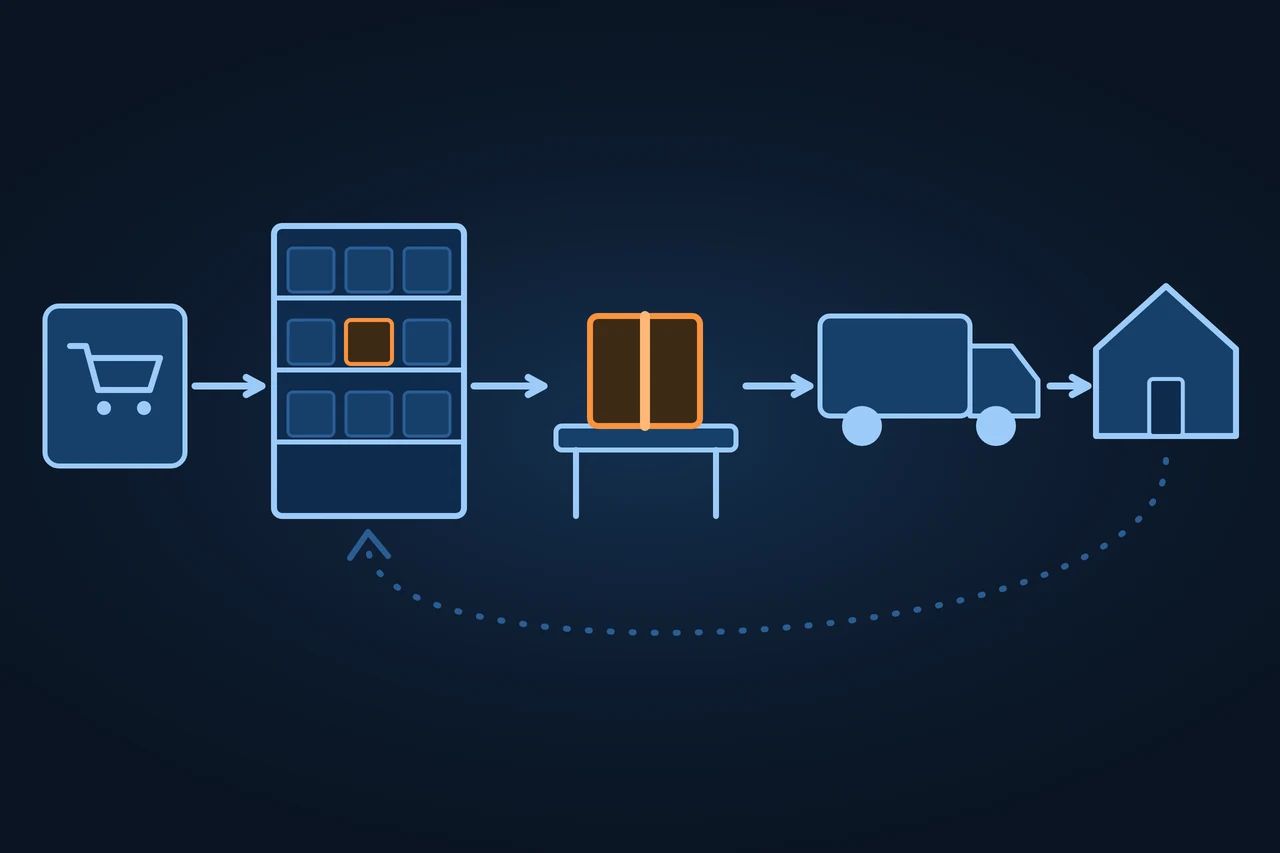
From left to right: an order with a cart on a screen, a warehouse shelf with an orange box, a packing table with an orange parcel sealed with tape, a van and a house, linked by arrows; from the house, a dotted path runs back underneath to the shelf, on a dark blue ground.
On this page 14
  1. Origin of the term
  2. How it works
  3. Types and variants
  4. Examples
  5. How to measure it
  6. Advantages and disadvantages
  7. How it differs from related concepts
  8. Tools
  9. Criticism and limits
  10. Legal framework
  11. How to apply it, step by step
  12. Best practices
  13. Common mistakes
  14. How this entry was made
In brief

What order fulfillment is, how the chain runs from warehouse to returns, the main models, shop statuses and EU rules for fulfilment providers.

From left to right: an order with a cart on a screen, a warehouse shelf with an orange box, a packing table with an orange parcel sealed with tape, a van and a house, linked by arrows; from the house, a dotted path runs back underneath to the shelf, on a dark blue ground.

Origin of the term

In everyday English, fulfilment means a feeling of satisfaction with your life, and the Cambridge and Oxford Learner's dictionaries list that sense separately. In business the word means completing what an order requires. Cambridge gives two commercial senses: order fulfilment, the process of taking an order and sending a product to a customer, and a company's service of sending out advertising, taking orders, accepting payment and sending out goods for other companies.

Spelling varies. British English and EU law write "fulfilment"; according to Cambridge, US English usually writes "fulfillment". Amazon, Shopify, WooCommerce and BigCommerce write it with a double l.

Article 3(11) of Regulation (EU) 2019/1020 on market surveillance defines the "fulfilment service provider" as anyone who, in the course of commercial activity, offers at least two of the following services: warehousing, packaging, addressing and dispatching, for products they do not own. Postal services, parcel delivery services and freight transport services are excluded. The German version says "Fulfilment-Dienstleister", the Spanish one "prestador de servicios logísticos".

How it works

The physical chain has seven steps, and each can go wrong in its own way.

  • Receiving: goods arrive from the manufacturer or supplier and are counted, checked and booked into the system. Mistakes here show up later as wrong stock levels in the shop.
  • Storage: every item gets a bin location. If the system records the wrong location, nobody finds the item at picking time.
  • Order handover: the shop or ERP passes the order to the warehouse through an interface or EDI. If it never arrives, the order stays "unfulfilled" in the shop.
  • Picking: a person or a machine collects the items. A wrong size, colour or variant here means the customer gets the wrong product.
  • Packing: the goods go into a shipping box with a delivery note and, where used, a return label. The packaging rules described under the legal framework apply here.
  • Shipping: the parcel goes to a carrier and the tracking number goes back to the shop. Without it the customer cannot follow the delivery.
  • Returns (reverse logistics): the goods come back, are checked and either restocked or written off. The shop then issues the refund.
The chain from receiving to returns, with the typical failure at each step

Types and variants

The models differ in who stores and ships the goods and who owns them while they do.

ModelWho stores and shipsWho owns the goodsExample
In-house fulfillmentthe sellerthe sellerown warehouse; at Amazon, "Fulfilled by Merchant"
Fulfilment service provider (3PL)an outside providerthe sellerlogistics company with warehouse and shipping
Fulfillment by the marketplacethe marketplacethe sellerFulfillment by Amazon, Multichannel Fulfillment
Dropshipping (the opposite case)the supplierthe supplierthe seller holds no stock

Source: own classification based on Article 3(11) of Regulation (EU) 2019/1020 and Amazon's programme pages, accessed 20.11.2026.

3PL stands for third-party logistics. DHL describes a 4PL as a single partner that designs and runs the client's whole supply chain, coordinating warehouses, carriers, forwarders and agents, while a 3PL concentrates on carrying out the logistics itself.

Examples

Amazon offers all three routes; the details come from its seller pages. Fulfillment by Amazon (FBA) lets sellers send products to Amazon's fulfillment centers, after which Amazon picks, packs and ships orders and handles customer service and returns. In Germany the same programme is called "Versand durch Amazon", in Spain "Logística de Amazon". With Multichannel Fulfillment, Amazon says it also picks, packs and ships orders from a seller's other sales channels, such as the seller's own shop. Sellers who ship themselves sell as "Fulfilled by Merchant".

Platforms can also give such programmes up. On 6 June 2023 Shopify completed the sale of most of its former Shopify Logistics business to Flexport, so the Shopify Fulfillment Network no longer exists in its old form.

How to measure it

The formulas in the table are working definitions. Write them into any contract with a provider exactly as defined, so that both sides measure the same thing.

MetricFormula (own definition)What it shows
Cycle timetime of handover to the carrier minus time of orderspeed in the warehouse
Error-free shipmentsshipments without a complaint about wrong items or quantities ÷ all shipmentspicking quality
On-time deliveryshipments arriving by the promised date ÷ all shipmentsthe delivery promise in the shop
Return ratereturned orders ÷ shipped orders in the same periodreturns volume and cost

Source: own definitions, as of 20.11.2026.

The figures depend on the product range, the season and on when an order is counted as shipped, so compare your own months with each other.

A provider's costs can consist of several items: inbound handling, storage space over time, picking per line, packaging material, shipping and returns processing. Convert them to a cost per order, or offers cannot be compared.

Advantages and disadvantages

In-house fulfillment gives you full control over packaging, speed and returns. In return you carry the fixed costs of warehouse and staff in slow months too, and you have to absorb seasonal peaks yourself.

A fulfilment service provider turns those costs into variable ones and can cover peaks with its own staff. You give up visibility and direct control, though. Picking errors only show up in complaints, and changing provider means moving your whole stock.

Fulfillment by the marketplace gives you the platform's delivery promise. You then depend on its rules, fees and storage conditions, and your stock sits with a company that may also compete with you as a seller.

How it differs from related concepts

An online marketplace is a sales channel; fulfillment is the logistics behind the sale. The two can coincide, as with Fulfillment by Amazon, but they do not have to. In dropshipping you hold no stock at all and the supplier ships straight to your customer. Fulfillment is one part of e-commerce, not the same thing. A 3PL is a fulfilment service provider in the legal sense if it offers at least two of the four services; a pure parcel carrier is not.

Tools

Shop systems show a fulfillment status on every order. The labels differ; the meanings below come from each system's help pages.

Shop systemStatusMeaning according to the system
ShopifyUnfulfillednew order, nothing shipped yet
ShopifyPartially fulfilledpart of the items fulfilled
ShopifyFulfilledall items fulfilled and shipped
WooCommerceProcessingpaid, stock reduced, awaiting fulfillment
WooCommerceCompletedfulfilled and complete
BigCommerceAwaiting Fulfillmentcheckout completed, payment confirmed
BigCommercePartially Shippedonly some items shipped

Source: help pages of Shopify, WooCommerce and BigCommerce, accessed 20.11.2026.

"Unfulfilled" or "awaiting fulfillment" does not mean something has gone wrong. In Shopify every new order gets the Unfulfilled status until you fulfil it or set orders to be fulfilled automatically. Shopify also has "In progress" for orders being picked and packed and "On hold", for example while an upsell offer is shown at checkout. In WooCommerce the store owner or warehouse changes the status from Processing to Completed by hand, according to WooCommerce. How this looks in each system is covered under WooCommerce, Shopify and Shopware.

Criticism and limits

A provider's metrics are only as good as their definitions. Without a written formula each side measures differently, and a dispute about errors cannot be settled. There is also the dependency: if a provider drops its programme, as Shopify did with most of its logistics business in 2023, you have to move at short notice.

How to apply it, step by step

  • Decide which steps you keep and which you hand over.
  • Check that the provider has an interface to your shop and your ERP that passes stock, orders and tracking numbers in both directions.
  • Ask to see the returns process: who inspects, how fast items are restocked, when the shop triggers the refund.
  • Have ready what the provider must check under the Packaging Regulation: registration and self-certification.
  • Put the metrics, with their formulas, into the contract.
  • Test with a small part of the range before moving all your stock.

Best practices

  • Convert every cost item to a cost per order.
  • Reconcile shop stock with warehouse stock every day.
  • Track the return rate per item, not only for the shop as a whole.
  • Keep your producers' registration numbers up to date, or the provider may not ship.

Common mistakes

  • Comparing offers without working out the cost per order.
  • Treating "unfulfilled" in the shop as an error.
  • Assuming the old national packaging law still applies in Germany after August 2026.
  • Agreeing on metrics without formulas.
  • Confusing dropshipping with fulfillment: in dropshipping the seller holds no stock.

How this entry was made

This entry was written in November 2026 with AI assistance. The facts come from EUR-Lex, gesetze-im-internet.de, the Cambridge and Oxford Learner's dictionaries, the help pages of Shopify, WooCommerce and BigCommerce, Amazon's seller pages and publications by Shopify and DHL, accessed 20.11.2026. It was checked before publication and contains no customer data.

Manuel Riveiro Rodriguez CEO & Digital Strategist

A technical audit covers this and everything else in one pass.

Request an audit

Frequently asked

What does fulfillment mean in business?

Completing an order: taking it, storing and picking the goods, packing and shipping them, and handling returns. Outside business, fulfilment also means personal satisfaction, which is why business texts say order fulfillment.

What is a fulfillment center?

A warehouse where a fulfilment provider or marketplace stores sellers' goods and picks, packs and ships their orders. Amazon, for example, calls its warehouses for the FBA programme fulfillment centers.

What does "awaiting fulfillment" mean?

The order has been paid and is waiting to be picked, packed and shipped. BigCommerce uses Awaiting Fulfillment for paid orders of physical goods; WooCommerce describes its Processing status the same way.

What is a 3PL?

A third-party logistics provider that stores and ships goods for other companies. In EU law it is a fulfilment service provider if it offers at least two of warehousing, packaging, addressing and dispatching for goods it does not own.

What is the difference between fulfillment and dropshipping?

With fulfillment your goods sit in a warehouse, your own or a provider's. With dropshipping you hold no stock and the supplier ships straight to your customer.

Sources

  1. EUR-Lex, Regulation (EU) 2019/1020 of the European Parliament and of the Council of 20 June 2019 on market surveillance and compliance of products.
  2. EUR-Lex, Regulation (EU) 2025/40 of the European Parliament and of the Council of 19 December 2024 on packaging and packaging waste.
  3. gesetze-im-internet.de, Verpackungsrecht-Durchführungsgesetz (VerpackDG) (in German).
  4. Cambridge Dictionary, "fulfilment".
  5. Amazon, "Vender en Amazon FBA" (in Spanish).
  6. Amazon, "Amazon FBA (Fulfillment by Amazon)".
  7. Amazon, "Multichannel Fulfillment (MCF)".
  8. Shopify Help Center, "How order statuses work".
  9. WooCommerce, "Order Statuses Documentation".
  10. BigCommerce Help Center, "Order Statuses".
  11. Shopify, "Shopify Completes Sale of Shopify Logistics to Flexport", 6 June 2023.
  12. DHL Freight Connections, "What is Fourth Party Logistics?".
  13. gesetze-im-internet.de, § 6 ElektroG (in German).
  14. Amazon, "Versand durch Amazon (FBA)" (in German).
  15. EUR-Lex, Directive 2011/83/EU of the European Parliament and of the Council of 25 October 2011 on consumer rights.
  16. Oxford Learner's Dictionaries, "fulfilment noun".