
Skip to content

Glossary Shopify

What Is Shopify and How Does It Work?

  • SEO Basics
Definition

Shopify is a hosted commerce platform, sold as software as a service, from the Canadian company Shopify Inc. Merchants manage products, orders and payments in one admin and sell through their own online store, in physical shops with Shopify's point of sale and through other channels. Shopify runs the servers, the updates and the checkout; the merchant pays a monthly or yearly subscription.

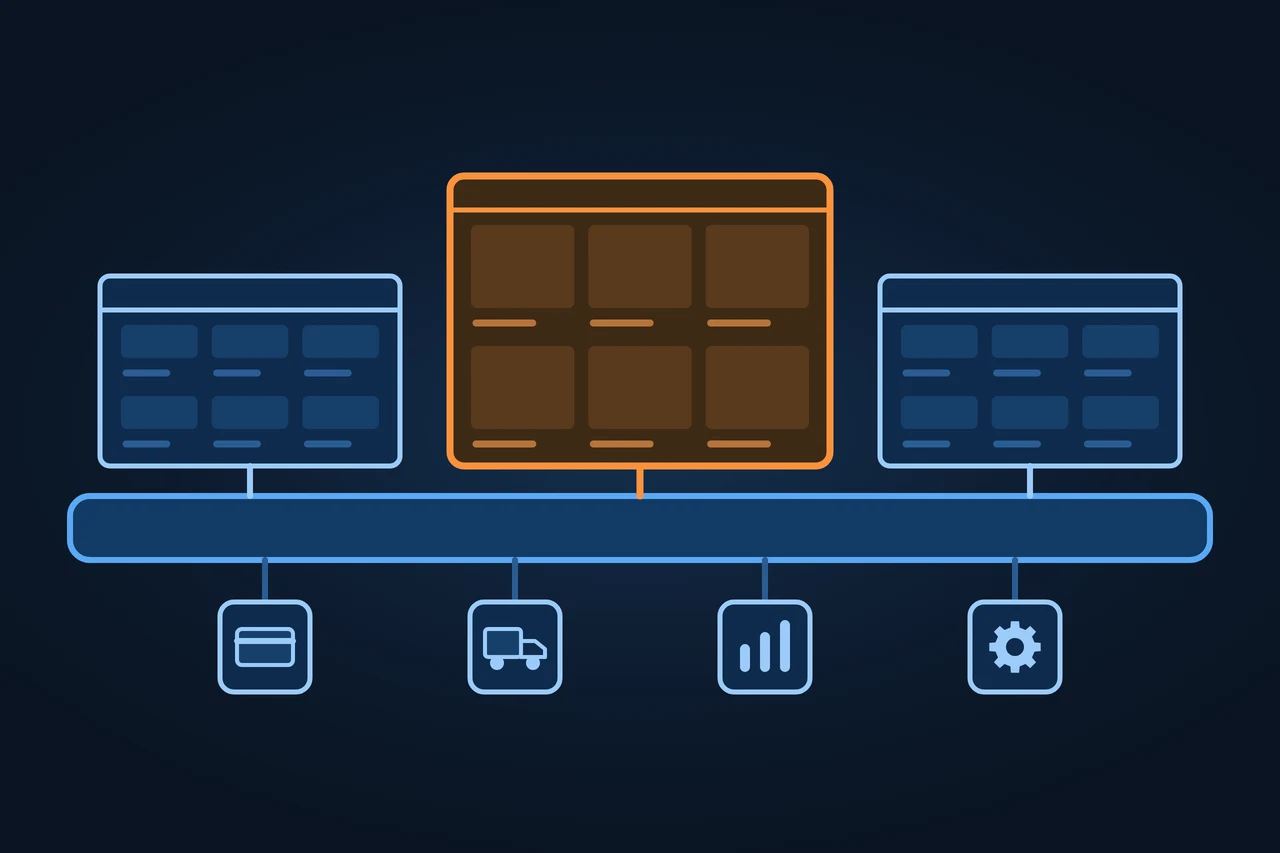
Three online shop windows with products standing on one wide platform; the middle one is larger and orange, and below the platform four modules are plugged in: a card, a van, some bars and a gear, on a dark blue ground.
On this page 13
  1. History and development
  2. How it works
  3. Types and variants
  4. Examples
  5. How to measure it
  6. Advantages and disadvantages
  7. How it differs from related concepts
  8. Criticism and limits
  9. Legal framework
  10. How to apply it, step by step
  11. Best practices
  12. Common mistakes
  13. How this entry was made
In brief

Shopify: the hosted commerce platform of Shopify Inc. How it works, history, pricing model without amounts, platform SEO and legal duties.

Three online shop windows with products standing on one wide platform; the middle one is larger and orange, and below the platform four modules are plugged in: a card, a van, some bars and a gear, on a dark blue ground.

History and development

According to its May 2015 IPO prospectus, the first Shopify store belonged to the founders. In 2004 they set up an online snowboard shop and, because the software they found did not suit them, wrote their own. They launched it in 2006 under the name Shopify. That is why two dates circulate: Shopify Inc. was incorporated on 28 September 2004, and the platform came out in 2006. The prospectus lists Tobias Lütke as having co-founded Shopify in September 2004 and as CEO since April 2008, and Daniel Weinand as co-founder of the platform.

  • 2004: the founders' own online snowboard shop; the company is incorporated on 28 September.
  • 2006: the Shopify platform launches.
  • August 2013: Shopify Payments in the United States, followed by Canada in September 2013 and the United Kingdom in November 2014.
  • February 2014: Shopify Plus launches.
  • May 2015: listing on the New York Stock Exchange (NYSE) under the symbol SHOP and the Toronto Stock Exchange (TSX) under the symbol SH; the offering closed on 27 May. The prospectus mentions more than 165,000 stores and more than 900 apps.
  • 31 March 2025: the shares move from the NYSE to Nasdaq and remain listed on the TSX.
  • 31 December 2025: according to the annual report, "millions" of merchants from more than 175 countries, more than 21,000 apps and approximately 7,600 employees.

In that annual report, Shopify gives Ottawa (Ontario) and New York as its addresses. Forty-four per cent of its merchants are in the United States and 31 % in Europe, the Middle East and Africa.

How it works

Shopify is a hosted system. Shopify runs the server, the checkout and the updates; the merchant installs no software. In the admin, the merchant adds products and manages inventory, orders and shipping across all channels.

The look of the store comes from the theme. Themes are written in Liquid, a template language that Shopify created and publishes as open source. Each page type has its own template: product, collection, page, blog, cart or the home page.

Features the system does not include come from apps. According to Shopify, apps run inside its own surfaces and work with its APIs and store data, and apps in the Shopify App Store pass a review before they are listed. A company can also have a custom app built that only it installs.

To take payments, the merchant uses Shopify Payments, Shopify's integrated payment solution, or a third-party provider. Shopify Payments has its own help pages for countries such as Spain, Mexico, Germany, Austria and Switzerland. With a third-party provider, according to the pricing page, a transaction fee may apply, and its rate depends on the plan.

Sales channels run from the same admin. The 2025 annual report names online storefronts, physical retail, AI platforms and social media; for in-person selling, Shopify sells hardware and a POS Pro subscription per location. Anyone who wants their own frontend can use Shopify only as the back end, with the Storefront API and Hydrogen; that model is explained under headless commerce.

Types and variants

Shopify lists four plans on its pricing page (Internet Archive copy of 14.11.2026):

  • Basic, "for solo entrepreneurs".
  • Grow, "for small teams", with up to 5 staff accounts.
  • Advanced, "for global reach", with up to 15 staff accounts and live third-party shipping rates.
  • Plus, "for complex businesses", with unlimited staff accounts, a fully customizable checkout, unlimited B2B catalogs and up to 200 POS Pro locations. Plus is signed for one or three years.

The pricing model has four parts, given here without amounts because they change:

  • The plan subscription, monthly or yearly.
  • A fee for each card payment through Shopify Payments, which according to the pricing page falls with higher plans.
  • A transaction fee when a third-party payment provider is used, also depending on the plan.
  • Paid apps, themes and domains. According to the annual report, Shopify earns revenue from selling them.

Current amounts are on Shopify's pricing page (see Sources). According to the annual report, most merchants subscribe to Basic or Grow, while most of the sales volume comes from merchants on Plus and the enterprise offerings.

Examples

A sample case with fictitious names shows what an SEO agency needs to know about the platform. A store sells the "blue-t-shirt" in the "summer" collection.

  • The product page lives at /products/blue-t-shirt and the collection at /collections/summer. /collections/all lists every product.
  • If the theme links the product with the within filter, the same product page also appears at /collections/summer/products/blue-t-shirt. Shopify's documentation warns that these are two URLs with the same content.
  • According to Shopify's blog (August 2025), themes from the Theme Store handle that duplicate with an automatic canonical tag; a third-party theme may not.
  • The sitemap is generated automatically at /sitemap.xml, with separate sitemaps for products, collections, blogs and pages.
  • The robots.txt is a default file. To change it, the theme needs the robots.txt.liquid template.
  • If the store opens France at /fr/ with Shopify Markets, Shopify adds the hreflang tags and extends the sitemap.

When migrating from another system, the store redirects the old /t-shirts/blue to /products/blue-t-shirt. The reverse is not possible: according to Shopify's help, the fixed paths /products, /collections and /collections/all cannot be redirected, and only URLs that already return an error can be.

The theme documentation also includes templates for /agents.md, /llms.txt and /llms-full.txt, which describe the store to AI agents (as of 15.11.2026).

How many addresses open your product?

How to measure it

Shopify measures its own business with two indicators, according to its annual report. Gross merchandise volume (GMV) is the total value of orders processed through the platform, including shipping and taxes and net of refunds; it is not Shopify's revenue. Monthly recurring revenue (MRR) adds up all subscriptions in effect on the last day of the period.

SegmentWhat it includesRevenue 2025Share 2025
Subscription solutionsSubscriptions, POS Pro, apps, domains and themesUSD 2,752 million (+17 %)24 %
Merchant solutionsShopify Payments fees, lending, shipping labels, POS hardware, App Store advertisingUSD 8,804 million (+35 %)76 %

Source: Shopify Inc., annual report (Form 10-K) for fiscal 2025, filed with the SEC on 11.02.2026.

In total, Shopify's revenue was USD 11,556 million in 2025, 30 % more than in 2024. GMV reached USD 378.4 billion (+29 %), and MRR stood at USD 205 million at year end. In the third quarter of 2026, according to the release of 3 November, GMV reached USD 119,145 million and revenue USD 3,742 million, 32 % more than a year earlier.

Advantages and disadvantages

On the plus side, the merchant runs no servers or updates, and the online store, physical shops and other channels share one admin. The more than 21,000 apps cover features the system does not include.

On the minus side, costs add up: plan, payment fees, the fee for a third-party provider, and apps. The URL structure is fixed, and anyone who wants to change robots.txt edits a template that Shopify Support does not help with.

How it differs from related concepts

WooCommerce describes itself as "the open-source ecommerce platform for WordPress" and is developed by Automattic. The merchant installs it on their own WordPress site and hosting. Shopify, by contrast, is a subscription hosted by Shopify.

A marketplace such as Amazon sells many merchants' products under its own brand. According to its terms, Shopify is not a marketplace: the merchant sells in their own store and is the seller of each order. The difference between an own store and a marketplace is explained under e-commerce.

Criticism and limits

In its annual report, Shopify lists among its risks that it depends on third-party apps and themes: if their developers change them, merchants can be harmed. Third-party apps can also store personal and payment data, and security flaws in them are another risk. In addition, the founder's special share (the Founder Share) concentrates between 40 % and 49.9 % of the votes with Tobias Lütke.

For merchants, the limits are technical: fixed URL paths, redirects only from broken URLs, and a robots.txt whose editing Shopify calls an "unsupported customization". If it is used incorrectly, the help page warns, all traffic can be lost. Shopify lets merchants export products to CSV and names backup, bulk editing and moving to another Shopify store as uses.

How to apply it, step by step

  • Choose the payment method before the plan, because a third-party provider adds a transaction fee.
  • Check the plan, card fee and third-party fee amounts on the pricing page.
  • If you are migrating, list your old URLs and redirect them to their new paths under /products/ and /collections/.
  • Choose a Theme Store theme or check that yours outputs the canonical tag.
  • If you sell in several countries, set up markets with subfolders.
  • Publish contact details, terms, returns, shipping and the information your country's law requires.
  • Submit the sitemap to Google Search Console.

Best practices

  • Change robots.txt with Liquid inside robots.txt.liquid, as Shopify recommends, so the file keeps updating automatically.
  • Export your products to CSV as a backup.
  • Review how many paid apps you use and what each one does.
  • Check that each market has its own redirects.

Common mistakes

  • Trying to redirect a /products/ URL that still works: Shopify only redirects broken URLs.
  • Blocking necessary paths in robots.txt.liquid; the help page warns that all traffic can be lost.
  • Linking products inside collections with a theme that outputs no canonical.
  • Assuming redirects apply to every market subfolder.
  • Assuming Shopify covers the store's legal obligations.

How this entry was made

This entry was written in November 2026 with AI assistance. The figures come from the documents Shopify files with the SEC; how the platform works and its SEO come from Shopify's help center and shopify.dev. It was reviewed before publication and contains no client data.

Manuel Riveiro Rodriguez CEO & Digital Strategist

A technical audit covers this and everything else in one pass.

Request an audit

Frequently asked

What is Shopify used for?

To build and run an online store and to sell in physical shops, on social media and through other channels from one admin, without running your own servers.

How much does Shopify charge for selling?

Shopify charges a subscription per plan, a fee for each card payment and, if a third-party payment provider is used, a transaction fee. The amounts depend on the plan and are on its pricing page.

Is Shopify legit?

Shopify Inc. is listed on Nasdaq and the Toronto Stock Exchange and files its accounts with the US SEC. According to its 2025 annual report, millions of merchants from more than 175 countries use it.

Shopify or WooCommerce?

They follow different models. Shopify is a subscription hosted by Shopify; WooCommerce is an open-source extension that the merchant installs on their own WordPress site.

Can you do dropshipping with Shopify?

Yes. Shopify's terms allow for the merchant working with a third-party supplier and ask the merchant to tell customers about it.

Sources

  1. Shopify Inc., annual report (Form 10-K) for fiscal 2025, filed 11 February 2026.
  2. Shopify Inc., third-quarter 2026 results release, 3 November 2026.
  3. Shopify Inc., IPO prospectus (Form 424B4), 21 May 2015.
  4. Shopify Inc., Form 8-K on the transfer of the listing from the NYSE to Nasdaq, 18 March 2025.
  5. Shopify, "Terms of Service", updated 20 October 2026, Internet Archive copy.
  6. Shopify.dev, "Liquid reference".
  7. Shopify.dev, "Templates".
  8. Shopify.dev, "Liquid filters: within".
  9. Shopify.dev, "Build", on apps and their distribution.
  10. Kyle Risley, "How To Set a Canonical URL for a Shopify Page Using Metafields", Shopify blog, 14 August 2025.
  11. Shopify Help Center, "Creating and managing URL redirects".
  12. Shopify Help Center, "Finding and submitting your sitemap".
  13. Shopify Help Center, "Editing robots.txt.liquid".
  14. Shopify Help Center, "International SEO for markets".
  15. Shopify Help Center, "Exporting products".
  16. Shopify Help Center, countries with Shopify Payments.
  17. WordPress.org, "WooCommerce – WordPress plugin".
  18. Shopify, "Pricing", Internet Archive copy of 14 November 2026.