In-house Search Engine Instead of SaaS: What We Built in Our Test Shop in 24 Hours
Mercadona replaced its product search with its own AI system, saving 94% of costs. We followed the same path in our own test shop, and here we show you what a self-hosted real-time search engine actually costs, can do, and cannot do.
Mercadona, one of Spain's largest food retailers, announced last week that they had replaced their product search with their own AI-assisted system, thereby saving 94% of costs compared to the previous solution.
This is not an isolated case but a symptom of a trend: search is one of the most expensive components in the modern e-commerce stack, and at the same time, one of the most easily replaceable.
With werkking.de, we operate our own affiliate shop, which we specifically use as a test lab for e-commerce topics. Everything we recommend to our clients, we test there first. Last week, it was search's turn. The result: a complete real-time search for about 10,000 products, over 250 categories, and more than 70 guide articles — setup in one workday, ongoing hosting costs effectively zero.
The Problem with Hosted Search
The standard answer to “We need better search” in medium-sized businesses is usually: a SaaS provider like Algolia, Elastic Cloud, Searchanise, or Doofinder. The advantages are real: well-documented, quick integration, support included. The price is also real:
- Algolia starts at around €0.40 per 1,000 searches, plus indexing volume. For a shop with 50,000 monthly searches, €250–600 per month is normal, and with larger assortments, it quickly reaches four figures.
- Lock-in: The search API integrates deeply into the Frontend. A subsequent migration is a retailer's decision, not a refactoring detail.
- Data Sovereignty: Search queries are perhaps the most honest signal a shop receives: what customers actually want, before they click. Sending this data to a third party is a conscious decision. In some industries, it's also a regulatory issue.
Mercadona is an exception only because they communicate it. Many do the maths quietly.
What We Built at werkking.de
werkking.de is our own affiliate shop for tools and DIY with over 10,000 products, several hundred categories, and a growing guide section. We deliberately use it as a playground for topics we later want to recommend to clients: search, performance, SEO structures. Before we sell anything, we do it ourselves there.
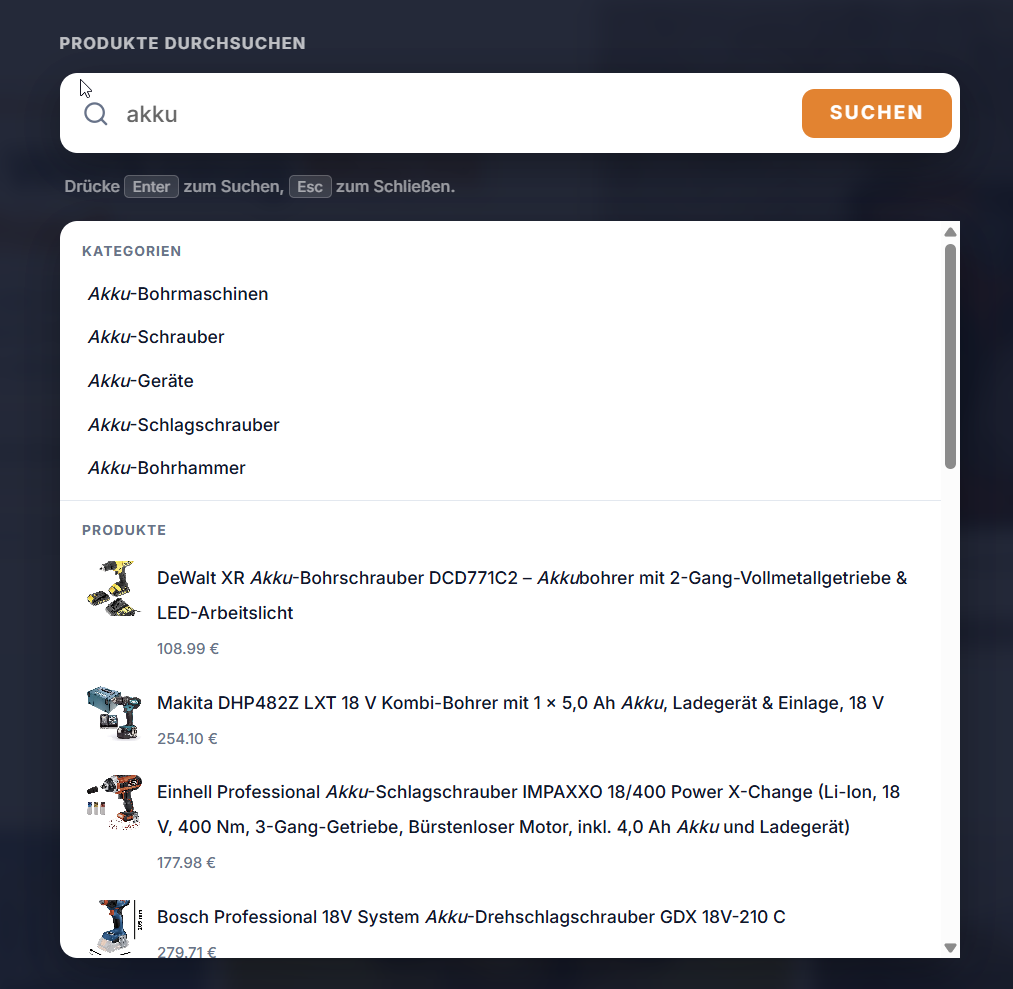
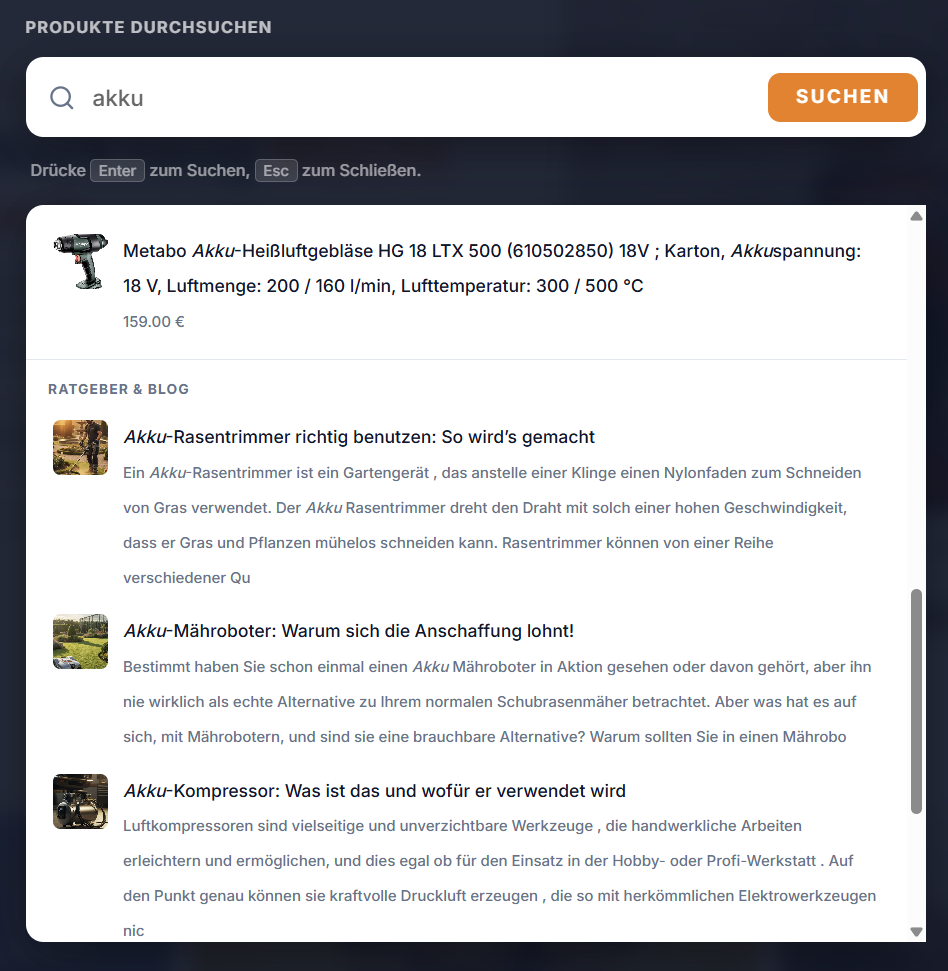
You can try the new search live: top right on werkking.de, click the magnifying glass icon, then type a few letters — results appear as you type, grouped by Categories · Brands · Products · Guide Articles. Response times are usually under 30 milliseconds.
What happens technically, in a nutshell: a self-hosted, lightweight open-source search index runs as a small service on the same server as the shop, the Frontend search queries it via a narrow proxy interface from the shop, and content is automatically updated in the index with every product or post change.
The architecture is deliberately kept small:
- Index Service: a single process, ~400MB RAM at full load, maintains three indices (products, categories, posts).
- Synchronisation: no nightly re-indexing. Webhooks from the shop (each product save action) send individual documents in real-time.
- Frontend: a lightweight search overlay, no JavaScript framework, no build step.
What the solution can do, without it being in the code:
- Typo Tolerance: “mata kit” finds “Makita”. Standard, not an extra.
- Multilingual Root Forms: Spanish singular/plural without configuration.
- Filterable Fields: brand, availability, price range can be combined.
- Highlighting: search terms are highlighted in the result.
What it honestly cannot do: the AI layer Mercadona uses for semantic meaning (“gift for father-in-law” → correct suggestions) is a higher level of complexity. For most shops in the 1,000 to 100,000 product range, this is not the bottleneck; fast keyword search with typo tolerance is.
When Is It Worthwhile?
An in-house search engine makes sense, in our experience, if at least two of the following points apply:
- From ~5,000 products or several thousand monthly searches — below that, standard WordPress/Shopware search is usually sufficient, or SaaS costs are small enough not to question.
- A server already exists — hosting the search service effectively costs no additional pennies if the shop is already running on its own machine. For purely SaaS shops (Shopify without a side server), the calculation is different.
- Search queries are a business-critical data source — who searches for what, when they don't find anything, what terms are popular. Having this data in your own database opens up analyses that remain hidden in a SaaS console.
- The shop has or plans multi-assortment structures — multiple brands, languages, clients. SaaS pricing often scales unpleasantly here.
When it is not worthwhile: pure Shopify without a dedicated server, very small assortments of fewer than 1,000 products, or if the team lacks technical staff who can restart a service in an emergency. Honesty sells better than marketing.
From Test Shop to Client Project
That's what werkking.de is for: tackling topics ourselves beforehand, learning the hurdles, and then approaching the client with practical experience. For search, this means specifically: we know the effort, the performance characteristics, the typical data management questions. Not from a slide, but from our own production environment.
What we do when someone asks:
- Inventory: How much does the current search cost, what does the shop get in return, where does it lose customers? Usually within a week.
- Architecture Proposal: two or three variants with effort, ongoing costs, data sovereignty aspects. There is no “one size fits all” solution.
- Implementation: typically 2–4 weeks for a productive solution including Frontend, Webhook synchronisation, monitoring, and handover.
- No Lock-in: What we build belongs to the client. Code, configuration, data. No monthly licensing drip.
If the Topic Starts to Itch
Take a look at the demo in our test shop: top right on werkking.de, click the magnifying glass, “akku”, “bosch”, “badezimmer” — results appear as you type. If you think “I'd like that too, without the four-figure SaaS contract”, then let's talk. By email, via LinkedIn, or in an honest conversation about what you truly need.
Note: werkking.de is an in-house affiliate shop of ZDS. Orders placed via the links included there may generate a commission for us, at no additional cost to visitors.
Want to evaluate an in-house search engine for your shop?
Tell us which platform you're on and how many products you manage — we'll provide an honest initial assessment of whether the change pays off for you.