
True to its policy of continuously introducing features that enhance user experience, Google joins the post-holiday 'back-to-work' rush with a mobile-focused innovation. The Californian giant has just announced the launch of In Apps, a new system for finding content within Android apps.
Very similar to Apple's Spotlight, In Apps is a search tab you can add to the Google app for Android, allowing you to locate information within apps on this mobile operating system, for both phones and tablets.
Mountain View made the news public yesterday on its blog, accompanied by an animated GIF demonstrating the innovation to users.
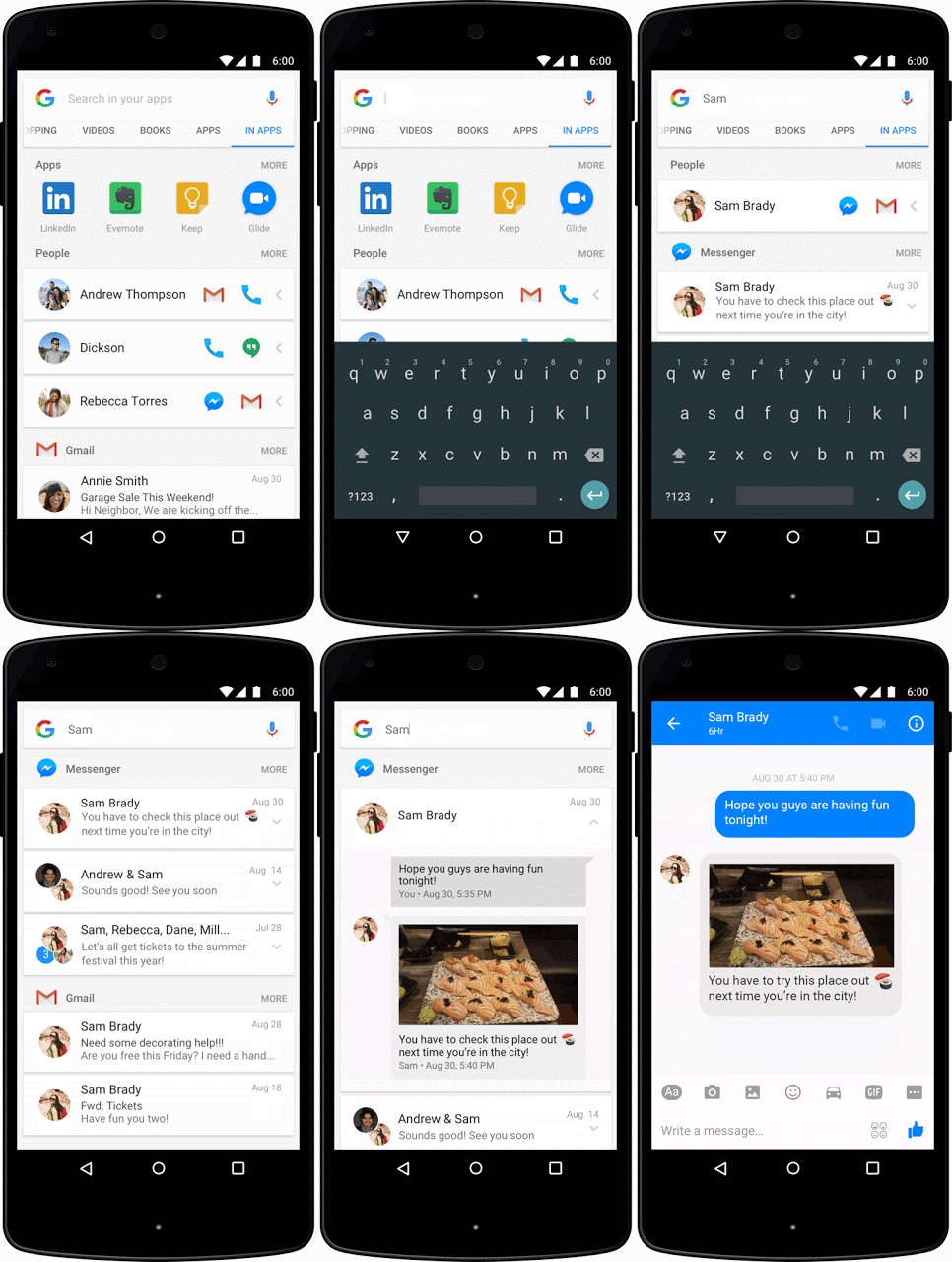
For now, Google states that this new search mode will only be compatible with Gmail, YouTube — which has been part of Google Inc. since 2006 — and Spotify. It was anticipated that, in the coming months, In Apps would also support other applications, such as LinkedIn, Facebook Messenger, Google Keep, Evernote, Todoist, and Glide.
What was a prediction in 2016 is a consolidated reality in 2024. The ability to search within applications has evolved significantly, integrating into the overall Android user experience. Tools like Google Files or the unified search functions in the latest Android versions demonstrate this maturity. In our experience working with clients, the ease of finding information within apps is a key factor for user retention and overall satisfaction, especially in sectors like e-commerce and financial services, where quick access to specific data is crucial.
One of In Apps' strengths is that it can be used even without an internet connection. This highlights that this type of in-app search differs from the services Google has offered to date.
Searches Beyond the Web: Evolution and the Role of AI
Google uses the Firebase App Indexing system, previously known as Google App Indexing. This ensures that developers and app owners can have their apps included in searches made through this engine.
Thus, when an internet search is performed via Google, this type of app indexing allows users to see content within applications, where applicable.
The new In Apps is specific to mobile devices. Searches performed through this tab do not target the web, but rather content on the user's own device.
This particularity makes Google's new functionality very similar to Apple's Spotlight, designed to find content directly on a mobile device running iOS. From now on, those with an Android device will be able to do the same.
The distinction between web searches and in-app searches has become even more blurred with the emergence of Artificial Intelligence (AI) and Large Language Models (LLMs) in search. Platforms like ChatGPT or Perplexity AI not only crawl the web but can also access and process information from structured sources and, in some cases, app data if developers allow it via APIs. This represents a fundamental shift in how users interact with information, expecting direct and contextualised answers, regardless of whether the source is a webpage or a function within an app. By 2026, generative AI will be an integral part of the Android search experience, predicting intentions and offering direct access to in-app functionalities even before the user completes their query.
Present in New Mobiles and the Importance of Integration
Google has also announced that the LG V20 phone will feature a specific shortcut for the new search application, as will other models soon.
The advantage of such a shortcut is that you won't need to perform a search to access the In Apps function (in fact, it will automatically take you to this application).
Users without this shortcut on their device can use In Apps both from the Google app and via the Google search bar widget, present on many Android devices.
The integration of these search functionalities at the operating system level has advanced tremendously. Voice assistants like Google Assistant and universal search functions in Android are designed to offer a seamless experience, allowing users to find not only web information but also contacts, files, messages, and functions within installed applications. For brands, optimising for in-app search is as crucial as traditional SEO. A well-indexed app with structured content can appear directly in operating system search results, increasing its visibility and engagement.
Why Pay Attention to Mobile Searches?
Google's mobile searches have officially surpassed desktop searches since October 2015 — at least, that's what the colourful letters company announced at the time, without counting tablets as mobile devices — yet many organisations still don't give it the attention it deserves in their SEO strategy.
If you want to know if your business is managing this crucial aspect for any site's positioning effectively, contact us or call us on 93 532 93 78.
At ZDS Digital, your digital marketing agency in Barcelona, we will review your corporate website or blog without obligation, and provide you with the keys to increase your web visibility and maximise the return on your online communication and advertising efforts. Get ready to boost your traffic and achieve more sales in a very short time!
The “Mobile-First” Era and SEO in 2024-2026: Beyond Indexing
The supremacy of mobile searches, declared by Google in 2015, has intensified. By 2024, over 60% of global web traffic comes from mobile devices, and this figure is projected to rise to 70% by 2026, according to Statista studies. This implies not just having a responsive design, but a “Mobile-First” strategy in all aspects of SEO.
Key Factors for Current Mobile SEO
- Core Web Vitals (CWV): Since 2021, CWVs are crucial metrics for Ranking. In 2024, Google replaced FID (First Input Delay) with INP (Interaction to Next Paint) as the main interactivity metric. A low INP (below 200 milliseconds) is vital for a good mobile user experience. Tools like PageSpeed Insights or Lighthouse are indispensable for monitoring and optimising these values.
- Mobile User Experience (UX): Ease of navigation, content legibility, and the absence of intrusive elements (like excessive pop-ups) are fundamental. Google actively penalises sites with poor mobile UX.
- “Helpful” Content and E-E-A-T: With Google updates like the “Helpful Content Update” (HUU) from 2022-2024, content must be original, useful, and created by experts (Expertise, Experience, Authoritativeness, Trustworthiness). This is especially relevant on mobile devices, where users seek quick, reliable answers. For ZDS Digital, this means focusing on creating high-quality content that concisely and directly answers user queries, ideal for consumption on small screens.
- GA4 and Data Analysis: With the complete transition to Google Analytics 4 (GA4), companies must correctly configure their events and properties to track mobile user behaviour. GA4, with its event-based model, offers a much more granular view of the mobile customer journey, enabling more precise SEO and UX optimisations.
- Privacy-First: Privacy regulations (GDPR, CCPA) and browser policies (Safari, Chrome) limiting third-party tracking force companies to adopt a “privacy-first” approach. This impacts how data is collected and used for personalisation and SEO, prioritising user consent and transparency.
Common Mobile SEO Mistakes and How to Avoid Them
In our consultancy, we often identify patterns of errors that hinder our clients' mobile Performance:
- Not optimising images: Heavy images slow down loading and affect CWVs. Using modern formats (WebP) and appropriate compression is crucial.
- Small text and inaccessible buttons: A basic error that impedes interaction and frustrates the user.
- Not having a specific XML sitemap for mobiles or AMP: A well-structured sitemap remains vital for indexation.
- Ignoring voice search: With the rise of voice assistants, optimising for conversational and long-tail queries is increasingly important.
- Lack of structured data markup: JSON-LD helps Google understand content and can generate rich snippets, highly valuable in mobile results.
The Future of Search: Generative AI and User Experience
Looking towards 2026, search will be even more dominated by Artificial Intelligence. Google Search Generative Experience (SGE) is already in beta, offering AI-generated summaries directly in search results. This means users will get answers without needing to click on a website, posing both a challenge and an opportunity for SEO.
Implications for SEO in 2026
- Optimisation for “direct answers”: Content must be concise, authoritative, and directly answer user questions to have a chance of being selected by Google's AI for its summaries.
- E-E-A-T more critical than ever: AI will rely on reliable and expert sources. Building brand authority and demonstrating expertise will be fundamental.
- Conversational SEO: Optimisation for voice search and complex queries will be the norm.
- Visual and multimodal search: Google Lens and other visual search technologies will be more deeply integrated, making image and video optimisation even more important.
- Integration with apps and services: The AI's ability to connect directly with in-app functionalities (booking a table, buying a product) will make app indexing and API optimisation essential.
At ZDS Digital, we adapt to these trends, developing SEO strategies that meet current requirements and anticipate the future of search. Our goal is to ensure your business is visible and the preferred source of information and services for your customers, no matter how or where they search.