
Last May, Google introduced its rich cards, a more advanced version of its rich snippets, designed to improve the user experience (UX) when viewing search results. Previously only available for films and recipes, they can now also be used for restaurants and online courses. This opens up a new range of possibilities when designing SEO strategies focused on these areas.
How does this scenario help marketers working in both sectors? What needs to be done to implement them?
What are rich snippets and what are they for?
In a nutshell, rich snippets are a convention adopted by the Schema.org microformat unification community and applicable to the three main search engines — Google, Bing, and Yahoo! They are used to tag website content and achieve a more attractive, visual, and advanced appearance than traditional search results.
Relying solely on conventional snippets — title, meta description, and URL — is no longer enough to meet user expectations. Hence the success of rich snippets.
Rich cards are a natural consequence of the widespread acceptance of these formats among internet users.
The success of rich snippets prompted Google to research and implement this more sophisticated version. Two other factors contributed to this: an increase in content consumption from mobile devices — both smartphones and tablets — and the need for businesses to stand out in Google's search results, which were becoming increasingly saturated with large amounts of information presented as rich snippets that no longer surprised internet users.
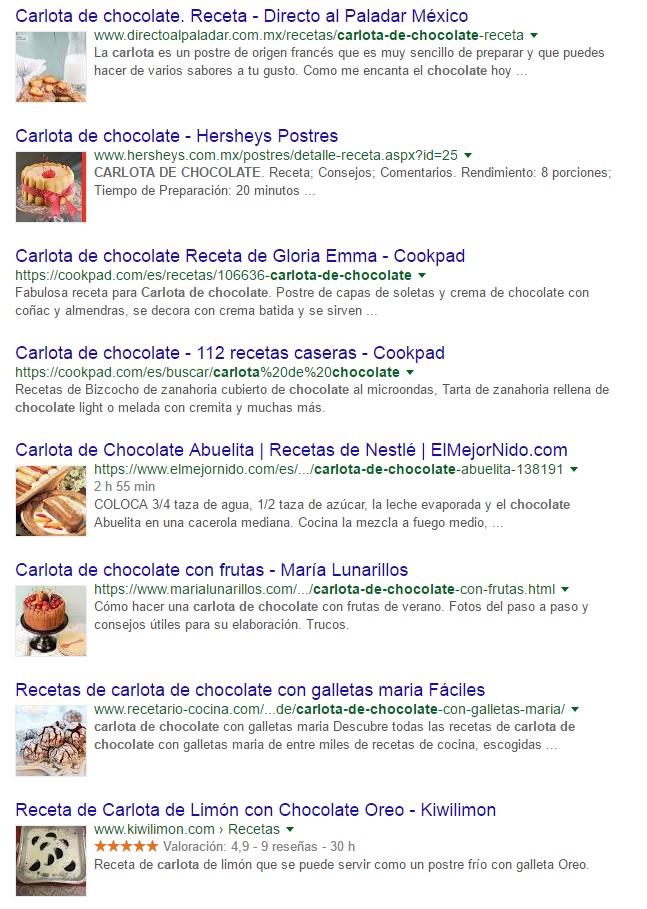
Here is an example of the generalisation of rich snippets, corresponding to a Google search for a baking recipe.
Evolution from Rich Snippets to Rich Cards and Beyond
What was an emerging trend in 2018 is now, in 2026, an unavoidable standard. Rich snippets have evolved from an 'extra' to a user expectation. According to a 2024 BrightEdge study, pages with rich snippets achieve a 58% higher CTR compared to traditional results. This improvement in visibility and engagement is crucial in an increasingly competitive search landscape.
The implementation of structured data, the foundation of rich snippets and rich cards, is more important than ever. Google uses this information not only to display rich results but also to better understand page content, influencing its ranking and how it responds to AI-driven search queries. Tools like ChatGPT or Perplexity AI, which rely on natural language understanding, benefit enormously from a semantically rich web.
At ZDS Digital, we have observed that the correct implementation of Schema.org for specific content types like “Recipe,” “Course,” or “Restaurant” not only improves appearance in search results but also contributes to better indexing and appearance in “featured snippets” or Google’s “direct answers,” significantly increasing qualified organic traffic.
What are Google's rich cards?
Google's rich cards are scrollable carousels that appear below search snippets. They allow site owners to preview individual pieces of content to internet users before they click on them.
Rich cards offer a new opportunity to attract more users to a specific website. Users can easily browse restaurant recommendations from sites like TripAdvisor, 10 Best, Time Out, Thrillist, Time Out, or Eater.
In addition to restaurants, the same applies to the other area where rich cards have been enabled: online courses from the following platforms: Coursera, Udacity, FutureLearn, LinkedIn Learning, Udemy, EdX, Harvard, Edureka, Open University, NPTEL, and Canvas Network.
For more information, you can consult Google's documentation for generating rich cards for restaurants and online training.
Google recommends using the AMP HTML framework on local restaurant and online course pages due to the speed it provides to users.
To facilitate the implementation of rich cards, the Mountain View company has introduced some changes to how its tools work:
1) Structured Data Testing Tool. This will show markup errors and a preview of the card for restaurants, showing how it will appear in search results.
2) Rich Cards Report in Search Console. This will report which cards contain errors and which could be improved by enhancing the markup.
3) AMP Testing Tool. Helps validate AMP pages and perform on-page markup.
Impact of Rich Cards on User Experience (UX) and E-E-A-T
Rich Cards don't just beautify search results; they are also a fundamental pillar for User Experience (UX) and Google's E-E-A-T (Experience, Expertise, Authoritativeness, Trustworthiness) concept. By offering a detailed and organised content preview, user friction is reduced, and the likelihood of them finding exactly what they're looking for increases.
For a restaurant, a well-implemented Rich Card can display ratings, price range, cuisine type, opening hours, and even booking options directly in the results. This saves the user time and conveys an image of transparency and professionalism, key elements for building trust and authority (E-E-A-T).
In the case of online courses, Rich Cards can highlight the instructor's name, course duration, price, student ratings, and platform. This information is vital for a potential student to make an informed decision, leading to a higher percentage of qualified clicks and a lower bounce rate.
According to Google data from 2025, websites that effectively use structured data for Rich Cards experience an average 20% improvement in time on page and a 15% reduction in bounce rate, demonstrating their direct impact on user experience quality.
Tips for Implementing Rich Cards in 2026
Implementing Rich Cards requires a technical and strategic approach. Here are some updated tips for 2026:
- Prioritise Schema.org JSON-LD: Google recommends JSON-LD for its ease of implementation and maintenance. Ensure structured data is embedded in the
<head>or<body>of the HTML. - Constant Validation: Use Google's Rich Results Test Tool. This tool has evolved to offer more precise diagnostics and real-time previews for a wider range of content types.
- Mobile-First and AMP: AMP remains crucial for mobile speed. Speed is an essential component of Core Web Vitals (now with INP as a key metric instead of FID), and a fast site improves user experience and, therefore, SEO. Integrate AMP where relevant for your Rich Cards.
- Accurate and Up-to-Date Data: Ensure the information in your structured data is identical to what is visibly displayed on the page. Discrepancies can lead to Google ignoring your markup or even penalising the site.
- Consider Voice Search and AI: Voice assistants and new AI-based search interfaces (like those from ChatGPT or Perplexity) feed on structured data to provide concise answers. Robust semantic markup increases the chances of your content being selected as a direct answer.
- Monitoring in Google Search Console: The rich results report in GSC is your best friend. Review it regularly to maintain the health of your Rich Cards.
Common Mistakes When Implementing Rich Cards and How to Avoid Them
At ZDS Digital, we have identified some recurring errors:
- Insufficient or Incorrect Markup: Not providing all required Schema.org fields or using incorrect properties. Always consult Google's official documentation.
- User-Hidden Data: Attempting to 'trick' Google by marking content that is not visible to the user. This can result in a manual action.
- Syntax Errors: Small errors in JSON-LD can invalidate the entire markup. Use validators.
- Not Updating Data: If a course price or restaurant opening hours change, the structured data must also be updated. Inconsistency breeds distrust.
- Ignoring GSC Warnings: Warnings are not errors, but they can indicate opportunities for improvement or future problems. Addressing them proactively is key.
The Future of Structured Data: GA4 and Privacy
With the full transition to Google Analytics 4 (GA4) and a growing focus on privacy (Privacy-first), how we measure the impact of Rich Cards has also evolved. GA4, being an event-based model, allows for more granular measurement of user interaction with rich results. We can set up custom events to track clicks on specific Rich Card elements or the subsequent behaviour of users arriving from these results.
Structured data offers a way to communicate valuable information to search engines without relying on third-party cookies or intrusive user identifiers. This reinforces the importance of having a solid and well-maintained structured data foundation for future SEO.
Want to improve your search results with rich cards?
If you are considering incorporating Google's rich cards into your websites related to restaurants, online courses, films, or culinary recipes, contact us or call us on (+34) 93 532 93 78. At B2 Performance, your digital marketing agency in Barcelona, we will provide all the support you need to make the most of this new format.
Start gaining visibility in Google search results as soon as possible.
At ZDS Digital, we have helped numerous clients implement advanced SEO strategies, including structured data and Rich Card optimisation, achieving tangible results. For a restaurant chain in Barcelona, we achieved a 35% increase in online reservations from organic search in just six months, thanks to comprehensive optimisation of their local listings and Rich Cards. For an online course platform, implementing Rich Cards for their programmes resulted in a 28% increase in CTR and a significant improvement in the enrolment conversion rate.
We stay abreast of the latest Google updates, such as the Helpful Content Update and the constant evolution of the algorithm, to ensure your SEO strategy is always effective and future-proof. Trust our expertise to take your online visibility to the next level.