
Skip to content

Glossary Omnichannel

What is omnichannel? Definition, levels and examples

  • Content Marketing
Definition

Omnichannel is a way of selling and serving customers in which all of a company's channels work as one. The physical store, online shop, app and customer service share the same stock, orders, prices and customer record, so a customer can start a purchase in one channel and finish or return it in another. In multichannel retail the channels run side by side; in cross-channel retail only some of them are connected.

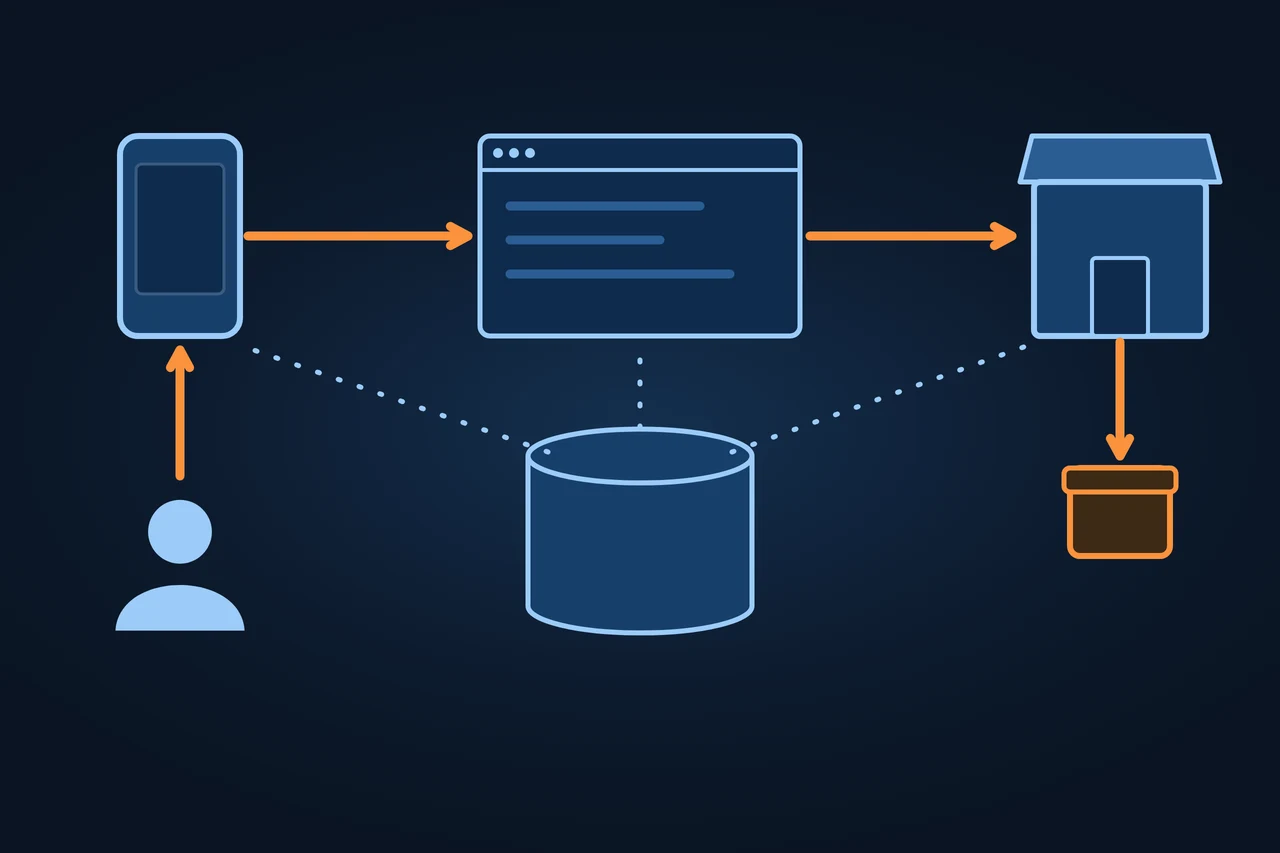
At the top, three channels: a phone, a web page and a shop with an awning; an unbroken orange path rises from a person to the phone, moves on to the web page, continues to the shop and comes down to an orange parcel waiting for collection; all three channels are linked by dotted lines to one shared database in the middle, on a dark blue ground.
On this page 14
  1. Origin of the term
  2. How it works
  3. Types and variants
  4. Examples
  5. How to measure it
  6. Advantages and disadvantages
  7. How it differs from related concepts
  8. Tools
  9. Criticism and limits
  10. Legal framework
  11. How to apply it, step by step
  12. Best practices
  13. Common mistakes
  14. How this entry was made
In brief

What omnichannel means, how it differs from multichannel and cross-channel, which data the channels share and what the GDPR requires when profiles merge.

At the top, three channels: a phone, a web page and a shop with an awning; an unbroken orange path rises from a person to the phone, moves on to the web page, continues to the shop and comes down to an orange parcel waiting for collection; all three channels are linked by dotted lines to one shared database in the middle, on a dark blue ground.

Origin of the term

Cambridge Dictionary defines the prefix omni- as "everywhere or everything". It lists "omnichannel" as a specialised business adjective for a way of selling that is the same and equally good for the customer whether they buy on a computer, in an app or in a physical shop, and points readers to "multichannel" for comparison.

In retail writing, Darrell Rigby of Bain described a strategy of "omnichannel retailing" in Harvard Business Review in December 2011: an integrated sales experience that melds the advantages of physical stores with the information-rich experience of online shopping. In 2015 Peter Verhoef, P. K. Kannan and J. Jeffrey Inman introduced a special issue of the Journal of Retailing titled "From Multi-Channel Retailing to Omni-Channel Retailing" on how retailing was moving from the first to the second.

The same year Norbert Beck and David Rygl published a classification with three levels: multi-channel, cross-channel and omni-channel retailing. In Spanish, Economía Industrial, a journal published on the website of Spain's Ministry of Industry, uses the same split and calls the levels multicanalidad, canalidad cruzada and omnicanalidad.

How it works

Beck and Rygl place a retailer by asking two questions. The first, which they call channel interaction, is whether the customer can trigger a switch between channels, for example by buying online and returning in store. The second, channel integration, is whether the retailer combines customer, pricing and inventory data across its channels. The further both reach, the higher the level.

In practice omnichannel rests on four foundations:

  • Stock that every channel can see. The online shop knows what each store holds, and store staff know what the online warehouse holds.
  • Shared order management. An order placed on the website can be picked in the warehouse or in any store, and every channel can see its status.
  • One customer record. Purchases, returns and service contacts sit under the same customer, for example in a CRM or a CDP.
  • Consistent prices and promotions, or differences that are explained to the customer.

If one is missing, the website lists an item as available that the store cannot reserve, or the till rejects a voucher issued in the app.

The channels stay the same at every level; what changes is what they share

Types and variants

The table sums up Beck and Rygl's three levels. The multichannel, cross-channel and returns examples come from their paper.

LevelWhat the customer can doWhat the retailer connectsExample
Multichanneluse several channels but not move between themno integration of channelsa store that also sells on Amazon, with no link between the two
Cross-channelswitch channels at some stepssome data, or full integration across only some of the common channelsbuy online and collect in store; buy online and return in store
Omnichannelswitch channels at any step, across all common channelscustomer, pricing and inventory data across all channelsreturn anywhere, wherever the item was bought

Source: Beck and Rygl (2015), Journal of Retailing and Consumer Services 27, accessed 21.11.2026.

Beck and Rygl note that multi-, cross- and omni-channel are used indistinctly. The German business dictionary Gabler records both readings of cross-channel, as a synonym for omnichannel and as an intermediate stage. Verhoef and his co-authors, who compare multichannel and omnichannel management in marketing, note that omnichannel management is sometimes called cross-channel management. That marketing comparison, with its table of channels and objectives, is covered in the entry on multichannel marketing. Beck and Rygl's scale measures something else: how far the channels are connected in operations.

What counts as a common channel changes over time. In 2015 Beck and Rygl listed the physical store, catalogue, telephone, online shop and mobile shop.

The payments company Adyen also uses the term unified commerce. In Adyen's words, omnichannel integrates customer service channels, while unified commerce aims to bring the whole running of the business onto one digital platform. Beck and Rygl have no such category.

Examples

These flows appear in Shopify's and Google's documentation. On their own they are cross-channel, because they join two channels in one purchase, and they become omnichannel when stock, orders and the customer record are the same in every channel.

  • Click and collect: the customer buys online and picks up in store. Shopify offers it at checkout, and if the pickup store is out of the item, a transfer moves stock from another location.
  • Ship from store: store staff pick and ship online orders from the store's own stock, with packing slip, label and tracking number.
  • Endless aisle: the customer takes home what the store has, and the rest is shipped to their address. Shopify calls the feature "ship and carry out".
  • Returning an online order in store: in Shopify a merchant can let customers request a return in the Shop app and bring the order to a physical store with a QR code. What happens to the item afterwards is covered under reverse logistics.
  • Local stock on Google: Merchant Center distinguishes three pickup methods. With "buy" the whole transaction happens online, with "reserve" the item is reserved online and paid for in store, and with "ship to store" it is bought online and shipped to a store for pickup.

Inditex describes a case in its 2024 annual report, in its own words. The group says RFID and its Integrated Stock Management System (SINT) have merged the inventory management of all its brands, so staff can quickly locate any item wherever it is and make it available to customers. The report adds that all its physical stores and online platforms are merged into a single sales environment. That would meet Beck and Rygl's condition of shared inventory data, though the account is the company's own and has not been checked independently.

How to measure it

The formulas in the table are working definitions for comparing your own months.

MetricFormula (own definition)What it shows
Click and collect shareonline orders collected in store ÷ online ordershow far store stock serves online sales
Cross-channel returnsin-store returns of online purchases ÷ returns of online purchaseswhether returns work across channels
Multichannel customerscustomers buying in two or more channels ÷ customers with a purchasereach of the shared customer record
Orders shipped from storeonline orders shipped from a store ÷ online ordershow far stores act as warehouses

Source: own definitions, as of 21.11.2026.

Splitting sales between channels is an attribution problem. If a customer sees a product in the app and buys it in the store, each channel may claim the sale and the total is counted twice.

One figure with a published method comes from Harvard Business Review (January 2017). Emma Sopadjieva, Utpal M. Dholakia and Beth Benjamin studied just over 46,000 customers of one US retailer who bought between June 2015 and August 2016. 73% used more than one channel. After controlling for shopping experience, these customers spent on average 4% more per store visit and 10% more online than single-channel customers. The authors warn that the correlations should not be confused with causation. With one retailer in one country, it does not support a general figure.

Advantages and disadvantages

One gain is in stock: an item left over in one store can be sold online, and a customer who cannot find it in one store can get it from another. Service improves too, because staff can see a customer's orders and returns even if they were made in another channel.

The price is the work of integration. Stock, orders and customer records have to sync in near real time, which takes systems that talk to each other, such as the ERP, the online shop and the till. Stores take on new work: they pick orders and accept online returns, and they need space and staff for it. If a store loses its own sales by picking online orders, its targets have to reflect that, or staff have little reason to help.

How it differs from related concepts

Multichannel marketing is about how communication channels are planned and measured. Omnichannel in Beck and Rygl's sense is about operations: stock, orders, returns and the customer. The customer journey is the path the customer takes across touchpoints; omnichannel is what the company does so that path does not break when the customer switches channel. A CDP combines customer data from all channels and is one of the technical foundations of omnichannel. E-commerce is one of the channels.

Tools

The online shop and the till have to share catalogue, stock and customers. Shopify documents in-store pickup, ship from store and mixed carry-out and shipping orders in its POS; Google Merchant Center shows products and store information to nearby shoppers searching on Google. The customer record lives in a CRM or a CDP. Which location fulfils each order is decided by order management, whether that sits in the online shop, the ERP or a separate system.

Criticism and limits

A chain can call itself omnichannel while its online shop and stores share neither stock nor customers. Beck and Rygl's two questions are a way to check.

Both classifications cited here are built on retail. For business-to-business sales, with field reps, ordering portals and distributors, they offer no model of their own.

Full omnichannel also carries a high fixed cost. For a small retailer without shared stock, a well-run click and collect may be the sensible step, even if it is technically cross-channel.

How to apply it, step by step

  • List your channels and note what each one shares: stock, orders, prices, customer.
  • Make stock at every location visible to every channel, read-only at first.
  • Decide which flows to offer: pickup, ship from store, in-store returns.
  • Link the customer under one identifier, with the GDPR legal basis settled.
  • Adjust store targets so they count the online orders a store picks or takes back.
  • Track the metrics in the table and check each month where the flow breaks.

Best practices

  • Show stock per store only when the data is reliable; a false "in stock" sends the customer to a store without the item.
  • Allow in-store returns of online purchases before adding more channels.
  • Give store staff access to the customer's online orders.
  • If online and store prices differ, say why.

Common mistakes

  • Calling an online shop and stores without shared stock omnichannel.
  • Treating click and collect on its own as proof of omnichannel.
  • Counting the same sale in two channels.
  • Merging customer profiles without a legal basis.
  • Judging each store only by its till sales.

How this entry was made

This entry was written in November 2026 with the help of AI. The information comes from academic papers, Harvard Business Review, the Spanish journal Economía Industrial, Cambridge Dictionary, the Gabler business dictionary, Inditex's annual report, Shopify and Google help pages and EUR-Lex, accessed on 21.11.2026. The metrics are our own definitions. It was reviewed before publication and contains no client data.

Manuel Riveiro Rodriguez CEO & Digital Strategist

A technical audit covers this and everything else in one pass.

Request an audit

Frequently asked

What is the difference between omnichannel and cross-channel?

In cross-channel retail the customer can switch channels at some steps, or only some channels are fully connected. In omnichannel retail all common channels share customer, pricing and inventory data, and the customer can switch at any step. That is the distinction Beck and Rygl drew in 2015.

Is click and collect omnichannel?

Not on its own. Beck and Rygl classify it as cross-channel because it joins two channels in one purchase. It becomes part of an omnichannel setup when stock, orders and returns are connected across every channel.

What are examples of omnichannel?

A retailer where the customer buys online, picks up in one store and returns in another while staff see the whole history. Inditex describes its integrated stock system in its 2024 annual report.

What is omnichannel fulfillment?

Using stock at every location, stores included, to fill orders from any channel: in-store pickup, ship from store and returns at any point.

Is omnichannel still relevant?

The term is still in use. Inditex's 2024 annual report counts a satisfactory omni-channel experience among the conditions for its commercial success. What has changed is the list of channels: in 2015 Beck and Rygl counted store, catalogue, telephone, online shop and mobile shop.

Sources

  1. Beck, N. and Rygl, D. (2015), "Categorization of multiple channel retailing in Multi-, Cross-, and Omni-Channel Retailing for retailers and retailing", Journal of Retailing and Consumer Services 27, 170–178.
  2. Verhoef, P. C., Kannan, P. K. and Inman, J. J. (2015), "From Multi-Channel Retailing to Omni-Channel Retailing: Introduction to the Special Issue on Multi-Channel Retailing", Journal of Retailing 91(2), 174–181.
  3. Harvard Business Review, Darrell Rigby, "The Future of Shopping", December 2011.
  4. Harvard Business Review, Sopadjieva, Dholakia and Benjamin, "A Study of 46,000 Shoppers Shows That Omnichannel Retailing Works", 3 January 2017.
  5. Economía Industrial no. 409, Acquila-Natale, Iglesias-Pradas and Chaparro-Peláez, "Omnicanalidad en el sector de la ropa: una nueva revolución digital" (in Spanish).
  6. Cambridge Dictionary, "omni-".
  7. Gabler Wirtschaftslexikon, "Omni-Channel-Management" (in German).
  8. Adyen, "Del omnicanal al comercio unificado, una tendencia en pleno desarrollo" (in Spanish).
  9. Shopify Help Center, "Setting up pickup in store for online orders".
  10. Shopify Help Center, "Ship from store".
  11. Shopify Help Center, "Ship and carry out in one order on Shopify POS".
  12. Shopify Help Center, "Processing returns and refunds using the Shopify POS app".
  13. Google Merchant Center Help, "Local inventory ads and free local listings overview".
  14. Google Merchant Center Help, "Local product data specification".
  15. EUR-Lex, Regulation (EU) 2016/679 of the European Parliament and of the Council of 27 April 2016 (General Data Protection Regulation), Articles 4, 6 and 21 and Recital 47.
  16. Inditex Group Annual Report 2024.
  17. Cambridge Dictionary, "omnichannel".