Skip to content

Glossary Reverse logistics

What is reverse logistics? Process, types and examples

  • SEO Basics
Definition

Reverse logistics is the planning and control of goods and information that flow back from the customer to the seller or manufacturer. The aim is to recover value or, where that fails, to dispose of the product properly. It covers online returns, and also retail overstock, product recalls, reusable packaging and products at the end of their life.

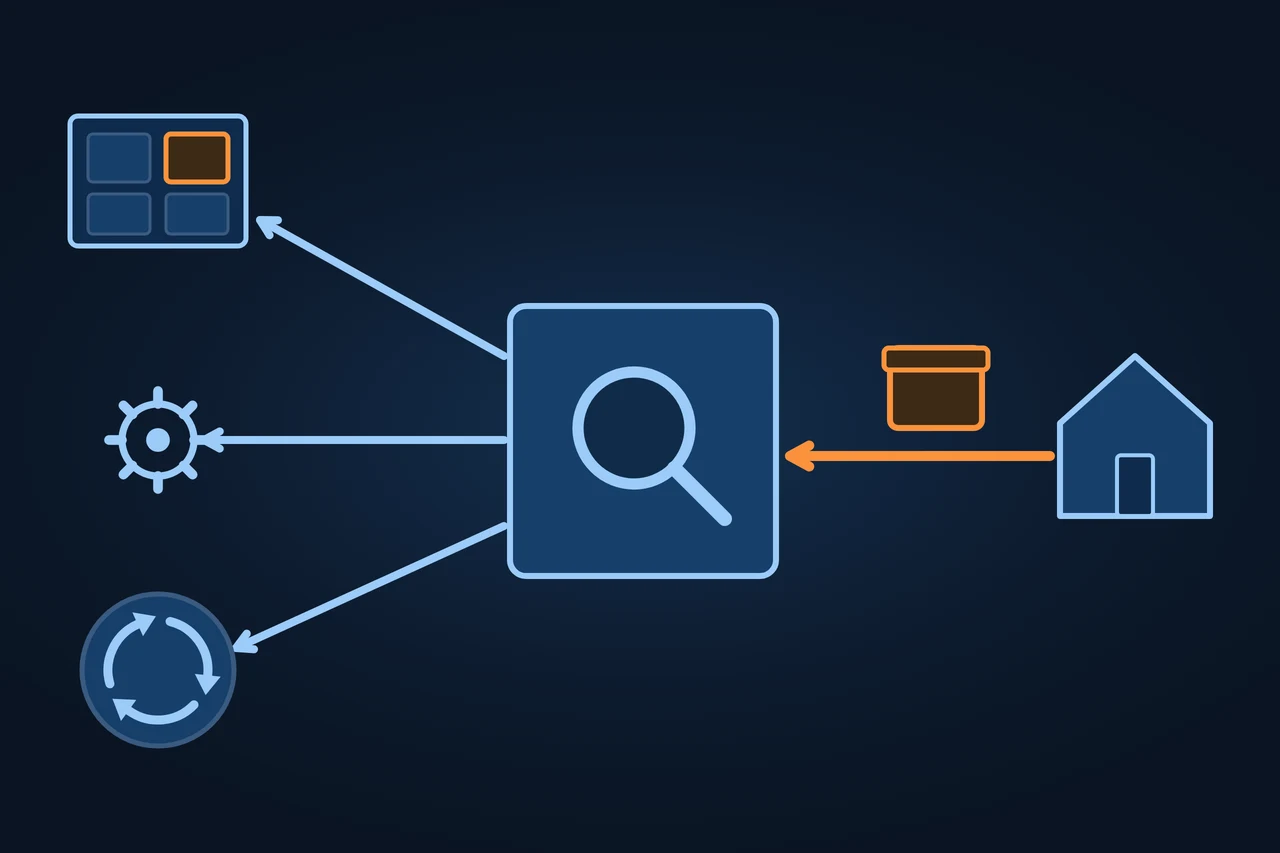
On the right, a house; an orange parcel leaves it on an orange arrow pointing left, towards an inspection station with a magnifying glass; from there three arrows lead on: to a shelf where the orange parcel stands again, to a gear and to a circle of three curved arrows, on a dark blue ground.
On this page 14
  1. Origin of the term
  2. How it works
  3. Types and variants
  4. Examples
  5. How to measure it
  6. Advantages and disadvantages
  7. How it differs from related concepts
  8. Tools
  9. Criticism and limits
  10. Legal framework
  11. How to apply it, step by step
  12. Best practices
  13. Common mistakes
  14. How this entry was made
In brief

Reverse logistics moves goods back from the customer: returns, repair, resale and recycling. Process, types, costs, consumer law and real examples.

On the right, a house; an orange parcel leaves it on an orange arrow pointing left, towards an inspection station with a magnifying glass; from there three arrows lead on: to a shelf where the orange parcel stands again, to a gear and to a circle of three curved arrows, on a dark blue ground.

Origin of the term

The standard definition comes from Dale S. Rogers and Ronald S. Tibben-Lembke of the University of Nevada, Reno, in "Going Backwards: Reverse Logistics Trends and Practices", published in 1998 by the Reverse Logistics Executive Council. They took the Council of Logistics Management's definition of logistics and turned it around: "The process of planning, implementing, and controlling the efficient, cost effective flow of raw materials, in-process inventory, finished goods and related information from the point of consumption to the point of origin for the purpose of recapturing value or proper disposal."

The same study separates it from "green" logistics, which covers using less packaging material or cutting transport emissions. In the authors' words, if nothing is sent "backward", the activity probably is not reverse logistics.

Returns management is the narrower term. It deals with what end customers send back, while reverse logistics also covers flows between supply chain partners and goods that are not returns at all.

How it works

The return flow has six steps. The outbound side is explained under order fulfillment.

  • Request: the customer asks to return an item in the shop or a returns portal and gets instructions or a label. A shop that uses a return merchandise authorization (RMA) number assigns it here, so the parcel can be matched on arrival.
  • Return shipment: the parcel goes to the seller's warehouse, a logistics provider or another address the seller names.
  • Receipt and inspection: Rogers and Tibben-Lembke call this entry filter "gatekeeping", the screening of defective and unwarranted returns. They name it the first critical factor in keeping the whole flow manageable.
  • Disposition: depending on condition, the item goes back to the supplier, is resold as new, sold as refurbished or through an outlet, repaired, broken down for materials or disposed of.
  • Refund: the seller pays the customer back, within the legal deadline for distance sales.
  • Root cause: the return reason goes back into product pages, size charts or supplier talks, so the next return does not happen.

Rogers and Tibben-Lembke describe a typical order for the disposition decision. A firm returns the item to the supplier first if it gets a full refund, then tries to resell it, then reconditions or refurbishes it, and finally disposes of it at the lowest cost. EU law sets its own order in Article 4 of the Waste Framework Directive 2008/98/EC: prevention, preparing for re-use, recycling, other recovery and, last, disposal.

From the customer's request to the recorded return reason, with disposition as the one point where the path splits

Types and variants

Rogers and Tibben-Lembke sort return flows by origin (supply chain partner or end user) and by material (product or packaging).

TypeWho sends it backTypical reasonTypical destination
Customer returnend customerdefect, changed mind, wrong sizeresale, outlet, supplier
Warranty returnend customerfault under warrantyrepair, replacement
Recallcustomer or retailer, at the manufacturer's requestsafety riskmanufacturer, disposal
Overstock and end of seasonretailer or distributorexcess stock, over-ordered promotion, end of seasonsupplier, outlet, donation
End of lifeend customerproduct has reached the end of its useful lifematerial recovery, disposal
Reusable packagingretailer or businesstotes, multi-trip packagingreuse

Source: own classification based on Tables 1.3 and 1.4 in Rogers and Tibben-Lembke (1998), accessed 21.11.2026.

In online retail the first row dominates, because a consumer who buys at a distance in the EU can withdraw without giving a reason. Returns management has two halves: preventing returns before they happen (accurate product data, honest photos, size charts) and handling well the ones that arrive.

Examples

A Shopify store handles returns from the Orders page. According to Shopify's help center, the merchant creates the return, sends shipping instructions and issues the refund after inspecting the items. When processing the return, the merchant can restock the item at a chosen location.

With Fulfillment by Amazon, Amazon says it handles customer service and returns for the seller. Sellers can also have Amazon return, dispose of or liquidate inventory held in a fulfillment center.

In Spain, a seller of washing machines at a distance must take back an equivalent old appliance free of charge, at the delivery point or at the buyer's home (Royal Decree 110/2015, Article 22.4). In Germany, the Electrical and Electronic Equipment Act (ElektroG, § 17) sets a similar take-back duty for large sellers, including online sellers, whose storage and shipping space counts as sales area. Neither case involves a return, and both are reverse logistics.

How to measure it

The formulas below are working definitions. Write them into the contract so that shop and logistics provider measure the same thing.

MetricFormula (own definition)What it shows
Return rateorders with at least one return ÷ orders shipped in the same periodreturn volume
Return rate per itemunits of an item returned ÷ units of that item soldproduct pages or sizes that fail
Time to refundrefund date minus date the withdrawal was receivedthe 14-day legal limit in the EU
Resale sharereturned units resold as new ÷ returned unitsvalue recovered

Source: own definitions, as of 21.11.2026.

The cost of a return is a sum: return shipping, inspection time, the refunded outbound shipping and the loss of value on anything that cannot be sold as new. Compare your own months with each other. Returns also lower average order value if you calculate it net of returns.

Advantages and disadvantages

Well-run reverse logistics wins money back: an item that is inspected and restocked quickly can be sold again, and a simple returns process can give buyers confidence. It also keeps the business on the right side of withdrawal rules, appliance take-back duties and the new destruction ban.

The costs are transport, space and inspection time, on top of the outbound shipment. Fashion can miss its season on the way back. Generous policies also make abuse easier, such as returning clothes that have been worn.

How it differs from related concepts

Order fulfillment brings the order to the customer; reverse logistics brings it back. The same warehouse may do both, but the flows and their checks are different. Returns management is part of reverse logistics and covers only what end customers return, not overstock, recalls or packaging. In dropshipping the seller holds no stock but stays responsible to the consumer: under the Consumer Rights Directive the trader includes anyone acting on its behalf, so the item may go back to the supplier while the refund is still owed by the seller. On a marketplace, returns may run through the platform's fulfillment program or through each seller.

Tools

Shopify lets merchants create returns, send labels, refund after inspection, restock and offer self-serve returns from the order status page. It also offers a restocking fee; under EU withdrawal rules, a trader may only pass on the direct cost of return. WooCommerce documents refunds, automatic through compatible payment gateways or manual, with an option to restock refunded items; the return shipment itself is outside that page. More on each system under Shopify and WooCommerce.

Criticism and limits

Free returns still cost money, and margin or price pays for it. Whether returned goods are really not destroyed is hard to check from outside, because the available figures are self-reported by retailers. A general return rate is only useful if it says how it was measured, for which shops and in which year. Lists of the "R's" of reverse logistics agree neither on the number nor on the terms.

How to apply it, step by step

  • Write the returns policy: period, item condition, who pays return shipping and how refunds work.
  • For EU customers, check that the shop shows a "withdraw from contract here" function throughout the period.
  • Set up a request channel with an RMA number or label, so each parcel can be identified on arrival.
  • Define inspection rules per product type and what follows: resale, outlet, supplier, repair, recycling.
  • Track refunds against the 14-day limit.
  • Record the reason for each return and feed it back to product data, sizing and buying.

Best practices

  • Measure return rates per item and per reason, not just for the whole shop.
  • Inspect and restock returns as fast as you can.
  • Tell customers before they buy if return shipping is at their expense.
  • If you are a large company that discards unsold products, publish each year how many and why, as Article 24 of Regulation (EU) 2024/1781 requires.
  • In dropshipping, agree the return address and who pays what with the supplier.

Common mistakes

  • Charging a restocking fee on a statutory withdrawal.
  • Refunding later than 14 days without having the goods or proof of dispatch.
  • Treating reverse logistics as a cost nobody measures.
  • Assuming returns are the supplier's problem in dropshipping.
  • Destroying returned stock without checking whether the ban applies.

How this entry was made

This entry was written in November 2026 with AI assistance. The facts come from EUR-Lex, gesetze-im-internet.de, the Spanish Official State Gazette (BOE), Rogers and Tibben-Lembke's 1998 study, the help pages of Shopify and WooCommerce and Amazon's seller pages, accessed 21.11.2026. It was checked before publication and contains no customer data.

Manuel Riveiro Rodriguez CEO & Digital Strategist

A technical audit covers this and everything else in one pass.

Request an audit

Frequently asked

What is an example of reverse logistics?

An online shop receives a returned jacket, inspects it, restocks it and sells it again. Taking back an old washing machine when delivering a new one is another.

What is an RMA?

A return merchandise authorization is a number the seller issues before a return is shipped. It lets the warehouse match the parcel to the order and the reason on arrival.

Who pays for return shipping in the EU?

After a withdrawal, the consumer pays only the direct cost of return, and only if the trader said so beforehand and did not offer to cover it. The trader refunds standard outbound delivery.

Can retailers destroy returned goods?

Since 19 July 2026, large companies in the EU may not destroy unsold or returned apparel, clothing accessories or footwear under Regulation (EU) 2024/1781. Spain also bans destroying unsold surplus non-perishable products under Law 7/2022.

What is the difference between reverse logistics and returns management?

Returns management covers what end customers send back. Reverse logistics also includes overstock between businesses, recalls, reusable packaging and products at the end of their life.

Sources

  1. EUR-Lex, Directive 2011/83/EU of the European Parliament and of the Council of 25 October 2011 on consumer rights, Articles 2, 9, 13 and 14.
  2. EUR-Lex, Directive (EU) 2023/2673 of the European Parliament and of the Council of 22 November 2023 amending Directive 2011/83/EU.
  3. EUR-Lex, Regulation (EU) 2024/1781 of the European Parliament and of the Council of 13 June 2024 establishing a framework for the setting of ecodesign requirements for sustainable products, Articles 2, 24 and 25.
  4. BOE, Real Decreto Legislativo 1/2007, de 16 de noviembre, texto refundido de la Ley General para la Defensa de los Consumidores y Usuarios, Articles 102, 104, 107 and 108 (in Spanish).
  5. BOE, Ley 7/2022, de 8 de abril, de residuos y suelos contaminados para una economía circular, Article 18 (in Spanish).
  6. BOE, Real Decreto 110/2015, de 20 de febrero, sobre residuos de aparatos eléctricos y electrónicos, Article 22 (in Spanish).
  7. gesetze-im-internet.de, § 355 BGB (in German).
  8. gesetze-im-internet.de, § 356a BGB (in German).
  9. gesetze-im-internet.de, § 357 BGB (in German).
  10. gesetze-im-internet.de, § 23 KrWG (in German).
  11. Dale S. Rogers and Ronald S. Tibben-Lembke, "Going Backwards: Reverse Logistics Trends and Practices", Reverse Logistics Executive Council, 1998 (read in the Internet Archive copy of 24.04.2003).
  12. Shopify Help Center, "Returns and exchanges".
  13. Shopify Help Center, "Processing and managing returns".
  14. WooCommerce, "Refunding Orders in WooCommerce Documentation".
  15. Amazon, "Amazon FBA (Fulfillment by Amazon)".
  16. EUR-Lex, Directive 2008/98/EC of the European Parliament and of the Council of 19 November 2008 on waste, Article 4.
  17. gesetze-im-internet.de, § 17 ElektroG (in German).