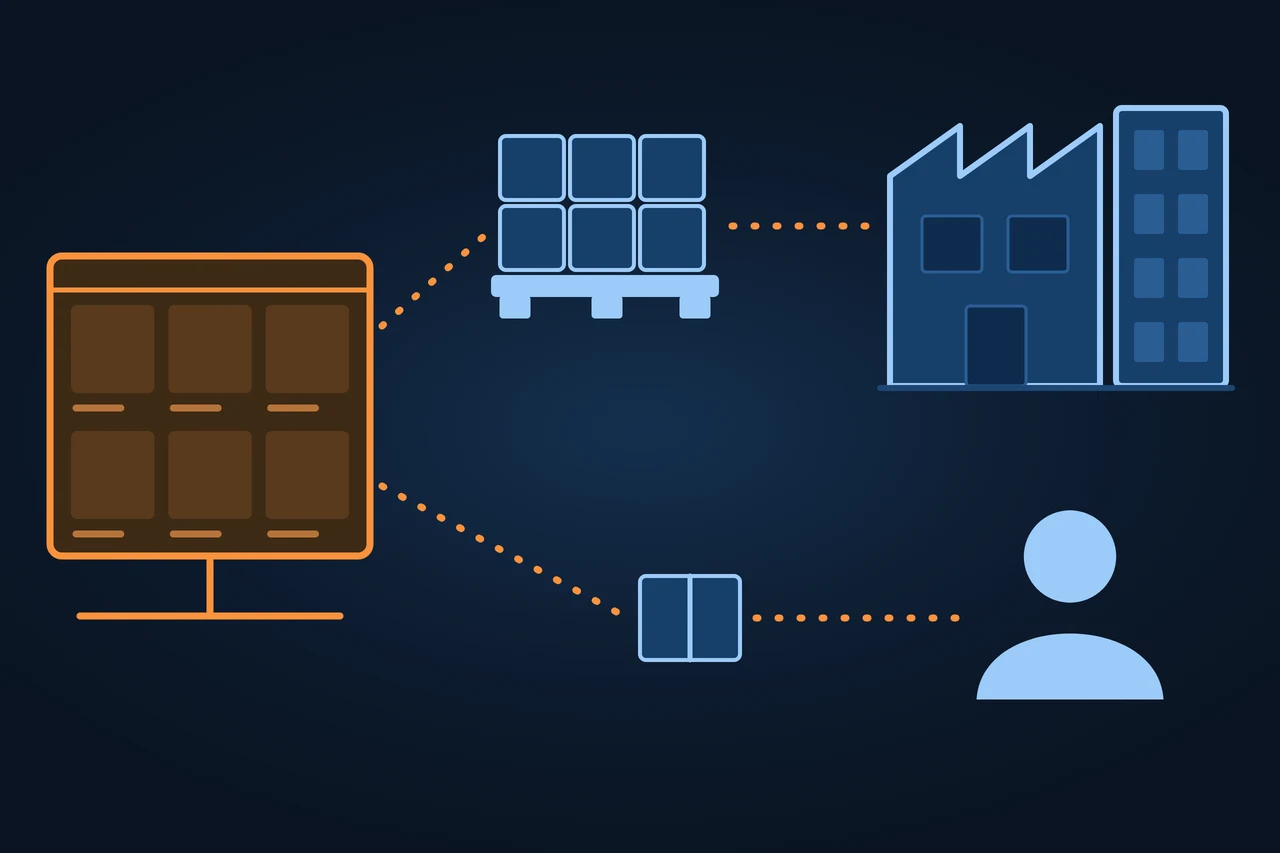
Shopware is an e-commerce platform made by shopware AG, based in Schöppingen, Germany. The current generation is Shopware 6. Its base version, the Community Edition, is open source under the MIT licence, and three paid plans sit on top: Rise, Evolve and Beyond. According to the vendor, a store can be self-hosted or run as PaaS or SaaS, and it serves both B2B and B2C commerce.
Shopware, the e-commerce platform from shopware AG in Germany: how it works, its editions, the MIT licence and how it differs from Magento.
Origin of the term
Shopware started as a product name. In 2008, as the company puts it, the product name became the company name, when the brothers Stefan and Sebastian Hamann and Stefan Heyne founded shopware AG. The company dates its beginnings to 2000, although the same careers page also gives 2001 for the founding of Hamann Media GmbH. It should not be confused with Shop-Ware, a US management software for auto repair shops (shop-ware.com) that fills many US results for the same word.
History and development
2000: Stefan Hamann, aged 16, founds Hamann Media GmbH in Schöppingen.
2008: shopware AG is founded.
Autumn 2010: the first open-source Community Edition; for Shopware 5 it was licensed under the AGPLv3.
15 January 2020: version 6.1 is released. Shopware 6 is a complete rebuild, licensed under MIT.
8 February 2022: Shopware takes outside investment for the first time, from Carlyle and PayPal, according to its press release.
End of July 2024: development of Shopware 5 stops, with no further security updates.
24 March 2025: a Fair Usage Policy for the Shopware Account and Shopware Store comes into force.
How it works
According to its documentation, Shopware 6 is built on Symfony and has three parts: the Core with the business logic, the Storefront that shoppers see and the Administration where merchants work. External frontends connect through the Store API, which is also how headless commerce setups work.
Two tools shape how the store behaves. The Rule Builder creates rules (customer group, country, cart value) that decide which shipping and payment methods a customer sees, which promotions apply and which prices they get. The Flow Builder links an event, such as a new order, to actions such as an email or a tag, without code. Content pages are built as Shopping Experiences. To extend the store there are plugins, which run inside the Core, and apps, which talk to it through the API. In the Shopware cloud only apps are supported.
Rules decide what each customer sees; flows respond to what happens in the store
Rule Builder
Conditions
Customer groupCountryCart value
Rule
What the customer sees
Shipping and payment methodsPromotionsPrices
Flow Builder
Event
New order
Flow
Actions, without code
EmailTag
First the condition or the event, then what changes
Types and variants
Edition
For whom, according to Shopware
What it adds
Community Edition
Businesses and developers who customise their store
Page builder, product and order management, source code
Rise
Growing businesses
AI-assisted content, returns management, support from Shopware
Evolve
Advanced B2B or B2C requirements
Quotes, purchase approvals, advanced search
Beyond
Complex pricing and fulfilment
Customer-specific prices, multi-location inventory, 24/7 support
Source: Shopware, "Pricing", accessed 18.11.2026.
The MIT licence of the Community Edition stays as it is. Since 24 March 2025, merchants whose shops exceed €1 million in gross merchandise value (GMV) over 365 days need a paid plan to keep access to the Shopware Account and Shopware Store; the store itself can keep running without that access. All Community Edition users must report their GMV once a year.
Examples
In its press release of 8 February 2022, Shopware names Philips, Jägermeister and Aston Martin as customers. The selection is the vendor's and reflects that date.
How to measure it
Shopware offers Shopware Analytics inside the store, and Google Search Console shows search traffic. The costs, without amounts because they depend on the provider and the plan:
Item
Type of cost
Note
Plan
Recurring, unless you stay on the Community Edition
Required for Account and Store above €1M GMV
Hosting
Recurring
Own server or the Shopware cloud
Extensions
One-off or subscription
Plugins and apps from the Shopware Store
Payments
Per transaction
Shopware Payments or another provider
Development and upkeep
One-off and recurring
In-house team or agency
Source: Shopware, "Pricing" and Fair Usage Policy, accessed 18.11.2026.
Advantages and disadvantages
Use case
For
Against
B2B with customer groups
Rule Builder for prices, shipping and payment
Quotes and customer-specific prices only in paid plans
Mid-sized B2C store
Shopping Experiences for content pages
A plan is required for Account and Store above €1M GMV
Small store
Community Edition with no licence fee
Server, updates and security are your job
Source: Shopware documentation and "Pricing", accessed 18.11.2026.
How it differs from related concepts
The most common comparison is with Magento. Magento has belonged to Adobe since 19 June 2018; its open version, Magento Open Source, is licensed under OSL 3.0, and the paid version is now called Adobe Commerce. Shopware's MIT licence essentially only requires keeping the licence notice. OSL 3.0 requires publishing modified code when you distribute it or offer it as a network service. Adobe offers cloud and SaaS only for Adobe Commerce.
System
Model and licence
Who hosts and maintains it
Typical use
Shopware
Community Edition under MIT, paid plans
You or Shopware (PaaS, SaaS)
Mid-sized and large businesses, B2B and B2C
Magento / Adobe Commerce
Open Source under OSL 3.0, Adobe Commerce licensed
You, with Adobe Commerce also Adobe
From founders to large businesses
PrestaShop
Core under OSL 3.0
You or PrestaShop ("Hosted")
Ready-to-deploy, self-managed stores
WooCommerce
WordPress plugin, GPL
You
Stores inside a WordPress site
Shopify
Subscription platform
Shopify
Stores without their own server
Source: websites and repositories of Shopware, Adobe, PrestaShop, WooCommerce and Shopify, accessed 18.11.2026.
Shopware's own add-on products, in alphabetical order and without ranking:
Copilot: an AI assistant.
Multichannel Connect: selling on marketplaces.
Shopware Analytics: reports inside the store.
Shopware Nexus: connecting other systems, such as a PIM.
Shopware Payments: payment processing, with transaction fees.
Criticism and limits
Moving from Shopware 5 to 6 was not an update: Shopware 6 is a rebuild, and data moves over with a migration assistant. Many B2B features are only in the paid plans, and GMV reporting is mandatory. Plugins cannot be used in the Shopware cloud.
Legal framework
In the EU, Directive (EU) 2023/2673 requires an online withdrawal function for distance contracts from 19 June 2026; Germany and Spain have their own rules on mandatory information. The UK and the US have separate consumer rules.
How to apply it, step by step
Decide whether you host the store yourself or use the Shopware cloud.
Choose the edition with your GMV in mind.
Set up customer groups and rules in the Rule Builder before prices, shipping and payment.
Set up flows in the Flow Builder.
Define the URL templates for products and categories before they are indexed.
Decide which filter pages may be indexed, as described under faceted navigation.
If you move to the cloud, check that every plugin has an app equivalent.
Report your GMV on time.
Common mistakes
Mistaking the MIT licence for a free store.
Staying on Shopware 5 without security updates.
Changing URL templates without redirecting the old URLs.
Installing a plugin for something the Rule Builder or Flow Builder already does.
Forgetting the withdrawal function when selling in the EU.
How this entry was made
This entry was written in November 2026 with AI assistance. The facts come from shopware.com, Shopware's documentation, the GitHub repositories, the Internet Archive and EUR-Lex, accessed 18.11.2026. It was checked before publication and contains no customer data.
Manuel Riveiro RodriguezCEO & Digital Strategist
A technical audit covers this and everything else in one pass.
The Community Edition has no licence fee; Rise, Evolve and Beyond are paid. On top come hosting, extensions, payment fees and development. Above €1 million in GMV, Shopware requires a plan for the Account and Store.
Is Shopware open source?
Yes, the Community Edition of Shopware 6 is under the MIT licence. According to Shopware, the 2025 Fair Usage Policy does not change that; it only governs access to the Account and Store.
What is the difference between Shopware 5 and 6?
Shopware 6 is a rebuild on Symfony, ready for production since January 2020. Shopware 5 has had no security updates since the end of July 2024.
Who is Shopware for?
Shopware targets mid-sized and large businesses in B2B and B2C. A small store can start on the Community Edition but then runs the server itself.
What are the alternatives to Shopware?
With an open core, Magento and PrestaShop; as a plugin, WooCommerce; as a hosted platform, Shopify. The comparison with Shopify is in its own entry.