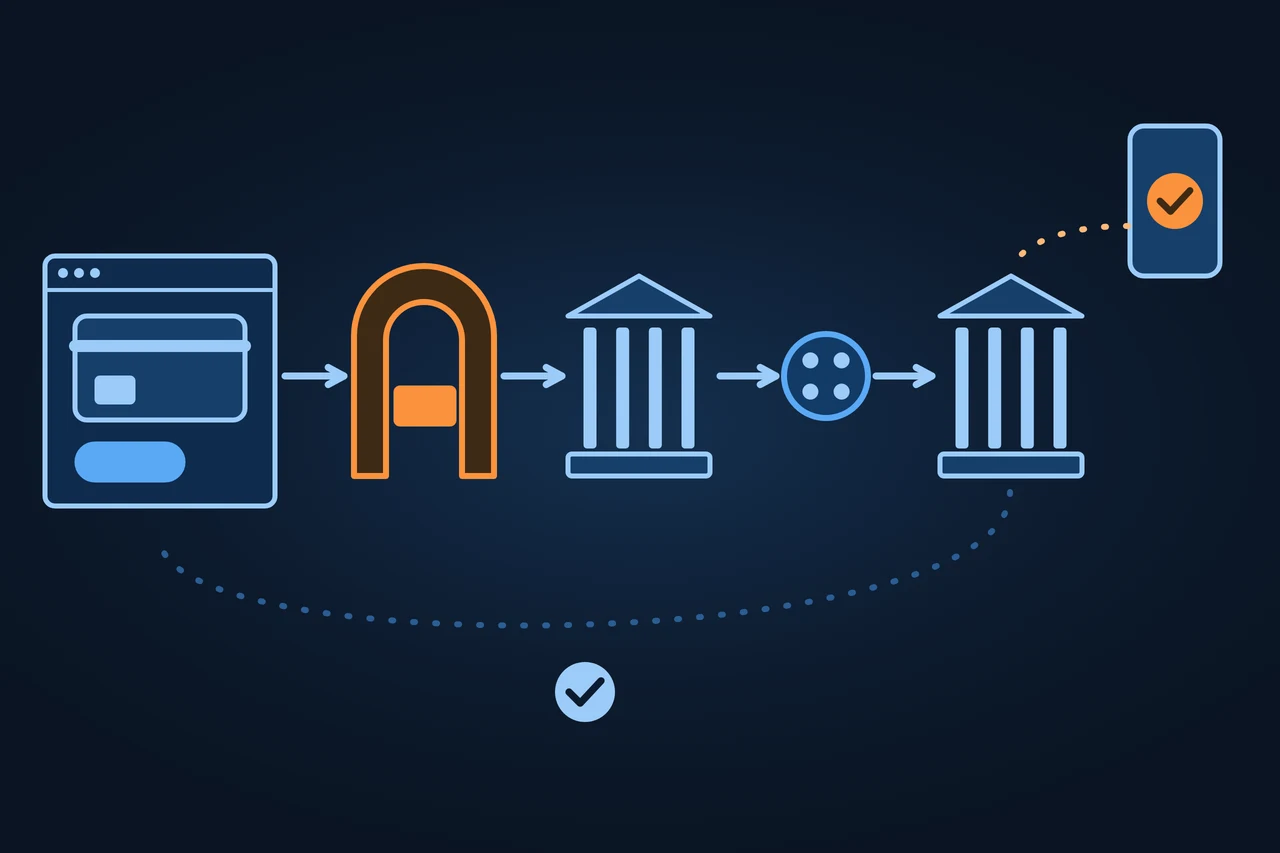
A payment gateway is the technical service that captures payment details in an online shop, sends them encrypted to the acquirer or processor and returns the answer to the shop: payment approved or declined. As a technical component it does not move the money; the acquirer and the banks do that. In Spain, banks offer it to their merchants as a "TPV virtual", for example through the Redsys platform.
What a payment gateway does, how it differs from a payment processor, a PSP and an acquirer, and what the EU's PSD2 requires for card payments.
Origin of the term
A gateway is a point of passage, here between the shop and the payment networks. It is not a legal term. Directive (EU) 2015/2366, known as PSD2, speaks of payment services, payment service providers and the acquiring of payment transactions, but not of gateways. In Spain the term "TPV virtual" is also used, the name Redsys gives to its online payment service. TPV stands for "terminal punto de venta", the Spanish for point-of-sale terminal, and "virtual" means there is no device.
How it works
According to Stripe and Adyen, a card payment in an online shop goes through these steps:
The buyer enters the card details on the payment page.
The gateway encrypts them and sends them to the acquirer, the bank or provider that collects payments for the merchant.
The acquirer passes the transaction to the card network, such as Visa or Mastercard, and the network passes it to the issuer, the buyer's bank.
The issuer checks the transaction. If the law requires strong customer authentication, the buyer confirms first, for example in their banking app.
The answer travels back the same way to the shop, which shows the payment as approved or declined.
Later, the money moves from the buyer's bank to the acquirer and from there to the merchant's account.
Authentication in e-commerce runs on 3-D Secure, an EMVCo protocol for card-not-present payments. Merchant and issuer exchange data about the transaction, the payment method and the device, and the issuer uses it to authenticate the buyer and approve or decline the transaction. Visa now calls its version Visa Secure, and Mastercard calls its version Identity Check.
A card payment: the answer first, the money later
Out
Buyer
enters the card details
→↓
Gateway
encrypts and sends them
→↓
Acquirer
collects payments for the merchant
→↓
Card network
→↓
Issuer
the buyer's bank, checks it
If the law requires strong customer authentication, the buyer confirms first, for example in their banking app.
Back
The answer travels back the same way to the shopapproved or declined
Later, the money
Buyer's bank
→↓
Acquirer
→↓
Merchant's account
The authorisation goes out and back through the gateway; the money follows later by another route
Types and variants
Variant
Where the buyer pays
Integration
Hosted gateway
On a page run by the provider, then back to the shop
Less technical work
Integrated gateway
In the shop itself, without a redirect
More development and maintenance
Plugin for the shop
Hosted or integrated, depending on the plugin
Installed in the shop system
Source: Adyen, "Everything you need to know about payment gateways"; Stripe, "¿Qué son las pasarelas de pagos?", accessed 20.11.2026.
Another difference is who collects the money. Some gateways only transmit data and connect to several banks and processors; other providers combine gateway, acquirer and processing on one platform. Payment methods are a separate layer: according to Bizum, the Spanish mobile payment system, its payment is integrated into the shop's gateway and the buyer confirms it in their banking app.
Examples
Providers in alphabetical order, each as described on its own website:
Adyen says it combines a payment gateway, acquirer and processor on one platform.
PayPal says it provides both a gateway and a processor, and explains that online sales need both.
Redsys serves financial institutions and payment service providers. Its TPV Virtual lets merchants integrate the payment gateway directly into their website, and Redsys refers merchants to their bank.
Stripe defines a gateway as a tool for accepting online payments securely and distinguishes it from a payment processor.
Advantages and disadvantages
For the merchant, a gateway saves building a separate connection to each bank and card network. PayPal puts it this way: one integration reaches many different banks and processors. On the other hand, every payment depends on a third party, with its own fees and terms. Each redirect or authentication step also adds a point where the buyer may give up.
How it differs from related concepts
Payment gateway vs. TPV virtual: in Spain, a TPV virtual is the service through which a bank offers online card acceptance, such as the Redsys TPV Virtual. It includes a gateway plus the contract with the bank that collects the money. "Gateway" refers to the technical connection; "TPV virtual" refers to the bank's complete service.
Role
What it does
Position under PSD2
Gateway
Captures, encrypts and transmits payment data and returns the answer
Technical service, outside the directive if it never holds the funds (Art. 3(j))
Payment service provider (PSP)
Provides payment services; may also offer the gateway
Body under Art. 4(11), such as a credit institution or payment institution
Acquirer
Accepts and processes the merchant's payments so the money reaches it
Payment service of acquiring (Art. 4(44))
Issuer
The buyer's bank; approves or declines and requires authentication
Issuing of payment instruments (Art. 4(45))
Source: Directive (EU) 2015/2366, Arts. 3 and 4; functions as described by Stripe and Adyen, accessed 20.11.2026.
Payment gateway vs. payment processor: according to PayPal, the processor moves the funds between customer and merchant, while the gateway obtains the payment data and passes it securely to the processor. PSD2 draws the legal line. A provider that only transmits data and never holds the money provides a technical service (in Spain, Article 4(j) of Royal Decree-Law 19/2018; in Germany, section 2 of the ZAG). A provider that accepts and settles payments provides a payment service, even if it also offers the gateway.
Criticism and limits
"Gateway" is used for different things: the technical connection, a provider's full service or a bank's TPV virtual. When comparing offers, ask what each one includes. For the buyer, the redirect and the authentication are steps where a purchase can stall; how much this matters is measured as cart abandonment. EMVCo presents 3-D Secure as a way to authenticate without unnecessary friction, which according to its website leads to abandoned purchases.
Legal framework
PSD2 requires strong customer authentication when the payer initiates an electronic payment: at least two independent elements of knowledge (something only the user knows), possession (something only the user possesses) or inherence (something the user is). For remote payments, the authentication is linked to the amount and the payee. The technical standards in Delegated Regulation (EU) 2018/389 have applied since 14 September 2019, and for e-commerce card payments the European Banking Authority set 31 December 2020 as the deadline. There are exemptions: remote payments of up to EUR 30, as long as no more than EUR 100 or five transactions have accumulated since the last authentication; recurring payments of the same amount to the same payee; trusted beneficiaries; and low-risk transactions based on the provider's risk analysis, with ceilings of EUR 100, 250 or 500 depending on its fraud rate. Spain transposed the directive with Royal Decree-Law 19/2018.
PCI DSS, the card industry's standard for protecting cardholder data, applies to everyone who stores, processes or transmits that data, from merchants to acquirers and issuers. The active version is 4.0.1. The rules that will succeed PSD2, a new directive (PSD3) and a payment services regulation, are still going through the EU legislative process.
Two of three elements, and four exemptions
Knowledge
something only the user knows
Possession
something only the user possesses
Inherence
something the user is
The elements are independent. For remote payments, the authentication is linked to the amount and the payee.
Exemptions
Remote payments of up to EUR 30
as long as no more than EUR 100 or five transactions have accumulated since the last authentication
Recurring payments
of the same amount to the same payee
Trusted beneficiaries
Low-risk transactions
based on the provider's risk analysis; ceilings of EUR 100, 250 or 500 depending on its fraud rate
What strong customer authentication combines, and when it is not needed
How to apply it, step by step
List the payment methods your customers use in each country, for example cards and Bizum in Spain.
Ask whether the provider only transmits data or also acts as acquirer, and which bank it works with.
Ask for a breakdown of costs: setup, monthly fee, fee per transaction, chargebacks and currency conversion.
Ask which exemptions from strong customer authentication the provider applies and how often it pays out.
Run test payments with approval, decline and authentication before going live.
Best practices
Choose the integration to match your resources: hosted if you have little development capacity, integrated if buyers should stay in the shop.
Do not store card data unless you have to, because PCI DSS applies to whoever stores it.
Show the accepted payment methods before the last step of the checkout.
Review declined payments by reason, to separate technical failures from bank declines.
Common mistakes
Assuming a gateway is never regulated: if the provider also accepts and settles payments, it provides a payment service.
Comparing a gateway and a TPV virtual as if they offered the same thing.
Still calling Visa's 3-D Secure "Verified by Visa": Visa no longer uses that name, it is now Visa Secure.
Copying old lists of payment methods: giropay stopped on 31 December 2024.
How this entry was made
This entry was written in November 2026 with AI assistance. The facts come from EUR-Lex, the Spanish Official State Gazette (BOE), the German ZAG, the European Banking Authority, EMVCo, the PCI Security Standards Council and the provider websites cited, accessed 20.11.2026. It was checked before publication and contains no customer data.
Manuel Riveiro RodriguezCEO & Digital Strategist
A technical audit covers this and everything else in one pass.
What is the difference between a payment gateway and a payment processor?
The gateway captures the payment data and passes it securely to the processor. The processor, according to PayPal, moves the funds between customer and merchant. Under PSD2, transmitting data without ever holding the money is a technical service; accepting and settling payments is a payment service.
Are PayPal and Stripe payment gateways?
They offer a gateway and more. PayPal says it provides both a gateway and a processor, and Stripe offers payment acceptance online and in person with Stripe Payments. What matters is whether a provider only transmits data or also accepts and settles payments.
How much does a payment gateway cost?
It depends on the provider and the contract. Stripe lists transaction fees, setup fees and monthly fees as the usual cost types. Ask about chargebacks and currency conversion as well, and compare offers by the total cost for your own volume of payments.
What is a payment service provider?
Under PSD2, a body that is allowed to provide payment services, such as a credit institution or a payment institution. Acquiring is one of those services. A PSP may also offer the gateway, but a pure gateway that never holds the funds is not a payment service.
What is strong customer authentication?
A check based on at least two independent elements of knowledge, possession or inherence, which PSD2 requires for electronic payments. It has applied since 14 September 2019, with exemptions such as small remote payments or recurring ones.